

College Hosts Inaugural AI Summit
On Saturday, the college hosted its inaugural AI Summit — a whole day event dedicated to discussion around artificial intelligence at Amherst and beyond. Student panelists, faculty across different departments, and an alumnus spoke at the event.
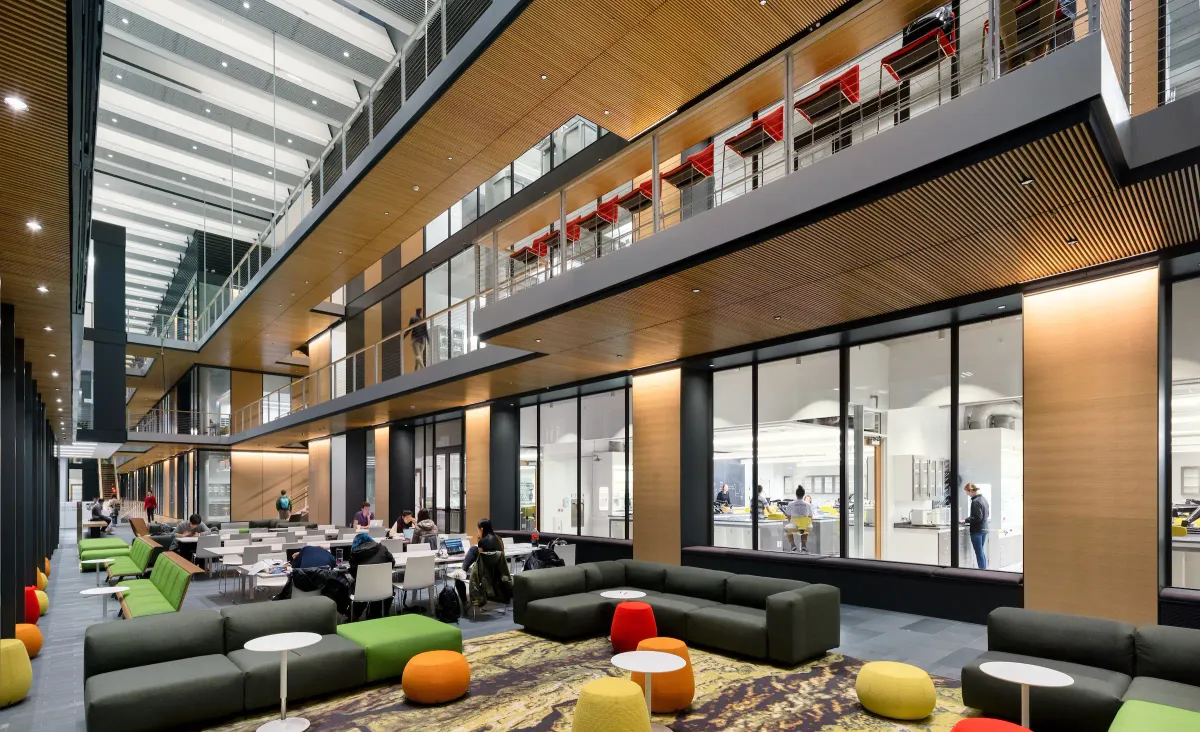
On Saturday, the college hosted its inaugural AI summit, a whole-day event that featured presentations from professors, student panelists, and an alumnus. Throughout the day, speakers and attendees discussed topics including ethical boundaries of AI use, how Amherst students are using AI, and how AI has influenced businesses.
Jay Batsaikhan ’28 led efforts in organizing the summit. In her opening remarks, she said the summit is the culmination of a series of discussions that began in March, when she spoke one-on-one with 57 students and realized the need for an open conversation about AI.
“What’s really happening? What’s the climate on campus when it comes to AI?” Batsaikhan said in an interview with The Student, reflecting on her initial motivations. She then drafted a proposal to implement students’ voices and needs, and sought sponsorship from Student Engagement and Leadership (SEL), the Loeb Center, the President’s Office, Association of Amherst Students, Center for Humanistic Inquiry, Student Affairs, and AI in the Liberal Arts initiative, as well as five academic departments.
President Michael Elliott opened the speaker series by emphasizing the three goals of an Amherst education in the age of AI: the ability to form complex thoughts without technological assistance, understanding of AI’s limits and ethical questions, and thinking about AI as a critical object — just like how Amherst engages with larger societal and governmental issues.
“We not only learn how to use the tools, we think about what the tools mean for society,” Elliott said. “And we ask questions. Critical object doesn’t [necessarily mean] just criticizing them, but it means understanding them and thinking about their ramifications.”
Provost and Dean of the Faculty Martha Umphrey added to Elliott’s comments, saying it is “at a real advantage” because of the close student-faculty relationship cultivated by the college’s small size and liberal arts education model. She recalled that during the annual Provost retreat, faculty and staff discussed important “qualities of mind” that the college wants to foreground, including the sense of curiosity and “the things that come along [with that]” such as risk-taking, the capacity for reflection, and the importance of integrity.
“Trust … is the fundament of an educational mission. If we cannot trust each other inside and outside the classroom, we’ve lost our way,” Umphrey said. She proceeded to reference Presidential Scholar Kate Crawford’s talk on the costs and challenges of AI, where she mentions a “crisis of confidence” — that people seem to rely on AI so much that they lose confidence in their own abilities. Umphrey added to the notion by stating that “what we need to maintain is confidence in our own judgment, our capacity to judge.”
Umphrey then gave the floor to faculty speakers from the departments of computer science, English, and psychology, who shared the fundamentals of AI, responsible use of AI in writing, and the status of AI use among Amherst students based on a survey given last spring.
Biddy Martin Professor of STEM and Computer Science Department Chair Lee Spector shared his understanding of AI as an AI developer for several decades. He began his talk by stating that the most important thing to know about AI is that “nobody knows.”
“Nobody knows what every student should understand, and part of that is that nobody knows where AI is going, and more than that, nobody knows what AI is right now,” he said. “In a very profound sense, this is the most mysterious technology ever developed.”
Spector then shared several other important aspects of AI, such as how the concept of AI is not a recent development but dates back to 1600s discussions about “formalizing and mechanizing reason,” and how AI is “wrong” not only because of its hallucinations, but also because of its subjectivity to the same limits that the human mind is subjected to. He added that “AI will change us” in terms of both self-perception and social interactions, and AI will continue to evolve through recursive self-improvement just like “biological evolution.”
“The last thing everybody should know is that you can help,” Spector said. “We’re all trying to grow our minds and develop, and we can make choices about how and when we use this technology that can do amazing things and can be amazingly destructive.”
Senior Lecturer in English Kristina Reardon shifted the discussion to boundaries of AI use in writing. She began by referencing a national study by a professor at Stanford University, conducted in 2008, that compared the number and types of errors in college students’ writing 100 years ago and now. Reardon shared that though the number of errors were similar, the types of errors have changed. Whereas the most common errors 100 years ago were spelling and grammar mistakes, these errors rarely occur nowadays due to technologies such as spellcheck and Grammarly. She predicts that AI use in writing would have a similar effect: reducing some errors while making new ones.
“Even if we use AI and use it all the time for your writing … different, new, weird, interesting things would arise,” she said. She then referred to a general pattern of AI writing: “[looking] very clean on the surface, but messy underneath,” and stated that if students were to write with AI attentively, proper fact-checking would be time-consuming enough that it cancels out the seeming convenience AI provides. On the other hand, Reardon shared that one of the greatest joys of writing comes from the human process that is slow and often messy.
“Trying to figure out what I want to say takes iteration … and I think all good writing now and in the future, if we really want to think about writing … as a process that we’re engaged with, and not just as a product or a piece of paper that comes out, that will take time … and I hope it will be, because that's where the fun is,” she said.
Reardon proposed two guiding principles regarding AI use in writing: consider the audience as well as the purpose of writing. She noted that in the creative publishing world, the line of acceptable AI use is often drawn by the audience instead of the authors themselves, as many authors have been confronted with “AI accusations” and requests to “provide a paper trail” to prove original work. On the other hand, the question one should ask when writing for oneself — whether for fun or self-development — is whether AI takes away from the purpose, and the answer will vary from person to person.
“Let’s say you’re writing a journal entry because you want to discover what you think,” she said. “Do you get the same thing out of that self-discovery if you ask an AI to do it for you or with you? That’s an open question that you might have different thoughts on. In my case … I just don’t see the need to involve AI in that space.
Associate Professor of Psychology Michael Cohen then took the floor to share results from a college-wide survey regarding AI use at Amherst, which around 500 students responded to. In short, around 75% of students said it’s “common” that students use AI for coursework, and more than 50% of students said AI is helping their overall learning. In addition, Cohen said students reported using AI for “effectively everything”: all stages of writing — from generating ideas to proofreading, summarizing and explaining readings, and technical work such as mathematical computations for STEM courses.
On the subject of academic integrity regarding AI use, around 50% of students said that they have seen people use AI in violation of the Honor Code, and around 50% said they believe it is “common” for students to do so. When asked about AI policies in the classroom, almost 75% of students said they feel like courses have clear AI policies, though more than 50% said the courses’ AI policies do not influence whether they use AI in assignments. However, when asked about whether assignments should actively incorporate AI use, 50% of students were against this proposal.
“There’s that sort of idea that students are actually yearning for a learning experience independent of AI,” Cohen said.
When Elliott asked how Cohen personally uses AI, Cohen shared that he often uses AI in determining the viability and novelty of his planned experiments. “It’s my best friend in terms of research brainstorming,” he said. “This summer I was back home with my family in Houston, Texas, and I didn’t have any colleagues to brainstorm with. It’s been helpful in brainstorming just so many aspects that I’m not at all embarrassed to use it.”
Attendee Sewit Deresse ’29 said Cohen’s response was particularly memorable. “I was super surprised to find out that a professor really loves AI and uses it as a companion,” she said. “I always thought that academic professors and researchers would be against it … but from a different perspective [it] has made me really curious about how AI is going to change even people who [were] against it.”
The topic then shifted to AI’s influence on industries, and how much it assists or replaces human input. Dr. Michael Holsey ’09, co-founder of Revanta, a startup specializing in AI-assisted drug discovery, shared that AI has greatly facilitated the process of drug discovery. According to Holsey, one of the largest benefits of AI in his field is that software such as AlphaFold can now help determine protein structure, an otherwise very labor-intensive process, which enables de novo design of highly specific drugs. However, he also mentions a series of skills essential to research that are irreplaceable by AI, including the ability to independently form hypotheses, design experiments, and understand results.
“Don’t rely on the output or the conclusions of AI, particularly in science, because you know it's not always just a yes or no answer,” he said, and “Ultimately, you’re the one who has to make the decision about the advancement of these molecules … That’s not something that AI can really own.”
Assistant Professor of Economics Jake Blackwood shared data from the Business Trends and Outlook Survey gathered from last December to this May on how different industries are using AI. Though only 20% of firms reported using AI, there is a clear predicted growth in AI use across all industries from May to January 2027. Blackwood then showed the reported AI use breakdown by industry, which varied significantly: While industries such as farming and construction did not use AI much, business, professional services, and finance increasingly use AI in areas such as research and development and information technology. In terms of workers’ use of AI, the most popular uses are writing or editing documents, searching for information, and interpreting or analyzing documents.
Blackwood concluded by stating that history suggests technological developments have generally had positive impacts on the population, and that the data suggests firms are using AI to complement rather than substitute for human labor. However, he also advises students to remain cautious about how AI uses shift in the future.
The event then transitioned to a student-led panel moderated by Aixa Kidd, Lewis-Sebring executive director of the Loeb Center for career exploration and planning. Five student panelists across eight departments shared their perspectives on how AI use has changed within Amherst, what the institution shouldn’t lose to AI, and how we can help each other learn to adapt.
During the discussion, Fulbright foreign language teaching assistant Jacqueline Cisneros Nava emphasized that Amherst should not run from AI. “We cannot stop it whether we like it or not. It’s already part of our lives,” she said. “I think it’s very important for us as educators to get to know the tool, so we can give clear policies of how responsible use looks like [and] students can actually use it for a purposeful goal.”
Math and philosophy major Saachi Yadav ’27 noted that in her experience, AI is generally not helpful when it comes to explaining philosophical concepts despite seeming to be more helpful in other disciplines. She suggested that department-specific discussions regarding the boundaries of AI use would be highly beneficial. Prospective environmental studies major Luke Healey ’29 also reminded the audience that there is an environmental cost associated with any AI use.
After a lunch break with speakers, attendees were offered the option to return to breakout rooms led by student panelists to discuss experiences with AI in four different areas: STEM, humanities, behavior and ethics, and career preparation.
“I think what was especially interesting is [that] most speakers reiterated the fact that nobody really knows what the future holds for AI and how it will impact the world,” said Anthony Saldana Valle ’27, who stayed for the entire program. “But the best we can do right now is probably just [to] try to understand it and see how it can be useful.”
Reflecting on the summit, Batsaikhan was grateful for the collaborative process that made the summit happen. “The idea may have started with me, but the Summit happened because people across Amherst helped make it happen,” she said. She especially thanked co-organizers Gaby Rivera ’29 and Ventura Garcia-Perez ’27, as well as all student volunteers.
Though 72 students signed up for the summit, the audience consisted of only around 25 students, with around 10 faculty and staff combined. Most students said they were interested in the content and actively participated, but attendance dwindled in the afternoon.
Batsaikhan called the summit “a win with a [lowercase] w.” “For us, the success was in the quality of the conversations, the diversity of perspectives, and what people took away from the day,” she said. “It was our first summit, so there is a lot we can learn and improve, but it also showed what we can make happen when people across Amherst come together around an idea. A couple of students approached me at Betty’s Kitchen and said, ‘I am now optimistic, I have some hope.’ That’s the purpose.”
As a student panelist, Yadav hopes the audience has learned to not be scared to engage in discussions about AI. “We should openly talk about our experiences with AI, and also talk about what we value,” she said. “I know you probably heard this too many times, but genuinely, what did you come to Amherst for? It’s something that both staff and students have to interrogate within themselves, and then we get to decide how AI plays into that narrative.”

Comments ()