

Degree Times Two: Double Majoring in Math
Why do so many Amherst students who double major decide to study math as one of their two disciplines? Staff Writer Daphne Witherell ’27 spoke to students and faculty across the department about their experience with this phenomenon.
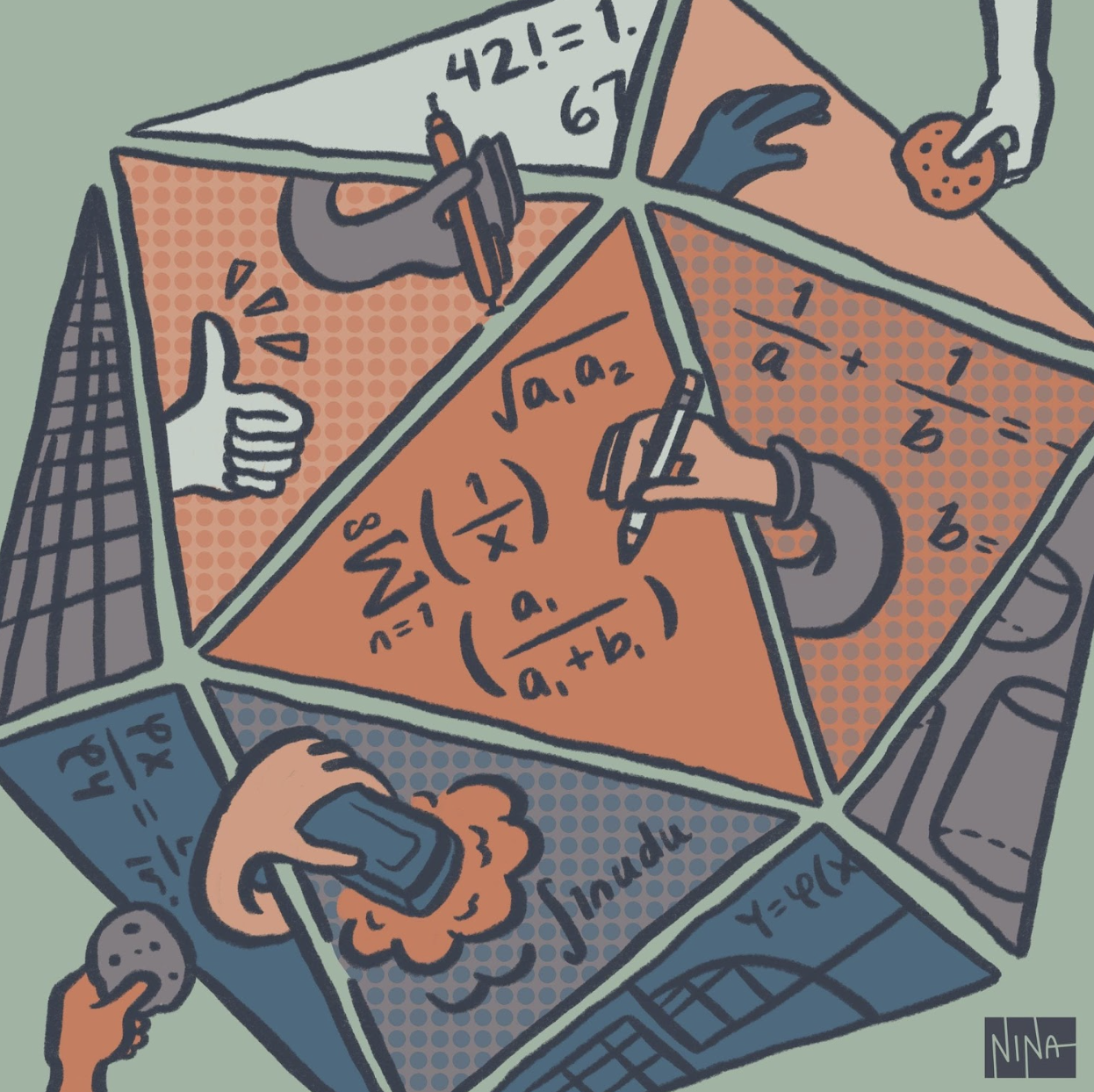
Amherst College’s open curriculum and its lack of core requirements inspire approximately 40% of students to double major. In the sea of disciplines that students decide to double-major in, perhaps none stand out more than mathematics. In the graduating class of 2024, 13.66% of the degrees conferred were in math and statistics, making it one of the top five most-declared majors.
Students who major in math are required to complete 11 courses: six core courses and five elective courses. However, one of the benefits of the math major is that the vast majority of students are able to place out of core requirements, including Introduction to Calculus and Intermediate Calculus, based on the credits they received prior to college. Some students can even place out of additional courses in the sequence, with a select few placing out of all six of the required core courses for the major.
Daniel Martin ’25, who graduated last May as a math and philosophy double major, described how he was inspired to double major in math because he’d already made significant progress in the major before his first class: “I was well into the major already when I got here, so the requirements were not too extensive. I came in having taken the full calculus sequence in high school, so I started the major by taking linear algebra.”
While many math double majors begin their Amherst journey planning to pursue the major, others stumble into the discipline rather unexpectedly. Nina Aagaard ’26, a math and chemistry double major, recounted falling into the math major and continuing to take classes due to her positive experiences in her early semesters at Amherst. Fondness for the department seems to be a common theme among math double majors. Sophia Price ’25, a math and environmental studies double major, echoes this sentiment, saying the flexibility of the requirements and the supportive professors make the major great.
According to Associate Professor of Mathematics Ivan Contreras, the positive environment that students encounter in the math department is cultivated by faculty who “[work] very hard to create an … inclusive and welcoming environment.” Contreras noted that the math department offers a lot of support to students and emphasized that “everyone can excel in mathematics.”
Although it has proven to be a popular choice, double-majoring in math can come with its difficulties. For students pursuing another STEM major alongside math, meeting the quantitative requirements for two disciplines and balancing double the exams can pose challenges.
Henry Dennen ’26, a math and astronomy double major, said that the most challenging part of pursuing two STEM majors has been “when the tests sync up [because] math and astrophysics classes are both test-based.”
Although pursuing a math double major has its drawbacks, many still feel these are outweighed by the benefits. Aagaard found that math taught her how to be a critical and logical thinker. Martin began working as a high school teacher this fall and is excited to “be applying the … concepts and skills [he learned as a math major] towards being in the classroom teaching high school math classes.”
Many math double majors have managed to find connections between their two majors. Daniela Rosario ’26, a math and computer science double major, found that math gave her “a solid foundation in understanding the theory behind functions and equations” that she can also apply to computer science. Price found applications in environmental studies, where she uses math to predict many natural events, such as “prey abundances based on predator and environmental behaviors.”
Similarly, Associate Professor of Mathematics Ryan Alvarado believes that math is a nice complement to the other liberal arts disciplines, particularly to the humanities. Alvarado recollected conversations he has had with students in his Introduction to Analysis class who majored in both math and humanities disciplines. These students expressed that the course “helped them with their writing because the logical thinking in the course teaches students to take a big problem, break it into smaller pieces, and convey their ideas to the reader in either oral or written format.”
Despite numerous students reporting a positive experience as a math double major, the relationship between multiple majors and the open curriculum can be a divisive topic. In December 2024, the faculty voted to ban triple majors beginning with the class of 2029.
However, many double majors described the math major as being very adaptable with the open curriculum, and encouraged others to take advantage of it. Many also emphasized that they would have taken the same number of math classes regardless of whether or not they were a declared math major.
Rosario had “at least one free spot for a humanities-based class or a class within the Five Colleges” every semester, as did Price. Both Price and Rosario also found time in their schedules to study abroad during their junior year.
When asked if they had any advice for prospective math double majors, students emphasized the importance of pursuing genuine academic interests and trying out the major early on.
Dennen encouraged new students to “ask yourself if you are interested in the different aspects of math before committing to the major.” Rosario emphasized that connecting with the department early on helped her to “navigate choosing classes, even when [she] hadn’t declared the math major yet.”
Contreras noted that “the decision to double major in math is relative to each person, and their interests, and it is something that we discuss with our students during advising.”
Martin advised students to never “feel obligated to add a second major,” but to definitely “take some classes if you’re interested, and if you end up feeling like you would like to complete the major, then that’s great.”

Comments ()