

Field Notes from a Wimbledon First Timer
Assistant Sports Editor Annie Lopez ’29 recalls her time at The Championships at Wimbledon, noting the event’s surprising commitment to both its upscale reputation and service to the public.
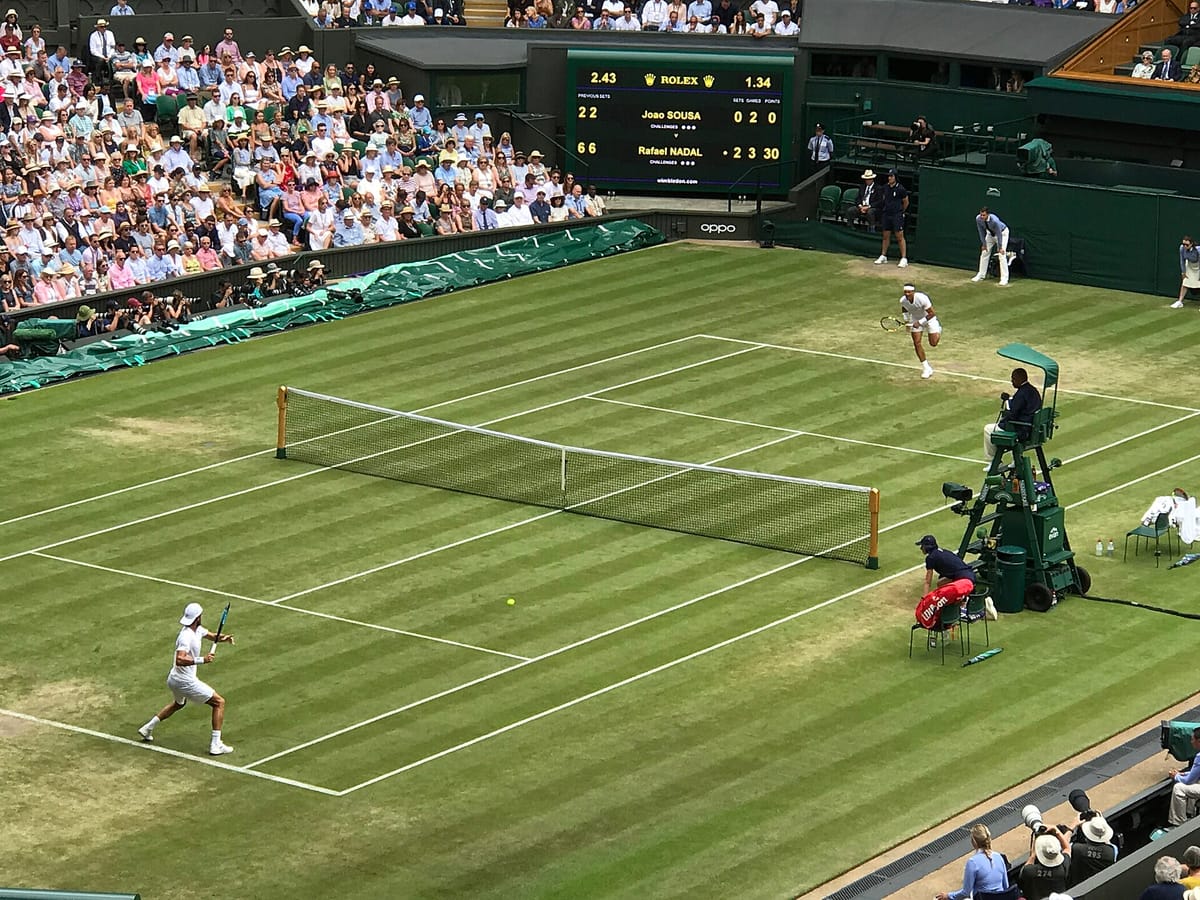
This past summer, I found myself with the incredible opportunity to study at the London School of Economics for three weeks while getting to live in a flat right in the heart of High Holborn. With only one class a day, my friends and I found ourselves with plenty of time on our hands to explore the incredible city that I was so new to. Of the many different once-in-a-lifetime experiences I collected, the frontrunner that I keep coming back to was the day we spent at the Wimbledon Championships, or simply Wimbledon as it’s best known.
Our opportunity to even be on the grounds was a result of potentially the most poetic aspect of the tournament, Wimbledon’s famous “queue.” For nearly 150 years, after the tournament began in 1877, Wimbledon has been the crême de la crême, so to speak, of all that tennis as an institution was made to represent. Participants of all ages and genders must adhere to the “tennis whites” policy, BBGs (ball boys and girls) look their sharpest in a tournament-issued uniform designed by Polo Ralph Lauren, and there is always bound to be a Royal Family member or two spectating from their box on Centre Court. In other words, this is not an event I could have ever imagined myself affording, much less attending, as merely a visiting American college student. This is where the genius and uniqueness of the queue lies, as what it is literally at face value is an opportunity for the ordinary Londoner to get to experience a slice of this upper-crust world.
In order to secure a solid spot, my flatmates and I jolted awake at approximately 3:45 a.m. to get to the grounds by 4:15 a.m. After a brief walk, we were escorted to a massive open field just a few minutes away from the grounds. Despite rallying to get there at the crack of dawn, there were hundreds of people who had already arrived before us. All the way at the front were at least a hundred tents, full of people who had been queuing since the day before. Picnic blankets, beach towels, and quilts lined the fields as hopeful spectators drank coffee out of thermoses, quietly read as the sun was rising, or, in our case, played two and a half hours’ worth of Uno.
When it was finally time to walk over to the grounds, it was around 10:30 a.m., and the air was abuzz, a very different environment from the sleepy queue hours earlier. Wimbledon officials beamed at us as we made our way to ticketing, remarking things like “you did it!” and “worth the wait, wasn’t it?!” I acquired my £25 ticket (equivalent to $33.97 — $33.97!) and finally set foot into the one and only Wimbledon. The meticulously kept greenery lined each court with flowers of every color budding and sprouting around the signage. Each court, billboard, and post stayed on theme; everything was strictly colored kelly green, royal purple, or bright canary yellow.
There was an air of luxury, undoubtedly. I felt I had entered into a sort of modern Jane Austen novel, with British socialites donning their Sunday Best complete with a Birkin 25 in their left hand and a Pimm’s lemonade in their right. I admit, I had felt out of place at first. After nearly six hours sitting on a grass field, I had never been more aware of the wrinkles in my dress and the knots starting to form in my hair. What was the most incredible part of this experience, however, was when I realized that there were more fellow spectators similar to me than there were ladies click-clacking around in their Manolo Blahniks.
Sitting there on Court Three toward the end of the day, we had the opportunity to watch a Men’s Singles match between No. 71 James Duckworth of Australia and No. 6 Flavio Cobolli of Italy. As we were watching these two men go back and forth with five thrilling sets of competition, the epiphany set in that, above all else, Wimbledon is about the tennis. Its high-end, old-money aesthetic that it has worked so hard to maintain, while an important aspect of the event, will always be secondary to the body and soul of the tournament, which is to host an athletic competition for as many people as possible to enjoy. The sharpness and beauty of the event itself is a byproduct, less of an exclusionary incentive but more of a way for people to become excited about the opportunity to be at Wimbledon. The queue is the perfect manifestation of this allegory, showing that, above all else, this is an event made for the public to be a part of. Wimbledon is hanging a Monet not in your living room, but in the British National Gallery.
Thus, looking back on those magical three weeks across the pond, I will always especially cherish my time on Wimbledon’s grounds. Not just as a sports fan who found a new thrill to chase before the crisp Autumn air delivers football season, but also as a reminder that, as the tournament understands, the best kind of event is the kind that can be enjoyed by all.

Comments ()