

Fresh Faculty: Xuanlin Ye
In this installment of Fresh Faculty, Staff Writer Savita Jani ’28 interviewed Visiting Assistant Professor Xuanlin Ye about his adjustment to Amherst, evolving art-making process, and educators who inspire him.
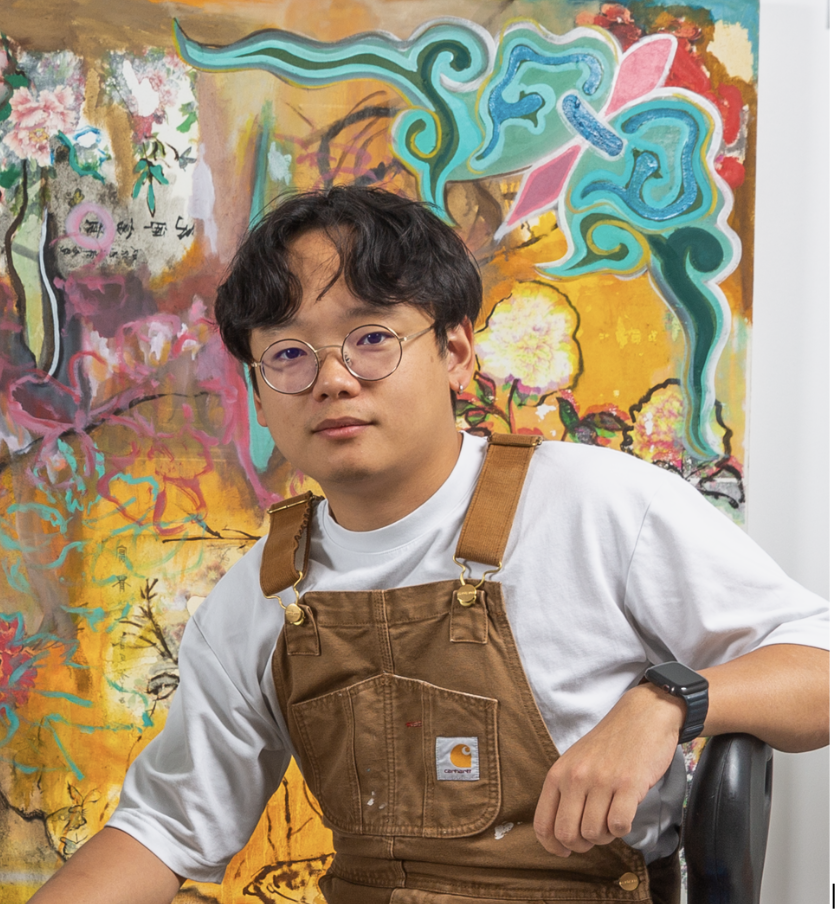
Q: Can you start by sharing a little bit about what brought you here to Amherst?
A: I was studying painting and drawing when I was in undergrad, and I got my [Master’s degree (MA)] in art history from the University of Chicago, and also got my [Master's in Fine Arts (MFA)] from the Maryland Institute College of Art. I think when I was a student, I would really enjoy and appreciate the sort of the close attention an instructor would normally give to a student. I’m a very curious person. I’m very curious about not only art, but also other fields and what they’re doing. So I think Amherst has this tradition of close attention to mentorship and also the interdisciplinary curriculum… [I really] resonated with that way of teaching.
Q: Tell me more about what you were doing before you came here?
A: I was an international student in Ohio. I went to a small high school, and then I was really good at painting and drawing. So I went to the School of Art Institute of Chicago for my Bachelor of Fine Arts, and then I got my MFA from the Maryland Institute College of Art, and then after that, I was like, “something is missing.” I’m not learning enough, and I feel like the practice of art alone [is] just not satisfying my intellectual needs, and also I realized a lot of my knowledge that I received was very Eurocentric. So I went to the University of Chicago, studied with Wu Hong for my MA in pre-modern Chinese art history.
Q: Did you teach in Chicago?
A: Yes, I was teaching at a school called Roosevelt University. It’s a school [that welcomes people of color and many first-generation students]. We had very limited funding as well. One thing it’s really made me aware of is the sort of racial economic divide in the U.S., and also it really challenged me in terms of how to teach with a different student body: How do I provide good education for them and make the class enjoyable and also intellectually stimulating?
Q: So that must have been a big shift to come from Chicago to Amherst! How have you been settling in?
A: It’s good! The place is very quaint, and I love all my neighbors. I love it so far. I’ve been making art, [and] I’ve been really developing my courses.
Q: Can you talk a little bit about the courses you're teaching now and what courses you have planned for the future?
A: The courses I’m teaching are really reflective of my journey as an artist and educator. The courses I’m teaching now are both painting courses. One is titled “Abstraction.” We’re teaching students how to make abstract paintings through a series of translation projects. So, for example, scent into painting, music into painting, and then towards the end, we're gonna go to the Smith College greenhouse, and we’re going to utilize the greenhouse as a source of inspiration for final projects.
Another course I’m teaching is called “Ground Without Place.” This course [focuses] on how we utilize the studio as a space to build a sense of home. How do we, by laboring, produce a sense of home? For example, we are building a shadow box. This is sort of serving as a memorial or as a space for cherishing a sense of memory in that shadow box. Then we'll make a still life painting out of the shadow box. Towards the end, we're gonna utilize some of this museum of art to learn a little bit about Chinese art history and learn how the Chinese literati use art history or cultural traditions as a way to build a sense of connection with oneself.
So next semester I’ll be teaching “The Practice of Art,” which is the intro level painting studio art course. I am expanding the practice of art from 2-D, 3-D, towards 4-D as well. So we’re not only gonna do drawings, painting, [and] sculpture. Also, we’re gonna do a little bit of installation. We’re gonna do a little bit of performance art. So really, all kinds of methods. I’m also teaching another course called the “Politics of Images.” It’s another painting course where students can learn how artists utilize art history [and] image syntax to build up their own image, and how we utilize art history as a way to further critique that history, enhance or revise that kind of image.
Q: Awesome. These all sound super great. And how has teaching been going so far?
A: It’s great. I’m really surprised how Amherst students are really on top of everything. They’re really good students. One thing that surprises me is that sometimes students are a little afraid to make mistakes. So that’s something I wanted to try to encourage them to do: to make bad art, to really believe in oneself, to never deny the possibility of making great art. So I think that’s something I’m trying to teach my students.
Q: That’s awesome. Did you notice that with your students at your old school or do you think that’s an Amherst thing?
A: I want to say that’s an Amherst thing. I found it very interesting [but] just also a little disheartening. I see everybody has this great potential, but [they are] simply denying themselves the possibility of making great works [by being afraid to make mistakes]. I feel it’s my responsibility to cultivate a sense of trust in the classroom. In a good studio course, towards the end, everybody trusts each other, we are like best friends, because we see the growth we’ve done in the classroom, [but] not through a “giving a right answer” sense. A studio class is a place of vulnerability, a place of struggle, a place of learning, growing, and supporting each other, cherishing each other, [and] making great works. So I think I want to build that with my students, and then hopefully students can take the courage to make mistakes.
Q: On that theme, do you have any advice for your students, but also for Amherst students overall, given what you've seen so far?
A: For me, it's just trusting oneself. I think that’s very important. Trusting oneself, and no matter what others say, compete with oneself, not with others.
Q: Switching a bit to your own art and work, can you tell me a little bit about what have been your biggest inspirations as an artist [and] as an educator?
A: I really like the kind of artists that focus on the everyday, like human emotions. You know, the sort of romance of quotidian sort of thing. I really enjoy that. I enjoy the artists [who] really get into the nitty-gritty of focusing on the craft of making paintings, and [who] have a little bit of a connection to art history and to our visual culture. But as an educator, obviously I studied with many, many great artists before. But one educator really stands out to me. My teacher [who] really inspired me was my high school art teacher. She’s this older, gentle lady, but she [was] always supportive. She was always sort of gently guiding me towards where I want to be, and I think that's the kind of teacher I want to be, or strive to be.
Q: I’m sure she'd be really happy to see everything that you’re up to now! Have you been able to work on your art since you’ve come here in addition to doing your teaching, and if so, what have you been working on lately?
A: I just started my studio work maybe a couple [of] weeks ago. Moving here into the country really allowed me to slow down and really think about what I wanted to do. And also by preparing the courses, also made me really rethink, “how do I articulate my thoughts?” So now I’m focusing more on not as much towards what I'm trying to say but how I’m saying it, so I’m focusing on the color mixing, [trying] to play with the composition a little bit more, and really paying attention to the small details of the images I’m trying to make.
Q: Separately from your work, what have you been up to in your free time lately?
A: I paint. I make my work, and then I also have a big dog. He’s getting a little bit older, so I try to walk him as much as possible.
Q: What’s his name?
Baobao. It means baby in Chinese, and he does act like one. I try to take him to places as much as I can and go for walks. We’re still exploring trails. We’re slowly expanding into the wilderness. I’m also trying to get myself used to how much wilderness, how much nature I can take in.
Q: Finally, how long will you be here as a visiting professor? And is there anything else you want to share?
A: It’s a two-year position. I'm really grateful to be here, and thank you for the opportunity [to interview]!
Comments ()