

Galloping Toward Greatness: Inside Amherst College’s Most Revered Athletic Dynasty
Managing Opinion Editor Caroline Flinn ’28 gallops into Amherst’s most important athletic team, arguing that the hobbyhorsing team’s obsessive training, ceremonial routines, and metaphysical competitions can turn even a stick into a symbol of institutional pride.
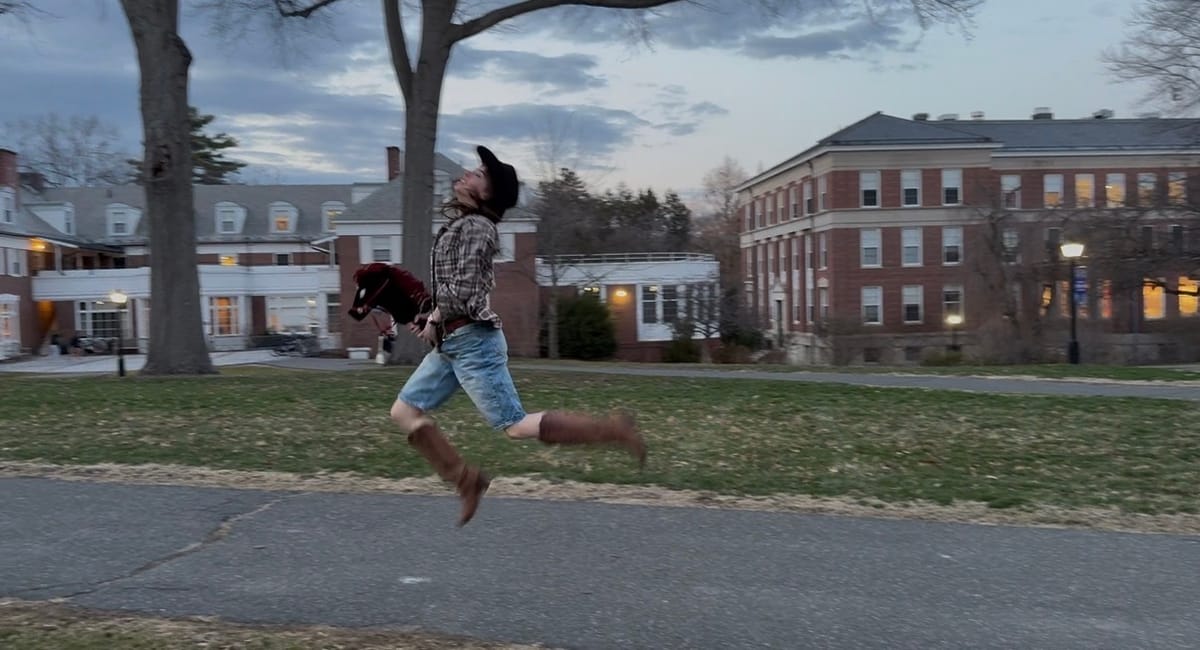
At precisely 6:12 a.m., as frost still clings to the grass on Pratt Field and the rest of campus sleeps in various states of academic denial, the Amherst College Hobbyhorsing Team is already in motion — or, more accurately, in gallop.
From a distance, it looks like a hallucination brought on by overexposure to JSTOR: a dozen students in athleisure, knees pumping, clutching decorated sticks between their legs, clearing invisible hurdles with expressions of operatic intensity. Up close, it is worse.
“We don’t play Hobbyhorse,” said team captain Eliza “Withers” Witherspoon ’26, gently brushing down her mount, Debt Collector (foam head, Swarovski eyes). “We become it.”
Founded in 2019 after a study abroad student returned from Finland with what she described as “a vision” and what others described as “concerning energy,” the team has since risen to dominance in the intercollegiate hobbyhorsing circuit — a circuit that Amherst insists exists, despite mounting evidence to the contrary.
Their biggest rival, they claim, is Williams College, which, for its part, has declined to comment, denied the existence of a team, and asked Amherst to “please stop emailing us videos.”
Still, the Mammoths persist.
Practice is grueling. Athletes train six days a week, combining plyometrics, dressage choreography, and what assistant coach Brian Feldman calls “deep psychological work.”
“Your horse knows when you’re lying,” Feldman explained, pacing along the sidelines. “If you’re not fully committed to the bit, the horse won’t clear the jump. That’s just science.”
The team’s regimen includes:
- Wind sprints, during which athletes neigh continuously to build “vocal stamina.”
- Jump drills, clearing hurdles ranging from 2 to 4 feet (the latter reserved for “advanced riders”).
- Stable time, where athletes sit silently with their hobbyhorses to “build trust” and occasionally “process things.”
Sophomore rider Max Chen ’28 described the bonding process as transformative. “At first, it’s just a stick,” Chen said. “But then, after a while … it’s still a stick. But like, a powerful one.”
Amherst admin has also promised to create a whole new athletic complex for what it is calling “next-generation equine-adjacent performance,” a phrase that has appeared in three separate all-campus emails and at least one grant application to the National Science Foundation.
Preliminary plans for the facility — tentatively titled the Center for Applied Hobbyhorse Studies and Emotional Kinetics (CAHSEK) — include a climate-controlled indoor arena with imported sand “chosen for its narrative texture,” a hydrotherapy pool for horses that cannot, technically, enter water, and a “reflection stable” where athletes can sit with their hobbyhorses and contemplate the consequences of their choices.
“We’re thinking big,” said one administrator, unprompted, gesturing to a blueprint that appeared to be mostly spirals. “This isn’t just about sport. It’s about redefining the boundaries between athlete, object, and whatever is happening here.”
Students have expressed mixed reactions.
“I mean, my dorm still doesn’t have hot water,” said one sophomore, watching a construction crew install what appeared to be a chandelier in an outdoor field. “But I guess it’s good that the horses — sorry, not horses — are finally getting the support they deserve.”
Still, the team insists the investment is necessary to remain competitive
“You can’t expect excellence without infrastructure,” said freshman Hattie Goolag ’29, adjusting the bridle on Neighomi Campbell, who stared ahead with the quiet intensity of an inanimate object under immense pressure. “Williams is probably already doing this.”
Williams, again, has denied everything — but in a way that has only deepened suspicion.
In a brief and visibly strained statement, a spokesperson insisted that “Williams does not now, nor has it ever, fielded a hobbyhorsing team,” before pausing to clarify that the institution also “does not recognize the ontological legitimacy of ‘hobbyhorse’ as a competitive category.” The statement concluded with a request that Amherst “stop sending cease-and-desist letters written from the perspective of the horses.”
Despite these denials, evidence continues to surface. Several students report seeing figures at dusk on Weston Field, moving in what one described as “a disturbingly coordinated trot,” while another claimed to hear “faint neighing” emanating from the direction of the library stacks during midterms week.
Most damningly, an anonymous tipster recently leaked what appears to be an internal Williams document titled Strategic Plan for Equestrian Minimalism (SPEM), which includes references to “stick-based mobility solutions” and a line-item budget for “manes (discreet).” Williams has dismissed the document as “satirical,” though it has not explained why it was printed on official letterhead or why several sections are heavily redacted under the heading “horse-related."
Amherst, for its part, remains unconvinced.
“They can deny it all they want,” said Feldman, watching practice. “But you don’t invest that much in silence unless you’re hiding something.”
At press time, Williams College issued a follow-up statement denying not only hobbyhorsing, but also “horses in general,” “the concept of galloping,” and “any knowledge of what a mane is,” before quietly installing what witnesses described as “a suspicious number of low hurdles” behind a newly erected privacy fence.
At meets, the team competes in events like show jumping, dressage, and “freestyle narrative gallop,” in which riders perform emotionally resonant routines set to music — but to describe these events in conventional athletic terms is to fundamentally misunderstand what is happening to the human body.
Show jumping, for instance, involves athletes sprinting full-speed toward a series of hurdles, knees lifting with unnatural precision, one hand gripping the neck of the hobbyhorse while the other hovers midair in what judges call “aura management.” At the moment of takeoff, there is a brief and deeply committed suspension of disbelief: The rider launches, the horse follows (metaphysically), and for a fraction of a second, both appear to agree that gravity is optional. Landings are less graceful.
Dressage, meanwhile, is slower, more psychological. Riders trace intricate patterns across the field — circles, diagonals, shapes that may or may not correspond to recognized geometry — all while maintaining what is known as “equine presence,” a state of heightened seriousness in which blinking is minimized, and every step suggests a rich inner life. Judges score based on rhythm, control, and “the plausibility of horse.
But it is in freestyle narrative gallop that the sport achieves its most incomprehensible form.
Here, the gallop itself becomes expressive. Riders accelerate, decelerate, pivot, and leap not just to demonstrate physical ability but to convey themes: longing, debt, the passage of time, and the administrative state. Arms tighten around the horse during moments of emotional intensity; strides lengthen during narrative expansion; small, almost imperceptible stumbles are sometimes incorporated intentionally as “commentary.”
“With freestyle, it’s not about speed,” Witherspoon explained. “It’s about intention. Anyone can run. Not everyone can gallop with meaning.”
Last month, Amherst hosted the New England Invitational, drawing competitors from across the region, with at least one confused intramural ultimate frisbee team that “took a wrong turn and decided to stay.” By mid-afternoon, the frisbee team had reportedly developed “strong opinions about gait authenticity” and was “no longer sure what sport they originally played.”
Goolag’s gold-medal routine — a haunting interpretation of late-stage capitalism set to a string quartet cover of “Party in the U.S.A.” — began with a restrained trot, almost hesitant, before building into a frenzied, unsustainable gallop that one judge described as “financially literate.” At one point, she circled the arena while clutching Neighomi Campbell close to her chest, as if protecting it from an unseen market force. By the final jump — executed in total silence — several spectators were openly weeping, though whether from emotion or confusion remains under review.
“I’ve never seen anything like it,” said one attendee, who asked to remain anonymous. “I don’t think I ever will again. I don’t think I’ll see anything at all for a while.”
Not everyone is convinced.
“This is not a sport,” said one anonymous Amherst athlete, speaking from inside a very real locker room. “There’s no ball. There’s no horse. There’s barely even a point.”
The hobbyhorsing team has dismissed such critiques as “deeply horsephobic,” arguing that the absence of a literal horse allows for “greater conceptual range” and “fewer zoning restrictions.”
“People said the same thing about rowing,” Feldman noted. “And look at them now — still confusing, but respected.”
With nationals approaching (location undisclosed, possibly metaphorical), the team is focused.
“We’re not just competing for Amherst,” Witherspoon said, gazing across the field as the sun rose dramatically for unclear reasons. “We’re competing for something bigger.”
As practice wrapped up, the riders mounted their horses one last time, charging across the field in synchronized silence. For a brief moment, in the soft morning light, it almost looked real.

Comments ()