

Kate Crawford Discusses Costs and Challenges of AI
Presidential Scholar Kate Crawford, one of the nation’s leading scholars on artificial intelligence, delivered a talk on “The Cost of Scale: The Challenges Facing Artificial Intelligence.” She argued for recognizing the environmental, political, and cognitive consequences of the AI industry.

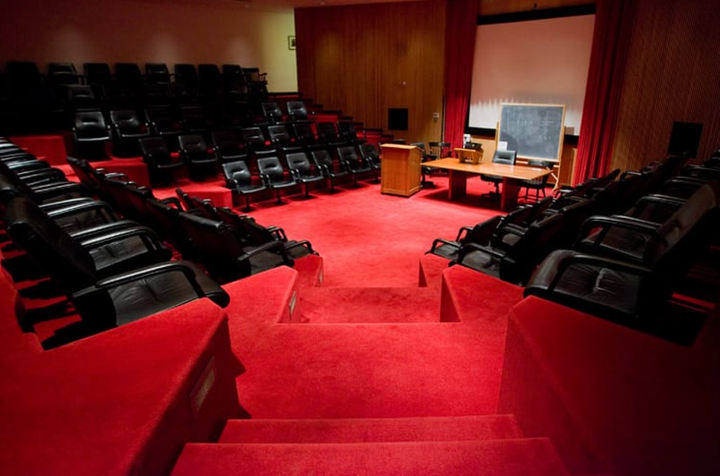
On Tuesday, Presidential Scholar Kate Crawford, one of the nation’s leading scholars on artificial intelligence (AI), delivered a talk in the Lipton Lecture Hall titled “The Cost of Scale: The Challenges Facing Artificial Intelligence.” Crawford is a professor at the University of Southern California, and her book “Atlas of AI: Power, Politics, and the Planetary Costs of Artificial Intelligence” was named best book of the year by The Financial Times. In addition, Crawford leads the interdisciplinary lab “Knowing Machines,” a transatlantic research collaboration that investigates how AI systems are trained.
Crawford introduced the talk by noting that this is the first generation of students to navigate the impact of artificial intelligence on their undergraduate education, which she described as a “formative experience” for this generation. She set the stage by emphasizing that AI, “the largest infrastructure project in history,” is changing education, politics, and how we understand ourselves.
In her book, Crawford seeks to make visible the hidden, unspoken structures and costs that sustain the AI industry but are often overlooked. In her talk, she adopted a similar approach, challenging the audience to understand how AI needs to be understood across the fields of history, geography, and ethics. She structured the talk around three essential problems in AI: control, climate, and cognition.
When addressing control, Crawford highlighted that many AI agents today are not fully under the control of their developers. She makes note of the recent cases of frontier AI models independently hacking external corporate and government systems around the world — which were observed by agents from Meta, Google, OpenAI, and Anthropic — that were not immediately reported by the company. According to Crawford, this is happening because AI systems are desperate for large-scale data.
On the lack of control, she referenced the issues with the U.S. being on the verge of a nuclear war with China because of a hallucination presented by an AI system in the U.S. military that claimed that Chinese ships in the Middle East were transporting components of nuclear weapons.
When addressing climate and broader environmental impacts, Crawford explained how the industry is highly dependent on minerals such as lithium and non-renewable resources that are being exploited in the most diverse parts of the world — from Latin America to Africa and Asia — with significant negative impacts on local populations. In addition, she noted the industry’s significant energy demands pose a major problem even in countries like the U.S. due to their heavy reliance on fossil fuels.
Crawford added that by 2030, the “AI data centers could take a bigger share of carbon emissions” than aviation does currently, adding that this is happening at a moment in history when the climate is already stressed by human greenhouse gas emissions and should be moving toward green energy systems.
Finally, Crawford moved on to discuss the impacts of AI on human cognition, which she considered the real issue at stake. According to her, people are using AI now more than ever, but far less is being studied about how these systems impact the people who use them every day. She cited “cognitive surrender,” a term introduced in a study by Steven Shawn and Gideon Nave used to characterize the phenomenon of AI users blindly accepting AI responses even when they are wrong.
Crawford emphasized that the effects of AI are cognitive, interpersonal, and collective. A report published by the Massachusetts Institute of Technology in September 2026 also found that when students didn’t use AI to check their work, they felt they couldn’t trust their own capabilities. Students also reported increasingly turning to AI rather than peers and instructors when they faced academic challenges, which she claimed undermined their social experience at university. The speaker argued that people are now more than ever “outsourcing our discernment,” but our capacity for discernment is precisely what allows us to navigate the complexities of everyday life and is one of the core features of humanity.
Moving forward, Crawford said that in an age when speed and ease are valued above all else, what society needs most is time, a call that is shared by AI companies’ top leaders. She argued that time is needed to think about how these technologies are changing our lives, our education, and how we live. Taking time to do things such as writing, painting, and creating is what makes humans human, and outsourcing this process diminishes our trust in ourselves.
Crawford also highlighted the increasing need for political leadership equipped to address society's new challenges, as well as for local communities willing to take action and stand for the deceleration of these technologies’ development.
Crawford’s remarks were followed by a Q&A session with Biddy Martin Professor in STEM (Computer Science) Lee Spector as well as an open floor for audience questions. Among the questions, one prominent topic was the persistent sense of hopelessness regarding the prevalence of AI. Crawford shared that even in the face of hopelessness, we can still look to the past and see moments in history — such as the development of nuclear weapons — when humanity was still able to collaborate in the name of its safety and greater good.
When asked about how students in Amherst should be facing and dealing with this new era of AI, Crawford said that Amherst is in an “incredible and powerful” position right now, as a liberal arts education seems to be the only model of education that is going to be resilient in this new era — smaller class sizes, close contact with instructors, learning across disciplines, and critically discussing ideas are assets available in small school that are hard to obtain in bigger universities, where the impersonality of education makes the use of AI more tempting.


Comments ()