

‘Late Fame’ Holds Up a Mirror to Artistic Performance
In this review of Kent Jones's 2025 film "Late Fame," Staff Writer Luke Deeble ’29 praises Willem Dafoe and Greta Lee's performances and discusses the film's thematic focus on the lessons about authenticity that artists of different generations can learn from one another.
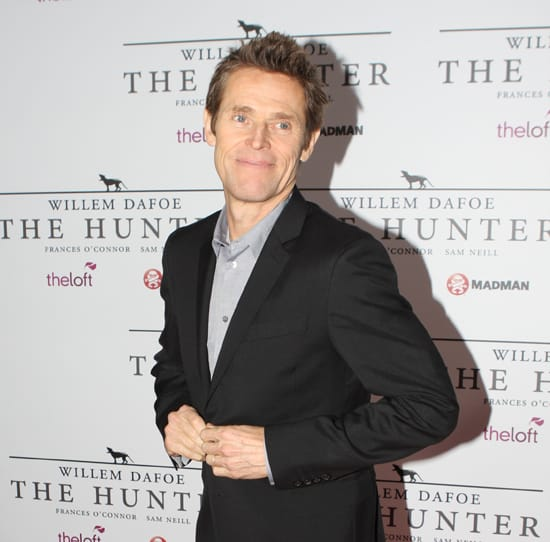
“Late Fame,” a 2025 film directed by Kent Jones (released only a month ago), is a story about the collision of two older and less-privileged individuals with an idealist strain of a younger generation. I saw it; it was a great watch, and I think you should see it, too.
The great Willem Dafoe plays Ed Saxberger, an older post office worker who published a book of poetry a few decades ago. Saxberger has aged gently and is neither a fool nor a sage. We are not asked to bemoan his failed literary career — we only discover it the same way Saxberger is reminded of it, perhaps for the first time in years: he is approached by a young man whose abundance of eagerness and transparent naivety is not neatly dangerous, delusional, or endearing. This young man, Meyers, portrayed precisely by Edmund Donovan, has read a collection of poetry Saxberger wrote decades earlier and is convinced that it is brilliant. Did Saxberger’s friend put him up to this? No, Meyers says, explaining that he is part of a group of writers — later dubbed “The Enthusiasm Society” — who are as enamored with his collection as Meyers is. Well, who wouldn’t be excited to hear a thing like that?
I am hard-pressed to think of many performances where as much meaning is impressed through facial expression alone as Dafoe’s here. He portrays, to my mind, a thoroughly reasonable man. Saxberger meets Meyers’ group out of politeness, curiosity, and only then excitement. He is tangibly apprehensive of their juvenile outlook and not overly anxious to play-act as the luminary they imagine him to be. His measured sense of self-importance is surprisingly resilient to the incessant flaming of his ego: for only one painful moment does he let himself believe that he is a rightly hailed genius. Still, he is understandably charmed by the group and their familiar refrains of artistic idealism — mainly, I think, because they seem to sincerely care. And they do — at least, about something.
The film is at its worst when it briefly descends into a predictable satire of the publishing industry somewhat reminiscent of “American Fiction.” Besides this brief lapse, the film is a careful character study. Possibly the most intriguing character is the film’s one woman: the consistently surprising Gloria (Greta Lee). Gloria is older than the men, and both a romantic and matriarchal figure to the group. She is also the only one who doesn’t seem to be attending New York University on their parents’ dime. Lee’s performance is excellent and a major contributor to the character’s novelty. However, I do not think that we are given enough of her, nor is the question of her identity given the suspense that it deserves.
The members of The Enthusiasm Society are subtly differentiated and engaging. We simultaneously cringe at and are warmed by their naivety. They call each other by last names — implicitly, I think, so that they can feel as though they are being referred to the way a critic refers to a great author. Their various forms of hypocrisy — on full display from the beginning in their use of disavowed technology — we want to think of as surmountable obstacles to their artistic fulfillment. But this is not a film about the development of a great poet, or indeed about poetry at all. The Enthusiasm Society wants to be the Dead Poets Society, a group of privileged young men transformed on the basis of enthusiasm for poetry more so than poetry itself. They want Saxberger to play the role of the manipulative and egotistic John Keating, a role which Saxberger cannot and will not fill. But the group is not entirely performative, and there is something charming or at least useful about their naivete. There is a reason that Gloria, who is not naive and, as we will see, knows distresses foreign to them, seeks their companionship.
To its credit, “Late Fame” never tries to tell us where great art does come from. Maybe this is because great art can indeed come from anywhere. Many of the greatest writers had aristocratic privilege comparable to Meyers’ parent-funded New York penthouse, and many had beginnings comparable to Meyers’ romantically overstated image of Saxberger’s humble background. But as it happens, no one in “Late Fame” is more than a local talent, so it can’t tell us more about the “greats” we laud as heroes and expect our movies to concern. What the film can do is hold up a mirror to artistic performance and self-deception, the kind that is not entirely absent from a place like Amherst. I am glad that the film does not mention artificial intelligence in what might be a crude attempt to appear topical, but the young artists are exactly the type who might spend more time rallying against algorithmically generated art than working on their own actual art. If this makes the film sound cynical, I am not doing it justice. I think it is a happy movie, even if I cannot think of much more than Dafoe’s smile that makes it so.
Comments ()