

Letter to the Editor: How Amherst Nuked WAMH
The WAMH Executive Board investigates the troubled rollout of the Ford Student Center, arguing that the loss of promised studio space, communication failures, and last-minute operational disruptions reveal a deeper institutional pattern in which student input is solicited but ultimately disregarded.
Dear Editors,
As you know all too well, there have been some changes to the palette of some student spaces. Namely, red ones. Upon being let into the new Ford Student Center for the first time, WAMH representatives — and we presume, editors of The Student — were… surprised at the coloring of what was about to be their new homes. Situated next door to one another on the ground level of the Ford Student Center, the new WAMH 89.3 station and The Student newsroom are both red. Very red.
Surprise, confusion, bewilderment: these are words that characterize the nature of the reactions of the WAMH executive board at our first meeting of the semester (not in the new studio, as it was still inaccessible, but on the second floor of Keefe Campus Center). Since its 1998 move from the Charles Pratt basement to the studio in what was Keefe Campus Center, the WAMH studio has been a historical site. If you, editors, have ever been inside it, you might distinctly remember its walls: white, and covered with signatures. That writing is still there, even if Keefe is a ghost town. It spans corner-to-corner, cloaking the doors, marking dates, names, radio shows, performing artists, and many more forms of history-marking. So you can imagine our surprise when the blank canvas we had requested turned out to be not so blank.
The red walls themselves are not the root issue. They are changeable. But they are a very visible result of what has been a term of frustration between WAMH leadership and the administrative representatives purported to support student groups. The process of relocation has been one characterized by a lack of open, consistent, and detailed communication from administration, and has forced us to compromise and suspend operations.
In March of 2026, WAMH leadership was contacted to arrange a meeting with Deans Angie Tissi-Gassoway and Megan Lennon. In this meeting, we were shown the floor plans of the building (starting with the top floor and proceeding through the pitches of every space that Dean Angie was especially ‘excited about’), before we reached our space in the basement. At this point, it was revealed to WAMH leadership that our space was being significantly downsized. Our Keefe Campus Center space included a broadcasting booth, lounge/office space, production studio, and hallway for storage of our CD and vinyl collection. As we looked at the floor plans, it became clear that any kind of appended storage space and the entirety of the production studio had disappeared from what would be our new space.
We were confused. Why would our new space be only half as functional as our old studio? When we expressed our disappointment to Dean Angie and our desire for production and storage space, they said that the plans for the new center had been informed by prior students’ input. In other words, if we didn’t like something about our space, we would have to take it up with the students who gave their input for the new radio station eight or nine years ago.
As most club leaders are likely familiar with, the turnover of leadership in student groups due to the nature of a four-year college makes it difficult to preserve any kind of institutional memory within an organization. Thus, at this point in the meeting, we had no way of verifying what the input of our predecessors had been, and we took the bad news with a nod of our heads.
Since then, we’ve been able to contact a previous station manager, Holden Orias ’24, who was in talks with John Cooke, Senior Capital Projects Manager, Design & Construction, and Alexandra Thompson, a representative from the architects Herzog de Meuron in 2022. Orias forwarded us emails of correspondence with these folks that revealed not only that white walls had been formally requested, but that a production studio and storage space, in addition to our lounge and broadcasting booth, had been designated for WAMH in the blueprints of the building:
“Amherst stated desired finishes are as follows: white gypsum on solid walls of spaces, acoustic treatment confined to ceiling, pinup surface may be desirable for west Wall of booth for DJs to leave notes, schedules etc.”
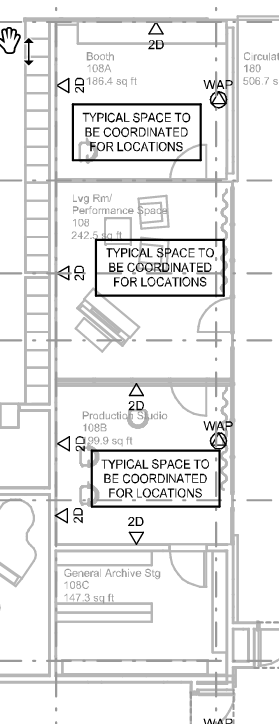
10/24/2022, as an email attachment from John Cooke, Senior Capital Projects Manager, Planning Design & Construction, Amherst College.
What is labeled ‘production studio’ on this blueprint is now the new (and strikingly red) newsroom of The Student. This downsizing wasn’t the only major adjustment revealed to us; at this same March meeting, we were told that our broadcasting time would be cut. Since the building would close at 1:00 a.m. and student access would be denied after that time, we would not be able to fulfill our 4:00 p.m. to 2:00 a.m. broadcasting hours, cutting 10% of our total air time.
When not broadcasting student programming between 4:00 p.m. and 2:00 a.m., WAMH broadcasts the Classical NEPM (New England Public Media) stream on the 89.3 FM airwaves. It is our understanding that the agreement between WAMH and NEPM to share the airwaves is a contractually binding one. Thus, we were finally told this past week that we will have a means of access until 2:00 a.m.; the specifics of this access are unclear.
The maintenance of our broadcasting hours is thanks to our administrative liaison and Associate Dean of Students, Scott Howard. Along with ensuring we can fulfill our typical broadcasting hours, Howard has been integral in getting engineers in to install and test our broadcasting equipment so that the studio can reach an operational level as soon as possible. This has been refreshing in the face of repeated delays in moving and installation timelines.
Such delays to the start of the semester have reduced our air time. Currently, the WAMH studio is not operational for broadcasting. We’d have typically begun returning programming on Sept. 13th, and had new disc jockeys on air starting Sept. 20th. However, due to the delayed move, installation and testing of equipment has been ongoing. We’d like to begin broadcasting by next week; this would be ideal — though more improbable with each passing day — and result in only 15% of our typical 13 weeks of airtime cut.
We’ve been unable to onboard returning and new DJs, and currently have no way of accessing the studio. It is locked via key, as opposed to the keypad to our previous space. None of us are in possession of this key.
During our March meeting, many possibilities were discussed as to what would happen to WAMH with the new move: a live performance setup, professionally photographing the walls of the Keefe studio, bringing the old studio doors into the new space, and, among many other things, ensuring white walls. We weren’t completely left out to dry.
We were asked to be patient, and to work with administration to come up with solutions to an imperfect situation come the fall.
Well, the fall has come. We intend to follow through on this agreement and ensure that solutions, though imperfect, are reached. Changes will be made, starting with the walls.
Yes, we’ve heard the rumors of a year-long suspension on any aesthetic alterations to the building. Did the knowledge of this year-long hiatus of customization come to us from administration? Of course not. We can be patient, with gritted teeth. We’d like to begin documenting a new history as soon as possible, as we’ve had to leave our old walls to whatever murky fate Keefe will meet. It’s ambiguous as to whether that will be possible.
Some changes, like the full truncation of our storage space and production studio, are not so easy to fix. Not only that, but they leave us unable to function at the capacity we did — we have no way of recording or mixing music, no place to set up and use the monitors, mixing board, or compressors that are all club property. Most of our CDs and vinyl will likely be stored in a space outside of the studio and harder to access. We’ll be able to broadcast, sure. We’ll have to make some adjustments. But these adjustments will be uncomfortable — and preventable.
If WAMH is forced to face major changes like the removal of an entire production studio from their operating capacity with little more than an administrative shrug of the shoulders, something is deeply wrong with operations between administration and students. We took it on the chin because of a lack of information within the club and a deflection of responsibility for lacking communication from administration.
Where is the communication disconnect happening? This is a genuine question we are asking ourselves. The way we see it, the answer is in one of three possible problems. This first is that the relationship between administration and architects is predicated on poor communication; thus, the architects’ omnipotent control over and changes to the building have left administration surprised and scrambling to cover for unexpected adjustments. The second is that the administration has been fully aware of the changes made to spaces despite the requests of student leadership and has failed to inform and take accountability for these changes. The third is that administrative function is spread so thin that critical information, like the amputation of operational student spaces, is lost in the melee.
No matter the cause, the effect is thus: the students, the constituents of this college, the subjects for whom this building is meant to serve, are left to stomach the aftermath, adapt to suboptimal conditions, and shrink their operations.
With the move to the new student center and the avalanche of problems that have arisen for students as a result of this move, we must ask ourselves: how can this system be better? How can we achieve transparency between administration and student leadership? What needs to change for students to be listened to? And not ‘listened to’ in the therapy-speak echo chamber, ‘I hear you’ way, but in an actual way, where material change is upheld and accounted for.
The physical problems are not the root of the issue. Like the bright red walls, they are simply material manifestations of a deeply structural fissure in the relationship between administrative systems and student desires. We intend to repaint, nonetheless.
In red wall solidarity,
WAMH 89.3 Executive Board

Comments ()