

LitFest Welcomes Innovative Author Jamaica Kincaid
Among this year’s distinguished LitFest guest speakers was author Jamaica Kincaid. Managing Opinion Editor Caroline Flinn ’28 and Managing Puzzles Editor Madeline Gold ’28 explore how Kincaid's personal experiences and values have shaped both her writing and her life.
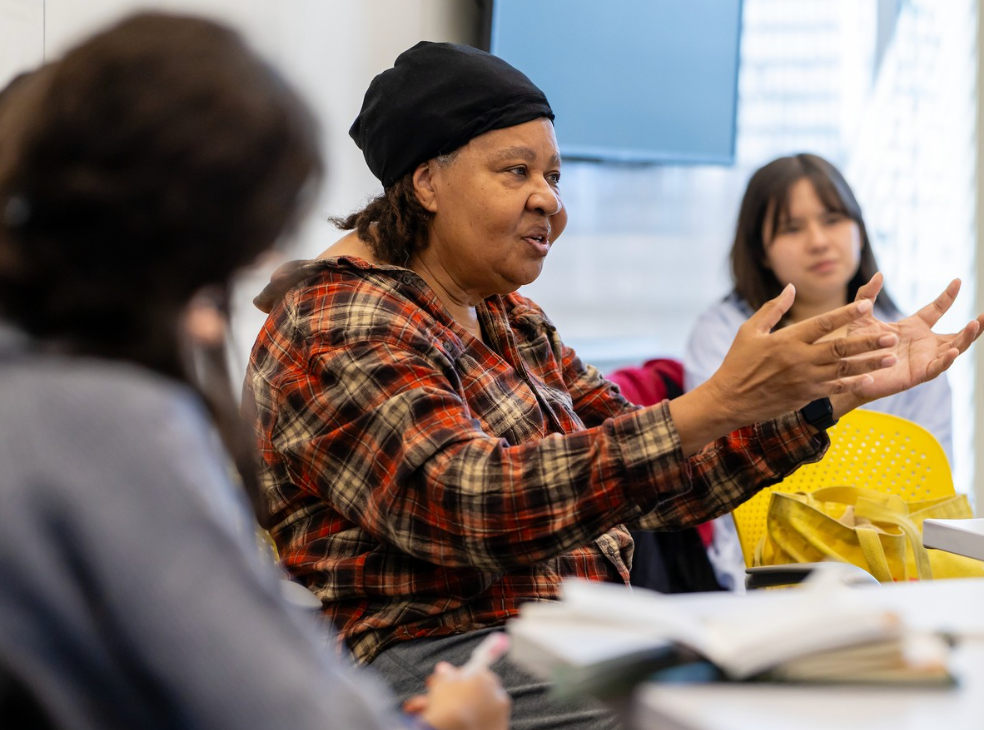
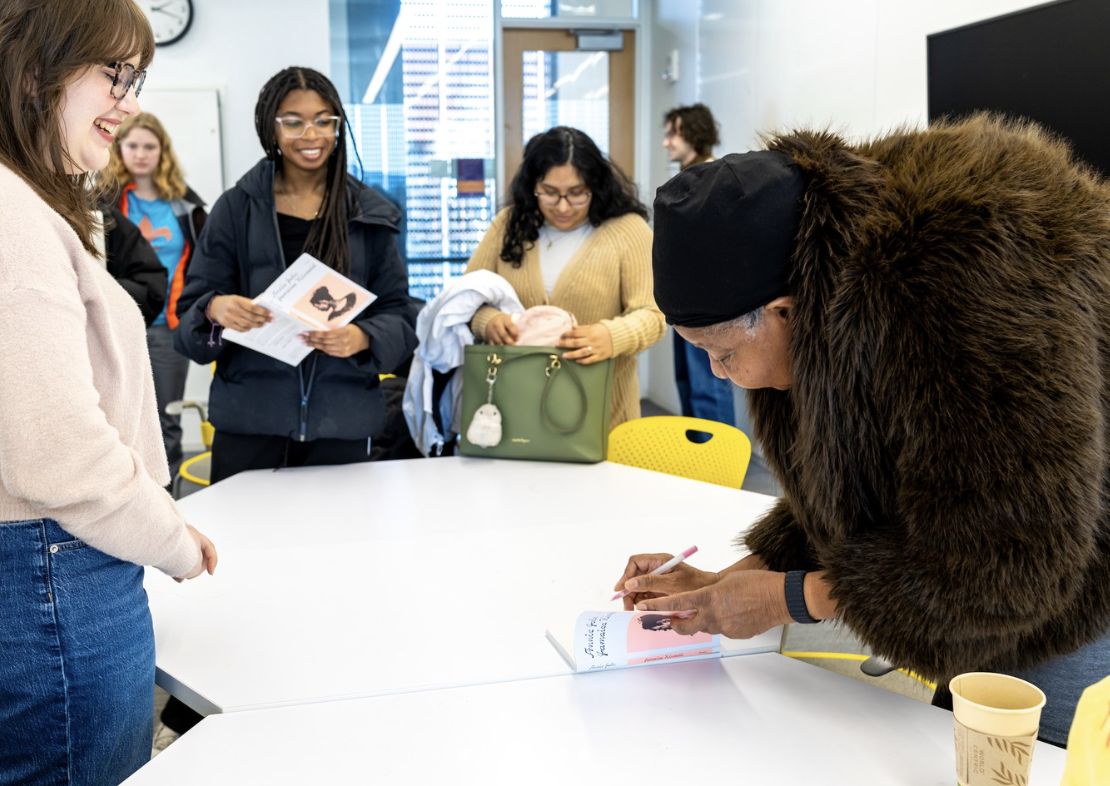
LitFest at Amherst College — the annual literary anchor of the spring semester — featured a striking lineup this year, including Pete Buttigieg, Evie Shockley, and Jamaica Kincaid H’96. On Saturday, Kincaid appeared in conversation with Jennifer Acker ’00, director of LitFest and editor-in-chief of The Common. When Kincaid walked into Johnson Chapel, she was greeted with a standing ovation that began before she had fully reached her seat. The moment felt almost comic: She appeared genuinely startled, even embarrassed, as though the applause were meant for someone else and she inadvertently stepped into it. When we later had the privilege to speak to her at her book signing, and thanked her effusively for coming, she reacted with the same astonishment, as if she couldn’t quite understand why anyone, myself included, would be so excited to see her at all.
Around campus, people quite anticipated her arrival and spoke about her in a way that made her feel almost untouchable. Many were thrilled that an actual (sorry, Pete) literary genius was part of our LitFest. From the pews of Johnson Chapel, friends were sending their old AP Literature teachers photos of her on stage and of them with her, because for many of us reading Kincaid’s work like “Annie John” or “A Small Place” had been formative — the kind of writing that rearranges your sense of what sentences are allowed to do.
Kincaid has such a command of language — in her writing, yes, but also in speech. You can hear the precision and clarity of a writer even when she is answering something casually. She joked about being narcissistic, recounting a quarrel with her son recently in which he accused her of centering herself in their relationship; she responded, dryly, that of course she did — she had raised him, carried him, made him. Yes, this is just a funny anecdote, but to me, it said something important: an insistence on authorship, on not apologizing for one’s centrality in one’s own life. As Kincaid put it plainly, “What’s wrong with being in love with yourself?”
She is hilarious in a way that feels accidental, and she even referenced that in her life. For example, she shrugged and said, “I always say yes to things — it’s a wonder I never ran into a serial killer.” At least for us, that attitude stood in sharp contrast to the room she was in. For Amherst students trained to spreadsheet our futures, to audition for opportunities before we even want them, her refusal to narrate her life as a series of strategic choices felt almost subversive. The joke lingered because it suggested something unsettling and freeing at once: that a meaningful life might come not from constant calculation, but from the occasional willingness to walk straight into the unknown and see what happens.
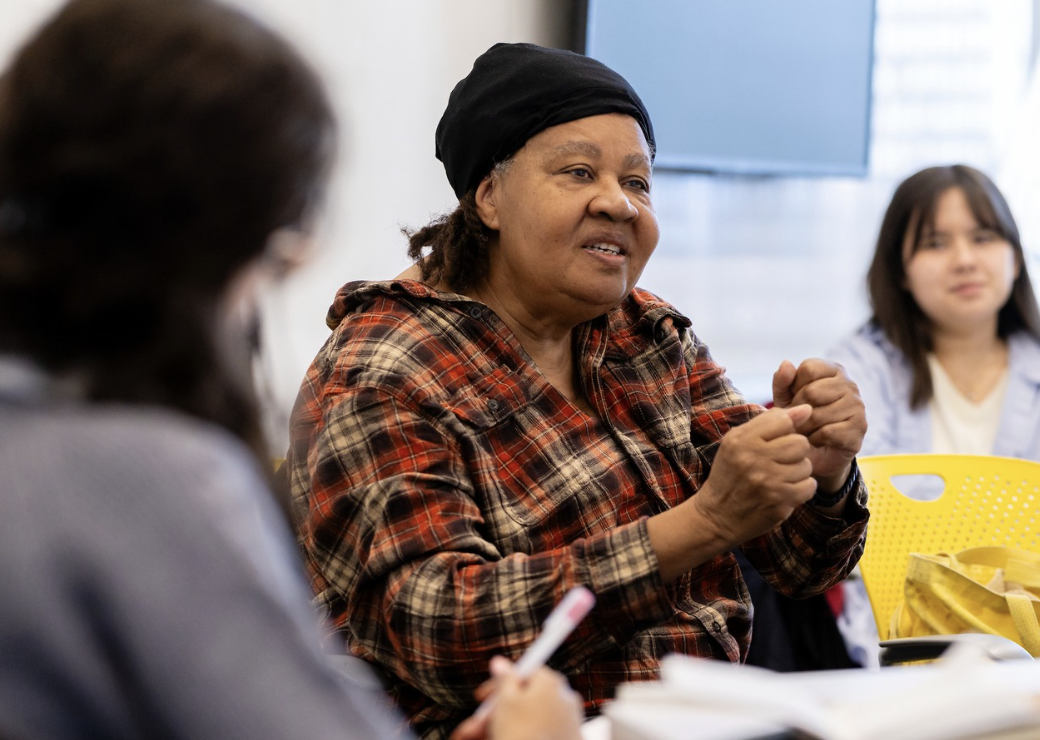
One of the things she returned to again and again was luck. “I’m not brave,” she said, “I’m just not afraid to be lucky.” That phrasing shifted something. Her life, she suggested, was less about destiny and more about proximity, whether that be to: to language, to opportunity, to people who opened doors. It was only a different way of thinking about agency — one that balances humility and initiative.
She spoke about her years at The New Yorker under editor William Shawn, whom she still calls “Mr. Shawn.” Shawn gave her the space to grow while shaping her voice with subtle guidance. During that period, she interviewed figures like Gloria Steinem, wrote “Talk of the Town” pieces, and honed the observational sharpness that now marks her prose. You can see the rhythm of that early work in her 1978 New Yorker fiction piece “Girl,” in her essays, in the way she dissects a moment, a gesture, a sentence.
At one point she said, almost in passing, “Everything is something. I just can’t see it.” She doesn’t believe in nothing. The statement is both modest and defiant: an acknowledgment of limits alongside a deep faith in meaning. That faith is what animates her writing: the small humiliations of girlhood, the pressures of colonial hierarchies, the intimacy of mother-daughter estrangement, even the act of tending a garden — all treated with the same weight, the same care.
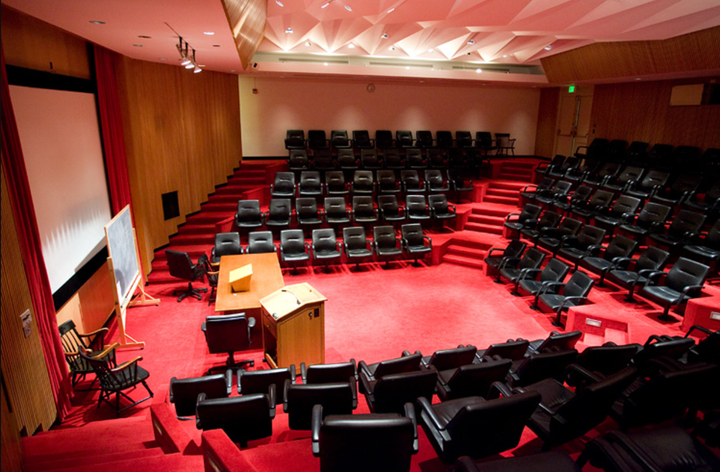
During one of the Craft Talk sessions earlier in the day, Kincaid spoke with a smaller group of students in a conference-style setting in the Science Center. To say that the discussion focused on honing the craft of writing, however, would be inaccurate — Kincaid argued that “[she doesn’t] believe in craft.” She spoke of emulation in writing, and of trying to achieve a specific style within the scope of the “rules” of the practice, claiming that both are counterproductive to developing one’s own voice. Indeed, Kincaid attributes much of her success as an author to her willingness to subvert rules or to dismiss them completely.
One particular example of such a disregard of standards is Kincaid’s frequent use of conjunctions to begin her sentences. Taking inspiration from the book of Genesis — Kincaid was raised Methodist in Antigua — she explained that she is “not afraid of the ‘and’.” If a revered document like the Bible can contain the sentence fragment “and it was good,” Kincaid sees no issue in her own breaking with grammar rules.
Kincaid also rejects the standard format of the novel. While many of her published works take shape in long-form narratives, she prefers to write in fragmented, almost lyrical language and blatantly repudiates the labeling of these works as “novels.” Her view is that the novel came to be as a function of boredom in the Western world; in the midst of destruction of indigenous cultures and colonialism, Europeans developed the novel to fill the empty spaces in their lives. Kincaid therefore asks how she can engage in a literary practice built upon the ruin of her own ancestors: her conclusion is that she cannot. So while works like “Girl”, an approximately 650 word-long piece composed of a single sentence, appear to subvert standard writing conventions, they also pick apart deeper historical practices under the surface.
Kincaid concluded the Craft Talk by opening the conversation to questions, one of which focused on her current role as a professor at Harvard University. When asked about which books she selects to teach in her classes, Kincaid replied that she opts for texts written before 1950. “I have a cutoff of 1949, coincidentally the year I was born,” she added humorously. While such a coincidence is certainly amusing, Kincaid’s earnest message to students is to return to the classics, the likes of Wordsworth and Bartram, to name a few. She urges the next generation of writers to focus first on their roles as readers, not so that they can strive to replicate the style of the greats — for Kincaid views this as a literary misdemeanor — but so that they may themselves be inspired to develop their own style.
Kincaid learned to read at three and a half, started school the same year, and even read the dictionary for fun — though she confessed a dislike for the thesaurus. That early immersion in language set the stage for a lifelong attention to words, structure, and meaning, which would come to define her work. Her writing consistently explores the legacies of colonialism and postcolonialism, gender and sexuality, renaming, class, power, adolescence, and mortality — the textures of human life filtered through history and social hierarchy. One anecdote she told made this especially clear. In Antigua, everyone was Black. That was simply the default, the unmarked norm of daily life. It was only after she moved to the United States at sixteen that race became a system to navigate. To this day, she still assumes everyone is black until they tell her they are not. She described being labeled as the “sassy Black friend,” a seemingly casual phrase, that suddenly illuminated the precision and subtlety with which she observes colonial and postcolonial hierarchies. The shock was not in the existence of racism — Antigua had its own stratifications — but in its American form: pervasive, formalized, and endlessly rehearsed.
Throughout the talk, she invoked a sentiment reminiscent of Milton: “better to rule in hell than serve in heaven.” We laughed, but the principle was serious. Autonomy, even at great personal cost, has guided both her life and her work. She left Antigua rather than accept its constraints; she abandoned her birth name; she walked away from relationships that threatened to define her too narrowly. That same refusal to be confined appears in her sentences: recursive, incantatory, circling back on themselves until the reader is drawn fully into the speaker’s consciousness. Reading Kincaid is like inhabiting language itself — and in witnessing her life and work, we can learn something vital: that living and writing with integrity often means claiming your own centrality, refusing to be constrained, and trusting the clarity of your own voice.

Comments ()