

Poster Problems: Publicizing in Ford Student Center
Managing Features Editor Lauren Siegel ’27 looks into where students are able to advertise club meetings and events in Ford Student Center following the loss of high traffic spaces in Valentine Dining Hall and Keefe Campus Center.
The newly opened Ford Student Center intends to serve as “the crossroads of campus life at Amherst,” according to Bill Ford ’83 P’13, who provided a $50 million gift in support of the building.
While students and faculty have already begun to eat, study, and unwind in the new building, there is one thing missing from Ford that was a central feature of its predecessors Valentine Dining Hall (Val) and Keefe Campus Center: dozens of posters taped by the entryways advertising campus events.
“Postering this semester has been very odd because none of the normal places are really available,” said Isabella Niemi ’27, who is on the executive board of Line Dance Club and responsible for advertising its events. “Last year, the main ones were the Val hallway, where everyone got their information, and if not, then it was Keefe hallway, and both of those are just kind of out of order right now. It is very hard to make sure that your information gets seen.”
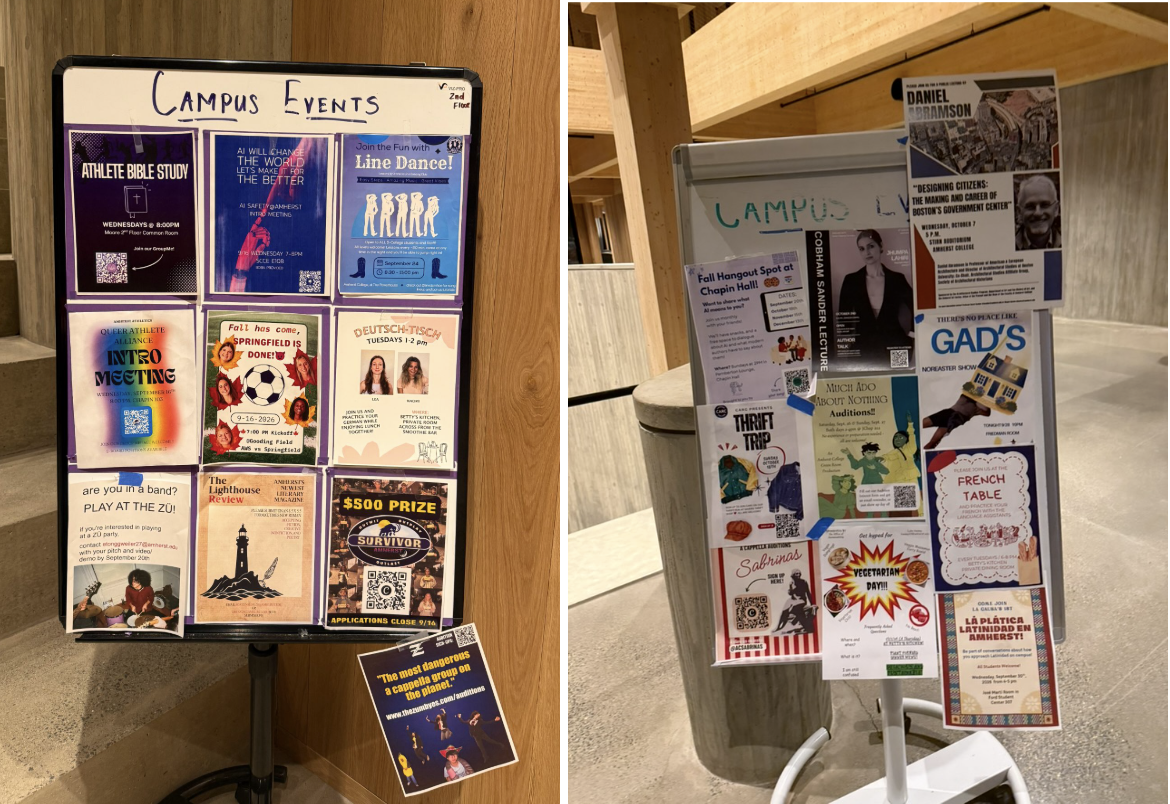
According to an email from Director for Student Engagement and Leadership Torshia Maxwell, “there will be designated areas where postings can be placed within Ford, with attention paid to foot traffic and how often areas are visited.” These designated areas are currently on rolling whiteboards with taped gridlines allotting space for nine posters to be displayed, and can be found across from the entrance to Betty’s Kitchen as well as by the building’s third-floor and first-floor entrances.
However, Niemi expressed discontent with the whiteboards’ effectiveness. “These new ones are not a feasible replacement; they don't accomplish the same purpose,” she said. “I would really prefer if the doors on the way into the dining hall would be able to be used for posters, just because that’s where people see things.”
GeorgeDaniel Dixon ’27, who is the junior chair of the Black Student Union (BSU), echoed these sentiments. “[The whiteboard] is very small. It's not gonna capture students’ attention,” he said. As an alternative, Dixon proposed that students should be able to put posters on the wooden poles near Ford’s entrance, better echoing the unfettered, eye-catching postering style in Val and Keefe.
“I feel like the campus is heartless without all of our random student stuff up all over the place,” Niemi said. “That’s what gives it character, that there [are] flyers all over the place telling you what there is to do … it shows that people live here and people are chaos.”
Maxwell stated that aside from the addition of Ford, “areas for posting [around campus] have generally not changed.” However, she acknowledged that the traffic flow on campus is likely to change as Ford’s impact grows, and said that staff will consider these changes as they develop.
For Dixon, the shift to Ford and the loss of old poster sites have led his student organization to reconsider how they disseminate information. “BSU has been leaning more heavily on social media to advertise things,” Dixon said.
On the other hand, Niemi believes posters are still the most important means of advertising events and intends to continue to utilize them: “There’s no way people are gonna look at the Daily Mammoth or Instagram and find [the information]. They need a physical thing to look at.”
While Maxwell told The Student that “posting policies remain the same” and can be found on the college’s website, students still expressed confusion about where they could advertise information in Ford.
“It was seriously like, ‘what are the policies around this?’” Dixon said, reflecting on his efforts to advertise BSU’s Black Beginnings Ceremony at the beginning of September. “For me, the actual policies around postering in the new student center have seemed very, very vague.”
Maxwell intends for The Office of Student Engagement and Leadership to collaborate with students to make Ford the heartbeat of campus. “I’m sincerely and genuinely excited to see how students activate the space and how we work alongside them to really realize its potential,” Maxwell said. “I think there are so many opportunities for students to gather, connect, host events, and really make the space their own.”
However, some students stressed that more open communication is necessary for this potential to be realized. “Communication and transparency are key,” Dixon said. “That’s one of the things that we hope can improve.”

Comments ()