

Revisiting Shakespeare: The Afterlives of “Julius Caesar”
In this edition of Revisiting Shakespeare, Editor-in-Chief Edwyn Choi ’27 reviews “Julius Caesar.” Choi discusses how Shakespeare’s play still grips audiences by bringing the past into the present and asking what power, loyalty, and public persuasion mean now.
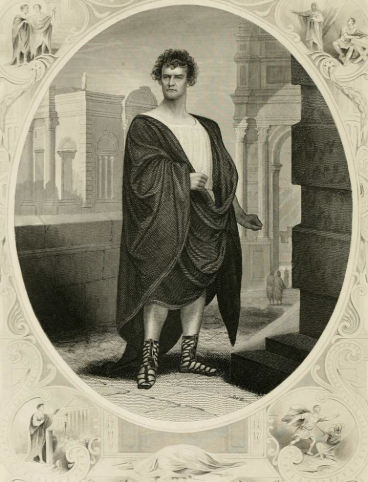
“How many ages hence
Shall this our lofty scene be acted over
In states unborn and accents yet unknown!” (3.1).
I think it’s safe to say that we all know how this story ends, whether you bring William Shakespeare into this or not. This week’s play, “Julius Caesar,” is all about what theater is at its core: To bridge time and space through performance. Here is a story that ostensibly takes place in Ancient Rome but has been transported to a variety of places — including 2017 New York City, where we watch a Julius Caesar “with a red tie and a svelte wife with a Slovenian accent” die (I hope you can tell who that’s describing).
This is all to say that history has seen Caesar, or rather Shakespeare’s resurrection of him, killed a lot of times. You might’ve guessed from the introductory paragraph that what I find the most interesting about “Julius Caesar” is not so much the plot and writing (though I’ll get to that) but its afterlife: What does it mean to perform the same murder over and over again, across centuries and continents, “In states unborn and accents yet unknown?”
For those who forgot what happened in this tragedy besides Caesar dying, here’s the recap: Julius Caesar has returned to Rome after defeating his rival Pompey, and there are fears among the senators that Caesar may use that momentum to seize power, essentially becoming a tyrant. Brutus, Caesar’s close friend, is among those concerned about Caesar’s power.
Coincidentally, there are other senators who are also concerned about Caesar’s power and feel that the best way to prevent him from becoming a tyrant is by killing him. But they feel as though they won’t have enough momentum without Brutus. The one to keep track of here, among others, is Cassius. Brutus is reluctant to join, although he’s later convinced after the conspirators manipulate him. In addition to framing Caesar’s assassination as benefitting the Roman public to appeal to Brutus’s sense of honor, Cassius also asks one of the conspirators to give Brutus forged letters saying the public wants Brutus to oppose Caesar. Portia, Brutus’ wife, soon asks Brutus to tell her what he’s planning. When he refuses, she stabs herself in the thigh as a “strong proof of [her] constancy.” He relents.
Meanwhile, Caesar is initially reluctant to attend the next senate meeting — soon to be the site of his assassination — as his wife warns him after hearing an omen: “Beware the Ides of March” (March 15, the date on which the meeting is scheduled). One of the conspirators, however, convinces him to attend, and Caesar walks to his doom.
Caesar dies in Act 3, Scene 1, where you can neatly split the play in two: The first half being the buildup to Caesar’s assassination, the second the consequences thereafter. Although the conspirators’ plan seemed foolproof in theory, things quickly fall apart. Brutus had made the mistake of both sparing Mark Antony — Caesar’s close friend — and letting him speak at Caesar’s funeral, under the pretense that it would show the conspirators’ fairness. Brutus will also speak at the funeral first, “And show the reason of our Caesar’s death,” before Mark Antony can twist the narrative. But Brutus makes the mistake of leaving before Mark Antony gives his speech, and Caesar’s friend is able to convince the Roman public to turn against the conspirators.
The rest of the story follows the civil war that ensues between Mark Antony (accompanied by Octavius Caesar, later Emperor Augustus) and the conspirators, led by Brutus and Cassius. Caesar’s ghost visits Brutus in what we might interpret as Brutus’ guilty conscience terrifying him. There are three suicides that pepper the later acts in the play: Portia, because of Brutus’ absence; Cassius, because he falsely believes one of his teammates is captured (and would therefore prefer suicide over being captured); and Brutus, because he realizes the battle’s over once Cassius dies.
If there’s one thing this play is really good at, it’s being efficient. The plot is efficient, and so is the language. I can’t go through every single instance of rhetoric in this play — there’s literature for that, if you’re interested — but you should at least see an example. We can go back to the funeral speeches, for instance. See the difference between how Brutus (anxious and, let’s just say, not too politically savvy) and Mark Antony (who is essentially trained in public-relations) open their respective speeches, which they give over Caesar’s bleeding body. Brutus goes first:
“Romans, countrymen, and lovers, hear me for my
cause, and be silent that you may hear. Believe me
for mine honor, and have respect to mine honor
that you may believe. Censure me in your wisdom...” (3.2).
He’s stumbling over his words. Note that the opening list, “Romans, countrymen, and lovers,” is rhythmically unsound — “Romans” is two syllables, “countrymen” three, and “lovers” back to two. “Lovers” also stands out as having a different emotional register than “Romans” or “countrymen”. His speech takes on the form of something with a structured “beat” (note the 12 syllables per line) but he can’t neatly fit his thoughts into each line, which is to say that he doesn’t really know what he’s doing. If reading Shakespeare is like listening to music (as James Baldwin once said), Brutus can’t get the beat right.
Now compare that to Mark Antony’s funeral oration:
“Friends, Romans, countrymen, lend me your ears.
I come to bury Caesar, not to praise him.
The evil that men do lives after them;
The good is oft interrèd with their bones;” (3.2).
One, two, three — Mark Antony’s on the beat. If you couldn’t see what I meant by Brutus having an awkward rhythm, let Mark Antony show you by comparison. His sentences aren’t chopped up by the beat and instead fit snugly within each line. There’s a certain rhythm and punchiness to his language, too, and we leave remembering aphoristic phrases like “The evil that men do lives after them” instead of longer, awkward sentences like “Believe me for mine honor, and have respect to mine honor / that you may believe.” You’ll notice this tight rhetorical precision all over Shakespeare’s work, but it’s arguably in “Julius Caesar” where it’s weaponized the most.
For those who aren’t really interested in what might sound like a bunch of English major nonsense, fine. We can go back to this play’s afterlife: its performance history. If the Trumpian Caesar I mentioned in the introduction indicated anything, it’s that this play loves attaching itself to the modern day and assassinating any contemporary leader it wants. Orson Welles famously dressed his Caesar in the fashion of Nazi Germany and Fascist Italy. A few years before the conspirators “killed” Trump, then-President Barack Obama had met a similar fate, too. In fact, we’ve been killing American presidents by transporting them to Ancient Rome for a long time now.
In my opinion, it’s the straightforward action and pointed dialogue (different from the poetry of “King Lear”) that makes “Julius Caesar” so portable — barring, of course, how political the story itself is. It’s no coincidence that when Nelson Mandela, while imprisoned in South Africa, got his hands on Shakespeare’s collected works, he chose to sign his name next to one of Caesar’s speeches out of all the options he had. To stage — or even imagine — anyone as Caesar is to say a million things about them before you even get to the words; it’s to include them in a 400 year old ritual spanning space and time, a pointed middle finger that illustrates the political nature of theater.
As for productions and films you can see right now, there’s also a lot. But here are a few notable ones: Marlon Brando played Julius Caesar in the 1953 film of the same name, and the college has access to the Royal Shakespeare Company’s 2024 filmed production. However, both of these are more straightforward visualizations of Shakespeare’s text. If you’re bored by that, I recommend the Donmar Warehouse’s 2024 filmed production — set in an all-women’s prison — which the college also has access to. Moreover, the Oregon Shakespeare Festival is putting on the play between March and October of this year.
It would be remiss of me to not mention that “Julius Caesar” continues with “Antony and Cleopatra,” or the adult version of “Romeo and Juliet.” But honestly? The best reading material for “Julius Caesar” is the news: The way Mark Antony exploits Caesar’s death for political gain might sound a little too familiar nowadays. Just listen to the way our leaders perform their speeches, the way they interact with their crowds, and how they deal with public tragedies. You’ll see strains of this play’s rhetoricians everywhere. You’ll notice so much more after experiencing “Julius Caesar.”


Comments ()