

Save the Humanities: Drop the Math Double Major
Staff Writer Olivia Law ’27 examines Amherst’s drift toward pre-professionalism, arguing that the college’s STEM-centric priorities are reshaping the liberal arts into a marketplace logic that undermines the humanities.
I write this article at my childhood desk in a quiet dread, awaiting Thanksgiving dinner. It is in these particular social environments where “social pressures” become interpersonal, unavoidable; the supposedly flawed elements of our lives become dinner conversation. It is, at least for me, an anxious time. I am an English major. I am, at the moment, uncertain of what I “will do with that degree.”
Thankfully, nowadays, this environment of speculation no longer stops at forced family gatherings. While it may be difficult to resist the temptation to compete, impress, and outdo your cousin Ralph, LinkedIn, college decision pages, and Instagram have only made this insecurity more accessible.
But while it is impossible to ignore the judgement floating under an aunt or uncle’s grating question, it is even more difficult to not let one’s life be geared by it. Aunt Kathie may have her opinions on your life (which include a nice husband and law school), but that does not mean that you must live the life that Aunt Kathie has prescribed for you.
When we choose to make our life decisions public, we must be wary of letting the public shape our decisions.
I write this article in critique of Amherst College’s culture of pre-professionalism — one that I see growing more intense by the day (and I have spent an inordinate amount of time making the graphs to prove it). I also write this article in response to my dozen or so friends who, as a result of that culture, struggle to take their interest in the humanities seriously.
But, most honestly, I write as an act of self-justification. I write in the hopes of discouraging others from falling down a path I’ve left behind.
Math Double Majors and the Fall of the Humanities
Just over a year ago, I was a prospective math double major. Double-majoring in … well, I actually hadn’t decided yet. I contemplated which humanities discipline I would pair it with, maybe anthropology or sociology — or English? While I found humanities courses more interesting, I struggled to consider them justifiable.
For me, as for many other people here at Amherst, double-majoring in math or economics provided some stabilizing “seriousness” to a liberal arts course of study. In the past 40 years, the percentage of Amherst students graduating with double majors has also effectively tripled, growing from 16% to 53%.
This need to credentialize our education is a direct result of seeing college not as a site of intellectual and personal development, but as a stepping stone.
While Amherst, in defense of the liberal arts, refuses any “pre-professional” major — economics and math majors, the clearest pathway to finance, investment banking, or consulting, are Amherst’s most popular majors.
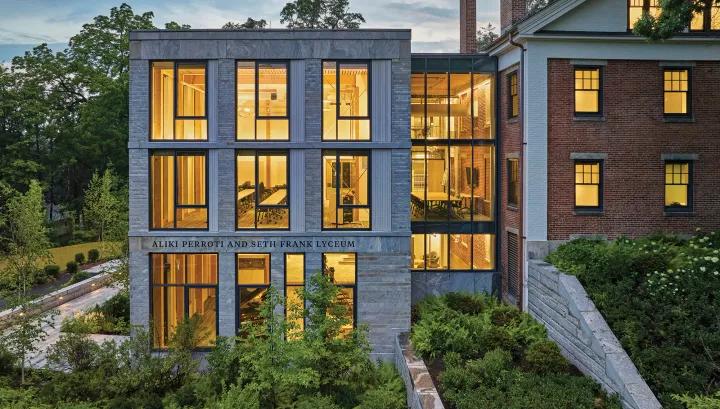
It is also not difficult to find evidence of Amherst’s turn towards STEM. Take a look at the Science Center, the glass-paneled gem of Amherst’s campus that cost 240 million dollars to build. STEM class enrollment has jumped by 85% over the past 15 years, and the percentage of graduates at Amherst majoring in a STEM subject has nearly doubled since 2005 (19% to 36%).
In contrast, English, once the most popular major, has fallen. In 1988, one in every five students was an English major — now, it’s one in every 20.
This shift is alarming — particularly because, although interest and enrollment in the humanities have been declining nationwide, rather than taking this as an opportunity to stimulate and preserve interest, Amherst eliminates the subjects themselves. Just this year, Amherst dissolved the Arabic language program due to low enrollment.
Amherst has also shown a push towards the “interdisciplinary” — threatening the possibility of removing disciplines entirely, declaring one subject significant only through the way it supplants the other. Last year, Anthony Fauci, a physician-scientist, headlined LitFest — a festival dedicated to “illuminating great writers and Amherst’s literary life.” Arguably, the college’s largest annual celebration of the humanities catered to a STEM audience.
While these are small steps, they indicate Amherst’s lack of resistance to a larger nationwide shift. Colleges across America are seeing parallel trends.
Just two weeks ago, Montclair State University (MSU) began a complete restructuring, effectively removing 15 humanities departments. The departments of English, classics, philosophy, world languages, and Spanish and Latino studies will now, tentatively, fall under the “School of Human Narratives and Creative Expressions.”
While Amherst has yet to make such a drastic change, we are, undoubtedly, heading in that direction. While it is, in part, a fault of the administration — resistance must also come from the students themselves.
Your Liberal Arts Education is Valuable
Some may argue that the push for the humanities stands on a foundation of financial privilege. As I am one of many sparked into insecurity by returning graduates flailing in the job market (sorry guys), this is understandable.
However, I urge Amherst students to resist the temptation to instrumentalize their education in service of a marketed “security.” Now, this may sound stupid. You need a job (I need a job). But, despite our confidence, we cannot predict what will or will not be useful for a future career.
Consider the decades-long push towards careers in computer science. It was widely believed that “computer science” was the future — that was, until the “bubble” burst this past year, when artificial intelligence left hundreds of thousands of graduates without jobs.
That means placing your bets on a financially lucrative career may not be so lucrative. Rather, to quote the Loeb Center, “skill-building” is important — it is flexibility and liberal-arts patented “critical thinking” that allow people to adapt in an uncertain job market.
This does not mean I am urging people to go out and anxiously clamour for “skills” that will make them employable. Rather, I am highlighting this uncertainty as an excuse for self-exploration. No career title is worth classes that don’t interest you or bland, meaningless internships (making choices that make yourself miserable now is a near-guarantee to making yourself miserable in the future). Rather, if you are interested in something — anything — take it seriously.
The things that bring joy and spark interest within your life are more than an accessory to your resume — unintrusive annotations on the script that was handed to you. Drop your math major, take a ceramics class, learn French — work to imagine a life outside the one expected of you. Remember that you are equipped with some drive or skill that led you to Amherst in the first place. What I am asking, essentially, is for you to take a risk.
I must acknowledge, however, that many of us are at Amherst because of others’ sacrifices, generational expectations, families depending on us to succeed and support ourselves. Some of us may not feel like we have a choice in our direction. I understand that, for international students particularly, not everyone is offered the same freedom. However, I encourage you to consider that there are things you owe yourself as well as others — often, there are compromises you can make.
It is hard to do the work of locating meaning in your life — and, if it’s not there, going out and finding it. What kind of work would make you feel like you’re living a life of consequence? What kind of world do you want to live in? What role could you play in contributing to this kind of world?
While you should ask yourself these questions, don’t stress too much about answering them. As poet Rainer Maria Rilke says, “Live the questions now. Perhaps you will then gradually, without noticing it, live along some distant day into the answer.”
Comments ()