

Shoveling through the Storm: Custodial Perspectives
After Winter Storm Fern blanketed Amherst with 17 inches of snow, Staff Writer Matthew Fisher ’26 spoke with administrators about the custodial and grounds crews who worked around the clock to keep campus safe and accessible.
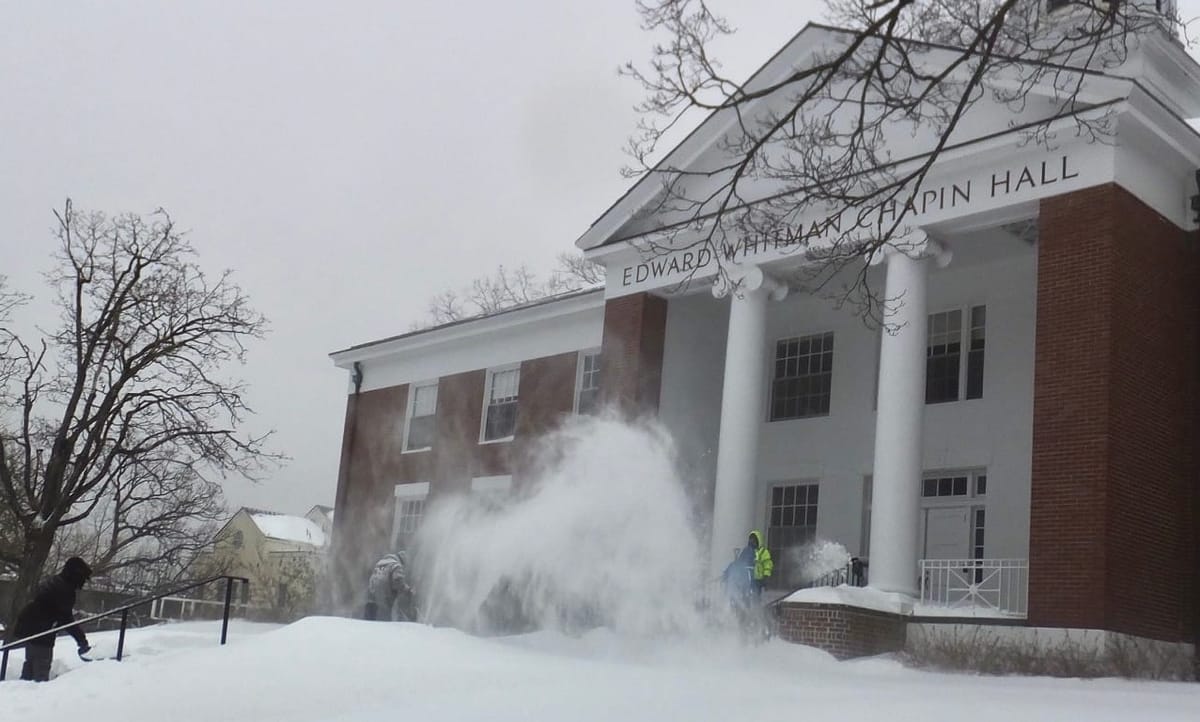
Last weekend, Amherst received 17 inches of snow in the biggest snowstorm to hit the region in 20 years. However, on Monday, January 26th, while students sledded down Memorial Hill and relished the news that the first day of school would be cancelled, the custodial and grounds crews were hard at work shoveling snow that covered walking paths and entrance ways.
At 7:30 a.m. on Sunday, Jan. 25th, Amherst College Police Department sent a campus-wide email stating that the college would be closed from noon on Jan. 25 through Monday, Jan. 26th. The email also said that “staff whose work is related to essential, emergency, or weather management should report to work if their supervisor determines that it is necessary.”
Director of Auxiliary Services/Facilities Kenneth Lauzier wrote in an email to The Student that during severe weather events, grounds and custodial teams report to work as essential staff.
“We are a residential campus and have a responsibility to those living on campus to provide essential services,” Lauzier said. “Students need to be able to move around campus, and emergency vehicles need to be able to access campus.”
Chard Houn, a custodian who works in Moore Dormitory, knows that working in extreme weather conditions is always a possibility. “It’s part of the job,” Houn said. “Essential, that’s what we are. So when the snow comes, we have to come.”
Houn clarified that custodial and ground teams were given consistent updates in the days leading up to the weekend’s storm due to its forecasted severity. Road and sidewalk crews were asked to report to campus by the time the storm began, and crews shoveled in accordance with “peak [student] meal periods,” Lauzier said. Crews could be seen around campus clearing entrances to dorms and academic buildings throughout Sunday and Monday as blizzard-like conditions continued and temperatures dropped to as low as 1-degree-Fahrenheit.
To ensure worker safety, “the employees who perform snow removal as an essential function of their job are provided with protective high-visibility clothing, including an allowance for snow boots,” Lauzier said. He also noted that all hourly staff required to work during the emergency closure were paid double time for their first eight hours of each day, and double time and a half for any additional hours.
Whenever possible, crews use heavy machinery to reduce the amount of manual shoveling required, Lauzier explained. Still, snow-removal teams are given “multiple breaks during their shifts,” during which employees can warm up indoors.
Houn emphasized the importance of the crews taking breaks from the cold. “You have to,” Houn said. “It’s freezing, you know. It’s too cold, then you can take some time inside, it does something to defrost.”
Residents of Valentine Hall reportedly received an email from the Office of Community Living on Jan. 23 informing students that some essential staff members would be housed in the residence hall to ensure the college could carry out safe storm response procedures. Lauzier confirmed that in addition to accommodations in residential halls, workers are also provided meals during multi-day storms like this one.
Crews were asked to report for a final snow clearing during the “predawn hours” on the 26th in preparation for the morning rush at Valentine Dining Hall. Houn confirmed that he and other custodians began shoveling snow at 6 a.m.
While Houn admitted that shoveling snow is hard work, he added that, at least for him, this storm was nothing new.
“I’ve been here for a long, long time, about 29 years,” Houn said. “It’s always expected that we come and clean up the front of the buildings to ensure the safety of the students.”

Comments ()