

Staff Spotlight: Heather Lerner
In this edition of Staff Spotlight, Contributing Writer Lena Miller ’30 spoke with Heather Lerner, first full-time director of the Beneski Museum of Natural History, about her journey from finding “dinosaur eggs” in her backyard to envisioning the new direction of the institution.
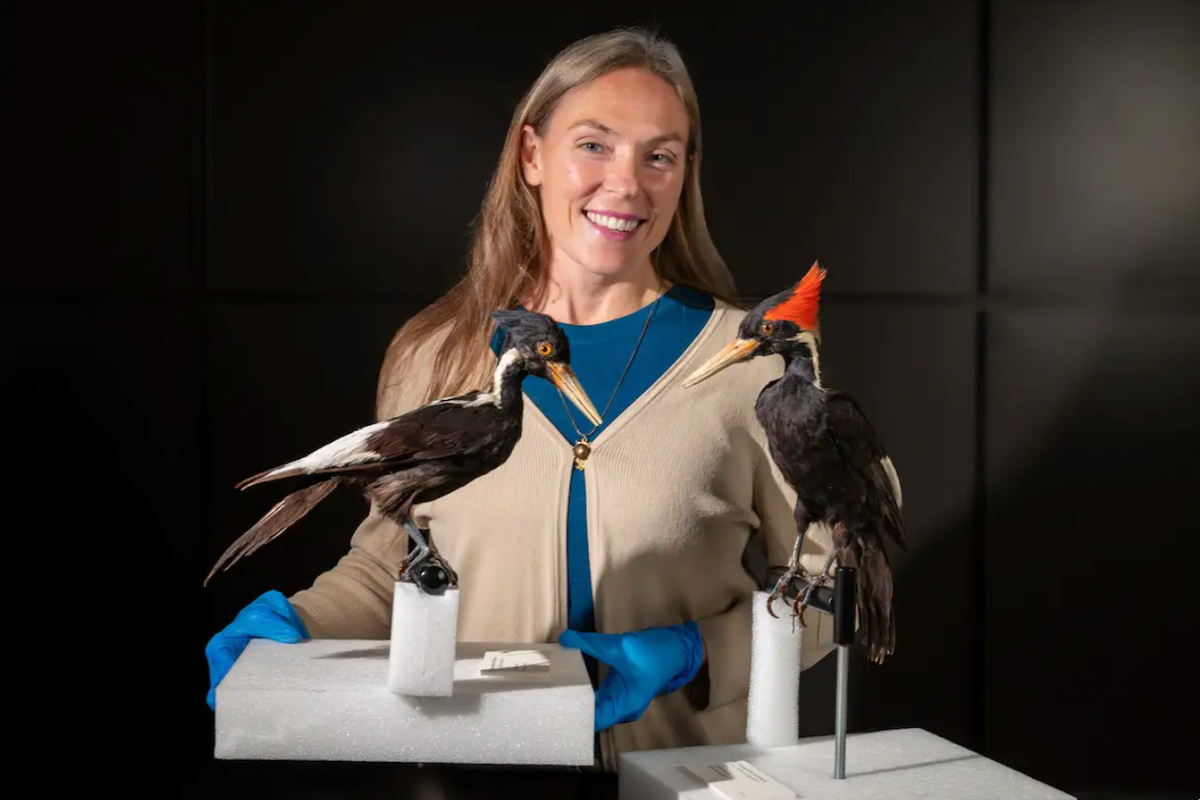
Q: Could you start off by sharing a little bit about yourself and your role on campus?
A: I’m Heather Lerner. I’m the first-ever full-time director of the Beneski Museum of Natural History. Essentially, my role is to do whatever the [Museum] Educator [Alfred J. Venne] and the [Head of] Collections [Gaia Orchard] don’t or can’t do. So, I’m working on getting up to speed and knowing what our programs are in case [Venne] can’t be here [or] one of the students can’t step in. I need to know enough about our collections that I can step in and make sure they’re being taken care of properly.
The more interesting part [of my job] is getting to think about what direction the museum is going to go in. We need to make sure the collections are safely stored and that people handling them are safe from any hazards they might contain. So that’s the first thing I always want to look at. We’re also doing quite a bit of work with the Native American Graves Repatriation Act. We’re working with tribes to return objects that were collected and brought here to Amherst, making sure that they go back to the tribes if that’s what they want, and figuring out how to move forward there. Those are some of the immediate priorities I need to deal with, but I’m also curious about things like who comes to the museum? How do they hear about it? Why are they coming? What are they hoping to get out of it? Once they’ve been here, did it meet their expectations? What was good about the experience? What would they like to see changed? That's kind of where we are going, we’re looking at: who are we serving, how are we serving them, and where is there room for improvement and growth?
Q: What brought you to Amherst?
A: Okay, it’s a funny story. My oldest daughter was looking at colleges in 2024, and we came out here to see Smith and Mount Holyoke, and then we went to Wellesley. My college roommate lives in Amherst, grew up here, is a teacher here, and she said, “Well, you have to also go to Amherst College.” I said, “Well, I don’t know. That’s not on our list.” And she said, “Well, you just have to go. You're going to be here. You might as well go.” I said, "Okay, that sounds great. And they have a museum. I’d love to see it.”
We came on a tour, and all the tours go through the museum, and we got to the museum on the tour, and I said to my daughter, “You go finish with your tour. I’m gonna stay here, and I’ll find you later.” I was just in awe of the museum, and I really wanted to talk to the students who were staffing the desk. So I had to wait until they were done talking to the tour group so that I could just start grilling them on “What’s your experience here? What do you do? How many hours do you work? What’s your training like?” I was asking these deeper questions that I’m pretty sure they don’t normally get, and they referred me to [Venne], the educator. So Fred came out, and I talked with him for a while. And I said, “Could we have a Zoom call later? Because I really want to talk more about how you train students and what your vision is for students working here.” At [Earlham College in] Indiana, I was a museum director and a professor of biology and museum studies, and so I was working with students. I had 50 students working with me in the museum, and I had classes I was teaching using the museum collections, and I really wanted to think about how other people approach this kind of institution.
We set up a time for a Zoom call, and on the call, Fred said to me, “You know, we are going to be hiring a museum director.” And I said, “Oh, that’s lovely. You know, I’ve got some former students who were geology majors who worked with me.” And he said, “No, I think you should think about it.” It took me a little bit to think through: Was this something I wanted to do, move my family across the country, and take on a different museum? I was pretty loyal to the Joseph Moore Museum, a really wonderful museum in Indiana at Earlham College, and I just couldn’t imagine not being there. So it took a lot of work to think through how I could leave our home. I said, “Okay, well, I’ll just send the materials, and if they think that a biologist who does some paleontology work would be suitable for a geology museum, then we’ll open the conversation and see where it goes.” And it’s kind of all history from there.
Q: You mentioned you were a biology professor before coming to Amherst. In what ways has being a professor influenced your approach to your current role?
A: One of the things I think a lot about is: how do people learn? How do people learn in classrooms? How do people learn when they’re not in classrooms? And I think about it in terms of the biology and the psychology of how people learn. I taught that for years. I taught a class called Engaging Audiences [about:] How do you engage an audience? What is an audience? How do you connect with them? How do you create learning environments and learning spaces? So, I learned a lot through teaching my classes and experimenting with different teaching methods, and then I’ve used that in the ways that I’ve developed exhibits and the ways that I’ve worked with students in an employment setting.
I really prefer to be in an academic setting where the thing that underlies everything is student learning — how is what we are doing as a museum part of the landscape of student learning? Fred can lead a program and does a phenomenal job. But if Fred is leading a program and our students are observing, and then the students are leading the next program on that same topic, that has even higher value for me, and for the college and for the museum. And I think working with students in the classroom has helped me get a sense of deep connections with students. What are their motivations? How are they learning best? What matters to them? And then working in the museum setting gives me the chance to know them on an even deeper level, and also on a more fun level. In the classroom, it's very much about your classwork, your grades, and your projects. When working with students in the museum, it’s [about] the connections they’re making with the other students, and how they are supporting the other students as student workers. Then it’s about how they are taking what they’ve learned in their classes and using that to share through the museum spaces.
Q: During your time at Earlham, you were also director of the Joseph Moore Museum. What did your work there involve?
A: The model that we had at the Joseph Moore Museum was having the students run the museum. So we had teams of students who worked with us. We had an education team that worked with our educator, we had a collections team that worked with our collections manager, and then we had a marketing team that worked across all of the teams. We had a fabrication team that worked with me to design exhibits and fix and repair exhibits. And then we had a research team that would sometimes do research for exhibits, but were often doing ancient DNA work with me in the museum lab. So we ended up having anywhere from, I think, at the low end, when I first started, we had 15 students working with us. And when I left, it was probably closer to 50. And we basically had those teams helping with everything we did, and taking the initiative to plan things and run things. And so the model was really students starting as freshmen and finding their footing, finding what team they wanted to be part of, and then from there moving on to leadership roles.
I think the growth piece was really important to the model and to what I wanted to happen there, and also just to make sure that students were involved in every aspect of the museum’s running. I had students helping write grant proposals, and just as much as we could, when students were ready to take on a leadership role, trying to do that. When I started, we had about 1,300 people coming to the museum a year, and by the time I left, we had 15,000 coming.
Q: What are some of your goals (either current or future) for Beneski?
A: We have so many objects in our collection that are not on public display. One of the things I think a lot about is the accessibility of our collections. For one thing, they’re not digitized, so you can’t just go online and search and see what we have, and that means that researchers don’t know, and students don’t know, and the public doesn’t know [what we have]. And so, one way we’ll address that is by digitizing the collections, by creating a database and making it accessible. But another way to get at that same goal of accessibility is to have exhibits that rotate objects into view.
Some other goals are making sure we’re compliant with all of the federal laws and that we’re an ethical museum. That’s really important to me. I’m hoping I can involve more students working with the museum, especially when we start looking at audience evaluation. It’s a great role for students to do some research, so I’d love to do some of that when we start working on strategic planning. I would also like to work on a temporary exhibit to go up; next summer is the timeline I’m looking at right now. I just had a publication come out on Hawaiian honeycreepers, about adaptive radiation and conservation. They’re some of the world’s most endangered birds, most threatened right now by climate change and invasive species. There is a class that [William R. Kenan, Jr. Professor of History and Environmental Studies Edward D.] Melillo is teaching on Hawaii, and so I’m going to get to connect with that class and see if they want to be involved in putting together some work that could be part of this exhibit, and the geology department has a class that's taking a field trip to Hawaii in January. So, a lot of things about the move to this role and what I’m interested in doing have just seemed to very naturally come together.
I’d also like the museum to have more hands-on, interactive experiences, and so a temporary exhibit is a great way to do that with a large number of people that come through here. I would really like to find ways to connect with and collaborate with more people who aren’t necessarily just the students working at the museum, and so this exhibit is a nice way to connect with other faculty and students who have a shared interest. I have a whole layout of where it might be in the museum, and I have a bunch of objects, some signs, and other things that I collected that we can use as the seed to get us started with the project.
Q: Were you interested in museums growing up, or did that interest develop later in life?
A: As a kid growing up, because I was near the University of Wisconsin-Madison and they had a free geology museum, I would often go there with my family. So it’s pretty cool that I’m at a geology museum now. And when I was little, I discovered a rock in my yard that I thought was a dinosaur egg, so I took it to the geology museum, and they took a look at it and said, “Well, definitely not a dinosaur egg, but it could be a geode.” And they cracked it open.
I remember being really horrified that they cracked my rock, but also how great it was that they were so interested in something that I found, and I just remember thinking, “Wow, you can find things, and you can connect with people over what you’re seeing,” and it just felt like such an interesting and authentic way to talk with people. We’re talking about this object right here; we can all see this, we can experience it, we can connect to it, and I really liked that as a kid. I was not really a collector per se, but I was very much someone who was always drawing people’s attention to objects and to the landscape around us, and enjoying seeing other people’s reactions and having that kind of an interaction. And my family would go to free museums. We lived not too far from Chicago, and I remember going to the Museum of Science and Industry. They had a heart that you could walk through, and it beat. It was like all the different chambers of the heart. I remember just thinking how incredible it was that someone thought to do that, and I was like, “I want to do that. I want to create cool things like this.”
Q: Do you have a favorite collection or artifact in Beneski?
A: I have a lot of favorite ones in this museum. In fact, one of the things I’ve been doing each time I come in is just trying to notice something different. Like opening a drawer I haven’t looked at, or opening the same drawer three or four times because there are so many objects in these drawers. I am pretty partial to the moa. I did some research on the eagle that preyed on moa, and I’ve spent two different semesters living in New Zealand. So being greeted by a giant moa, which is an extinct bird from New Zealand, when you walk into the museum, just feels kind of right. Given all my connections with New Zealand, it makes it feel like home.
Q: What do you hope students take away from visiting the museum or interacting with the museum?
A: I hope that students come to the museum to learn in a different way, to make their own observations, and to be in the presence of these incredible objects that have been brought here. I think we spend so much time reading and getting in our heads, and to be anchored to a place through the objects that are here is something that I hope that students get. I had a friend who came to visit, and I said, “Oh, you can walk on the tracks in the basement. There are these two rows of tracks you can walk on.” She said, “Oh, great!” She kicked her shoes off and walked soft-footed right over the top of them. And I thought, “Oh, well, yeah. Now I want to do that. I want to walk on the tracks with my bare feet.” Like, why would I walk with my shoes on? Of course, you want to feel the tracks. You want to put your foot where that dinosaur’s foot was. I mean, these are casts, of course, but what a unique way! And it was just such a genuine [feeling of], “Oh, well, this is how I’m going to interact with something. Yeah, walk right across with my bare feet.”
Comments ()