

WAMH x The Student: “Who is the Sky?” Tour
Art-rock icon David Byrne electrified Wang Theatre recently with surreal visuals and a balanced setlist of classics and experimental tracks. In their review, Rohan Badgandi ’29 and Rafael Gómez ’29 capture the performance's mix of political irony, nostalgia, and novelty.
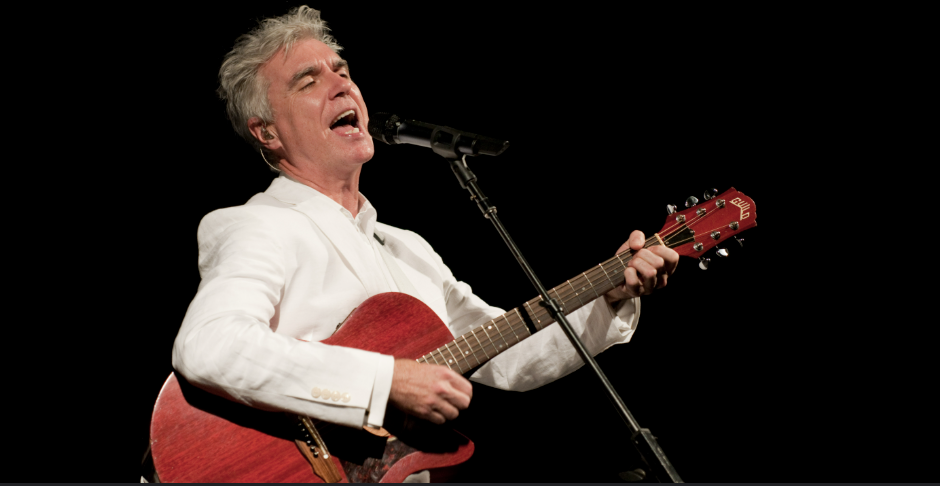
Boch Center: Wang Theatre, Boston. Cherubs and satyrs guild the ceiling of Wang Theatre, fixing their louche and languid smirks on the crowd below. A prerecorded message cuts through: It’s David Byrne encouraging the crowd to dance. The atmosphere is convivial — swapping college graduation years (’82, ’85, ’29) in the crowd’s din will do that. Two hours of vibing to nervy art-rock icon Byrne promises to bring us closer still.
When velvet curtains part at 8:18 p.m. (Byrne is remarkably punctual), they give way to the Moon incarnated onstage. Byrne and three bandmates pace and stamp upon its porous surface as Earth rises in the background to the tune of “Heaven.” With Earth’s musical peak, the crowd is on its feet, and we’re underway.
Byrne is touring in support of his September album release “Who is the Sky?” and he delivers a frantic, rousing performance filled with weird dancing and weirder visual effects. The show is rife with all the quirks and oddities one would expect from the former Talking Heads frontman. Byrne strikes a roughly even balance between classic hits (“This Must Be The Place,” “Once In a Lifetime”) and songs from his new album and solo career (“What is the Reason for It?”, “Strange Overtones”) to both keep the audience happy and explore new ground. The polyrhythms embedded in the music come to life through Byrne’s employment of variations and little textural reinventions of old Talking Heads songs, and it’s safe to say they succeeded in getting the crowd up and moving. Physically, the show is packed with sudden stops and starts (see Byrne and company’s dancing for an illustration), but sonically, it’s vintage Byrne worldbeat.
Byrne also takes the opportunity the tour presents to make a couple of sociopolitical statements. Both are overt. For the first: during the show’s rendition of “Life During Wartime,” clips and images of current political turmoil from across the globe are displayed on the stage backdrop. Byrne’s choice to combine a song written to reflect an entirely different period of turmoil with coverage of very contemporary issues is highly intentional — he is reaching into the past, looking back on a time when we felt adrift and scared, and suggesting: maybe this is history repeating itself.
Byrne’s second overt statement involves a gorgeous, yet unnamed and unreleased song about t-shirts, and critiques the reduction of politics to a sloganeering exercise. The band plays and harmonizes, and Byrne croons about t-shirts. At the same time, a slew of slogans from across the political spectrum are projected onto the backdrop, silently blaring at the audience. Byrne’s critique was blessed with a heavy sprinkling of irony at the Boston show, as the audience tittered and cheered for slogans they found compelling or amusing, despite their understanding that the slogans themselves are, in a very real sense, shallow — speaking to the power of the slogans to hold us in their thrall despite our critiques.
Still, in spite of the political bent to some of Byrne’s performance, his statements aren’t a call to action as much as an affirmation of shared grievances, and it’s dubious whether we really need more of the latter. Byrne’s polyrhythms and grooves are excellent, though, and the performers themselves are animated and lively — maybe, for a concert, that is enough.

Comments ()