

Aidan Cooper: Exploring the Multitudes
Aidan Cooper’s immense creativity manifests not only in their evocative poetry, but in the many ways they contribute to campus — whether on stage with the widely beloved Mr. Gad’s House of Improv, as president of the Poetry Club, or through “Voices of the Class.”
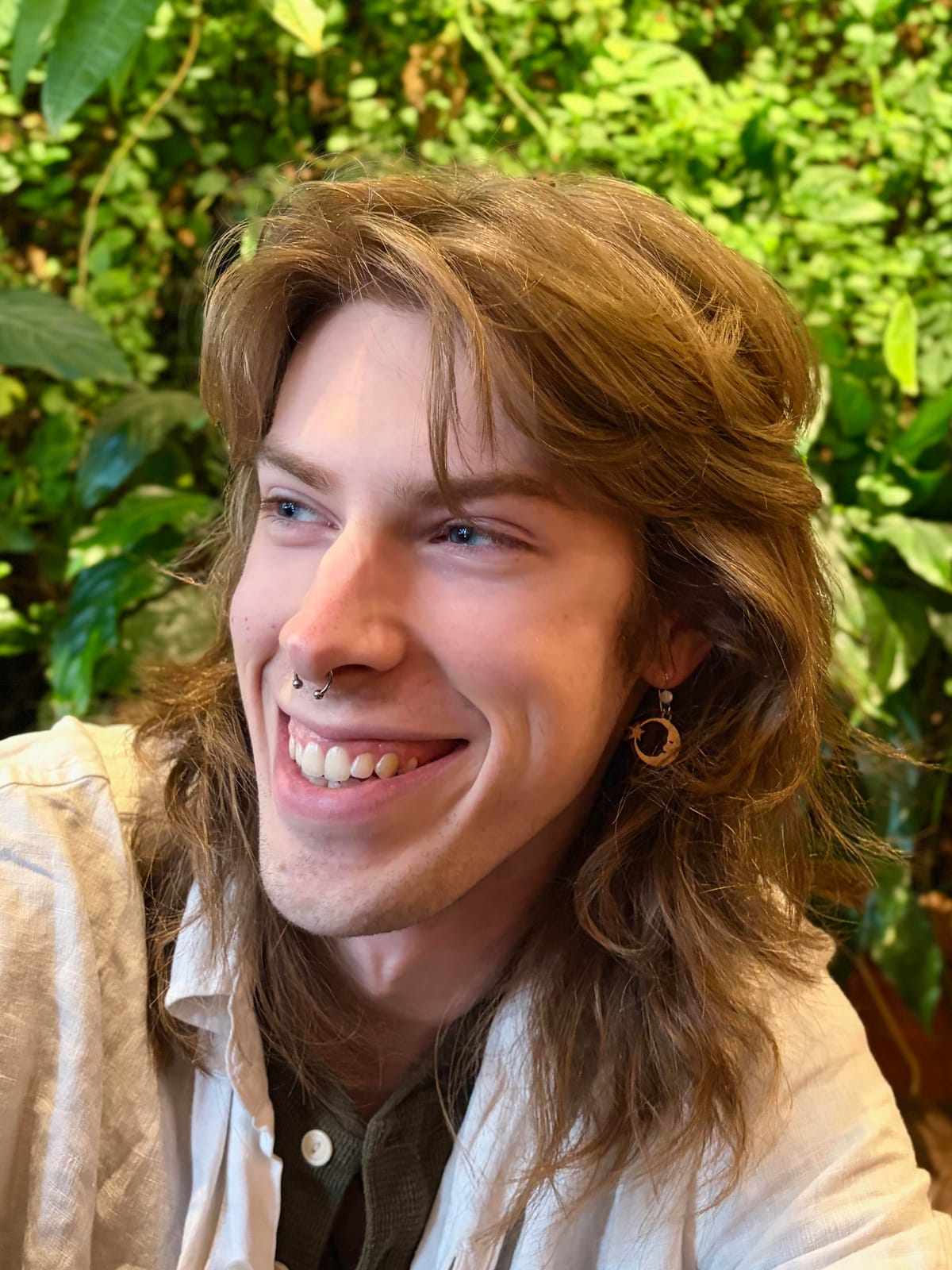
I’ll make a confession: I am not a poetry enthusiast. Yet, within the first few seconds of reading Aidan Cooper’s “Before They Traded Devers” in The Common, I was hooked. I read it again and again, returning to it throughout the following hour, trying to trace the intention behind its unconventional punctuation, pacing, and symbolism.
Their writing feels deeply personal, as though you have been pulled into a private conversation you were never meant to overhear. As you listen in, you begin to recognize feelings you have experienced yourself but never managed to put into words. I promised myself that, even if I wasn’t assigned to write Cooper’s commencement profile, I would still reach out to them.
Despite it being my first time speaking with Cooper, I felt at ease throughout our conversation – they are warm, friendly, and, as anyone who has spent time with them would likely agree, extremely funny. Within the first five minutes, any need to glance at my “emergency questions if the conversation was stalling” document had completely disappeared.
Wood Wizard, Short Stories, and Improv Twirl
Cooper grew up in Vermont, where they developed early interests in reading, music, writing, and theatre. They described their younger self as “a bit of a strange kid” — someone who would “romp around the woods pretending to be a wizard.”
That creative “strangeness” soon leaked into the real world. Cooper discovered theatre in the fifth grade through their younger brother, who played the lead role in “Stuart Little” at just eight years old. Cooper described their brother as “a really important person in [their] life,” and decided to follow in his footsteps. What began as an imitation of their brother quickly became something of their own: a “safe haven” throughout middle and high school.
“I didn’t have a whole lot of friends growing up, and the theater became a communal space, where everyone was involved in making something together,” Cooper said. “I felt valued, like I was contributing to something, and that was really special.”
They laughed while recalling their first role on stage: a Duloc dancer in “Shrek,” wearing a tutu. But when asked about their most memorable moment on stage, Cooper immediately thought of playing Danny — often described as the “song-and-dance boy” — in a production of “The Orphan Train.”
The first show of the play did not go as expected. As the pianist started playing, Cooper accidentally began singing the wrong song to accompany the music. Though many children would probably freeze or run offstage, little Cooper didn’t. Instead, they “stopped singing, stood in place for a second, and then did a little twirl,” soon seamlessly transitioning to the correct song as if nothing had happened. In retrospect, perhaps that moment was one of the first glimpses into the performer Cooper would later become.
Their creativity extended even beyond the theatre, as Cooper was also musical. They played violin in orchestra, ran a high school music blog featuring album recommendations, and even performed in a quartet with their younger brother (note the pattern of their brother’s influence!).
After freshman year of high school, Cooper transferred from a public school to Loomis Chaffee School, a Connecticut boarding school known — or perhaps notorious — for its academic rigor.
Cooper reflected on their time at the school, saying that “the academics were so rigorous that I was completely overwhelmed, but I really wanted to do well, and so almost my entire life was academics and theater.”
The Multitudes
Amherst was the first college Cooper toured, and it set the standard immediately. “This place seemed like the place to be,” they said.
Their tour guide, Luke Herzog ’24, a former director of Mr. Gad’s House of Improv and a playwright, spoke at length to them about theatre opportunities, Mr. Gad’s, and the English department. “I toured a whole bunch of other colleges. And I kept thinking about this place and that interaction with him specifically,” they said.
At first glance, Cooper’s interests seemed neatly artistic: theatre, music, and poetry. Yet, as Cooper started telling me about their plan to major in biology when they first came to Amherst, they completely dismantled that impression.
The “overwhelming passion” in biology they described first took root in Cooper’s high school microbiology class. As they talked about the course, their eyes lit up in excitement as they talked about microorganisms. “You can literally see evolution happening as different strains of bacteria work around different antibiotics,” they said. “It was so cool.”
As Cooper explained to me, their passions are not as separate as they might initially seem. Instead, they told me, they are united by the concept of multitudes. “Poetry can carry so much in different capacities, different tensions, different multiplicities. [Just] as a poem contains multitudes, we [also] contain multitudes. We have different colonies of different creatures living in our bodies,” they said. Studying bacteria also made Cooper realize that “there’s so much unseen about literally everything around us.”
This realization mirrors their approach to poetry. “My interest in poetry comes from a very similar interest in the unseen, the unnamable, the sort of reaching towards what we can physically sense,” they said. “I think about science — specifically microbiology and bacteria — in almost a parallel way to how I think about poetry.”
After taking nearly every cell biology class available at Amherst, Cooper confirmed that their deepest interest lay in microbiology. Yet, rather than pursuing a biology major, which would require studying organisms far larger than the microscopic world they were drawn to, they turned toward English.
“I think the English major satisfied a lot of my philosophical interests in bacteria and biology generally,” Cooper said. “So I just took the classes I wanted to take, and then I said, ‘whether I major in it or not, it’s been important to me.’”
Cooper’s sense of “multitudes” extends into their personal life. Friend and fellow poet Mariam Beshidze ’27 described them as someone who balances intellectual intensity with warmth and playfulness.
“Just as one can be charmed by their expansive intellect, eloquence, and their complex, intricate poetry, they can be simultaneously silly, fun, playful, and down to earth,” Beshidze said. “I admire their courage — the way they experiment with their identity, the way they engage with the world and confront difficult challenges, and speak about them honestly, truthfully, and with understanding and compassion.”
Experiments and Nothingness
The same pull to the overlooked and hard-to-define shapes Cooper’s academic work.
Their thesis, for instance, examines “nothing” — not as absence, but as a label. “I’m looking at the label of nothing, or sort of ontologically nothing,” they said. Cooper described the project as “one of the hardest projects” they have worked on. “I have drafts and drafts and drafts of these chapters, hours and hours and hours of banging my head against a wall,” they said.
Their thesis combines analysis of canonized English authors, post-colonial critique, and Afro-Pessimism to explore how “nothingness” can become a space of rejuvenation in experimental poetry. They described the process as “a number of [their] interests coming together in a very cool way.” Cooper also elected to write the thesis as a series of lyrical essays. “I was working with language in my own way, working with an essay, almost like I would with a poem,” they said.
That experimental instinct also carried into the classroom. Associate Professor of English Anston Bosman described Cooper as “a brilliant mind and a bright spirit.”
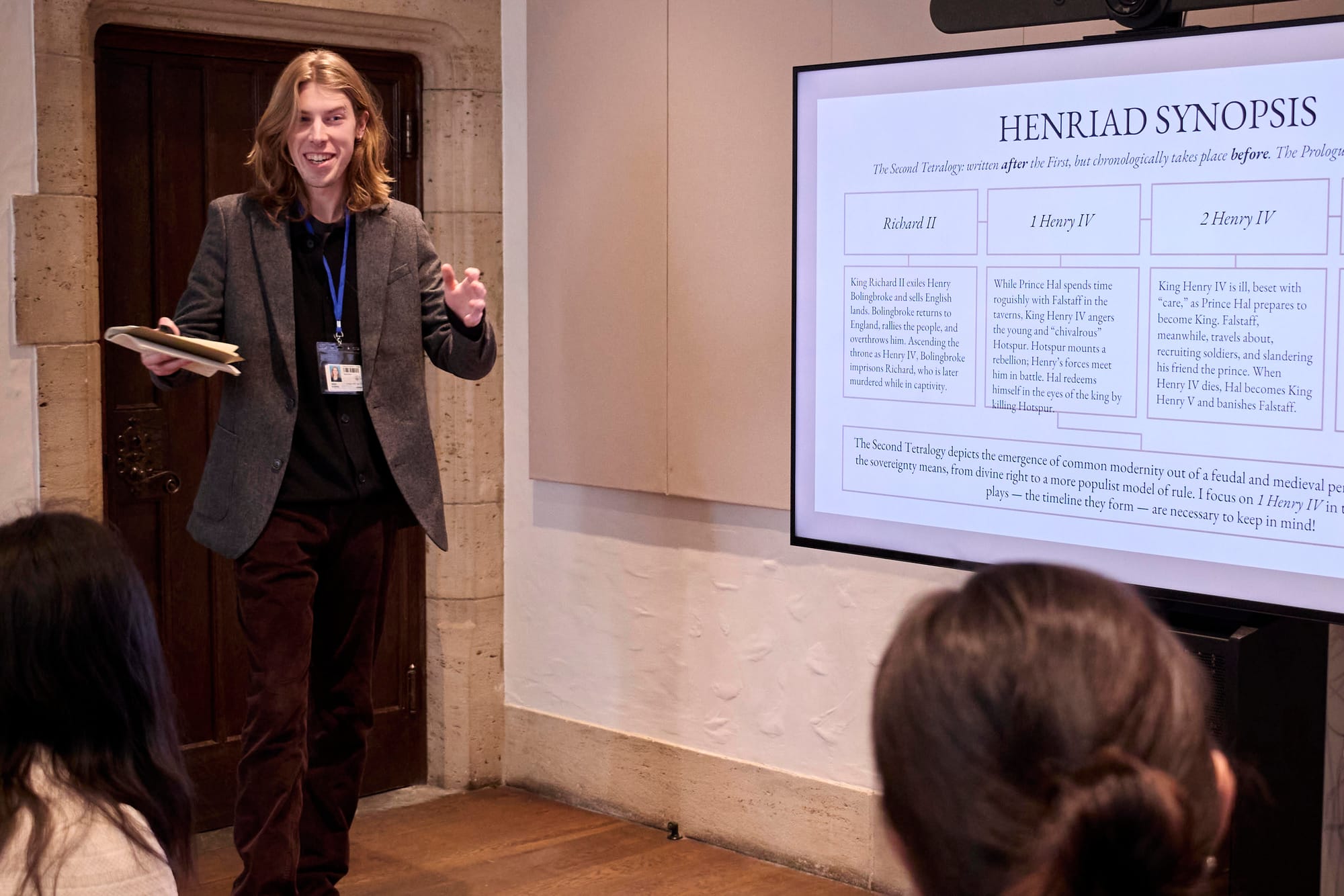
“As a student in my ‘Shakespeare’ class, they wrote unforgettable prose, a kind of glittering prose that approached poetry,” Bosman said. “I’m not kidding about the unforgettable bit — I can still remember almost word for word a piece they wrote that used the TikTok trend of ‘girl dinner’ to explain how gender works in ‘Twelfth Night’!”
On Stage and in Community
This openness to experimentation also shaped how Cooper moved through campus life. After auditioning for Mr. Gad’s three times, Cooper joined the group in their junior fall. They described the improv community as “one of [their] safe spaces on campus.”
“Every single week, Aidan lights up the improv stage and grounds Mr. Gad’s rehearsals with a much-needed veteran presence,” Aidan Gemme ’26, a member of Mr. Gad’s and Cooper’s close friend, said. “They are an expert performer but more importantly, a shining model of how to push out of your comfort zone and be fully and unapologetically yourself.”
Mr. Gad’s, however, isn’t the only place where Cooper’s presence on stage stands out. In their junior year, Cooper participated in “Voices of the Class” — the annual orientation performance in which students perform out-of-context scenes based on incoming students’ application essays. Cooper described it as one of the campus groups they are “most proud of being a part of.”
“You’re a group of people trying to put a production together, [and] you feel so close-knit,” they said. “And I think it’s a level of stewardship, honestly. That’s how I show my love for Amherst and for the people who inhabit this place.”
Gemme reflected on the effect Cooper has had on those around him, saying, “They have a sort of silent aura that follows them everywhere which tells you they are special. It’s not in an in-your-face or obnoxious way, but rather in a simple, undeniable form that lets you know you’re in the presence of greatness.
Fragmented Poetry, Fragmented Life
Fascinated by their poems, I couldn’t wait to ask about how Cooper got into writing. As we chatted, Cooper said they had only recently rediscovered the first short story they ever wrote — a second-grade piece they jokingly described as a “complete rip-off of ‘Stardust’ by Neil Gaiman.”
These longer stories gradually gave way to poetry poems in fourth grade, when a teacher introduced a poetry unit and asked students to write their own poems. “I had a little booklet that I carried with me, and I wrote on the bus to and from school,” Cooper recalled.
What started as scribbles in a little booklet became inventive, impactful, and intimate pieces published in The Indicator and The Common. It turned into work that consistently challenges preconceived ideas about poetry. “I think a lot of people think that poetry is a kind of obfuscation …” Luchik Belau-Lorberg ’28, who has worked with Cooper on The Lilac, said. “Talking to Aidan made me realize that it’s the opposite of that. It’s trying to say something true.”
Elsa Lyons ’27, a member of The Lilac, echoed the impact Cooper had on her writing. “Every time we talk, ideas that once seemed separate clatter together in my head, making new and unexpected rhythms,” she said. “Their presence invites my thoughts to arrange themselves in new patterns.”
Cooper’s poems often incorporate unusual punctuation and fragmented structures. “Before They Traded Devers,” the poem I was so magnetized by even before I met Cooper, for example, uses ampersands to play with tempo and fragmentation throughout the piece.
“I’m working with fragment modes, where words are here and there, and how words can apply to whole universes,” Cooper said. “It’s an experiment. It’s how I’m experiencing everyday life at certain times in my life.”
Lately, however, Cooper has begun reimagining how fragmentation appears in their work. “Right now I am trying to lean away from using ‘and’ at all in my fragments, and I’m trying to use just space on the page as a tether,” they said. “It’s not a silence or quietness even. It’s a teetering. You have a word, and you’re going to teeter for a little bit before you get to the next one.”
Cooper compared this new approach to their experience at Amherst. They described their sophomore and junior years as very “hectic,” as they balanced working at The Common, being a teaching assistant, working with Lewis-Sebring Professor of Humanities and Latin American and Latino Culture Ilan Stavans on an anthology, and numerous other commitments that I don’t have the space to fully get into. Now, they are learning to let go of that steadiness.
“I’m really trying to live in the blank, like when you are looking at a blank space and wondering what word will end up there,” they said. “I’m thinking about my next years — and even right now — about living in that wonderful uncomfortability of not knowing what’s going to happen next.”
So, What Next?
For now, there is at least one next step. Next year, Cooper will be working as The Common’s seventh Literary Editorial Fellow (LEF), where they have already spent more than two years contributing to the magazine; last year, Cooper was the recipient of the magazine’s David Applefield ’78 Fellowship. As a LEF, Cooper will assist with production, edit prose and poetry, and help organize literary events across the country.
After that, their path is less defined. “I wouldn’t be surprised if in five to 10 years down the line, I might end up trying to go to med[ical] school or trying to do other things,” Cooper said. “Wherever I go in my professional life, I hope I’m able to keep an interest in as many different things as possible. I am trying to keep an open mind, and I think Amherst has really crystallized that value in me.”
Comments ()