

Appreciating Abstractionism in the Everyday
What is this zigzag structure? Most students walk past “Arch Homage IV” without a second thought, but after two years of speed-walking by the sculpture, Contributing Writer Harman Aujla ’28 finally stopped to ask why it makes us so afraid of saying something wrong.
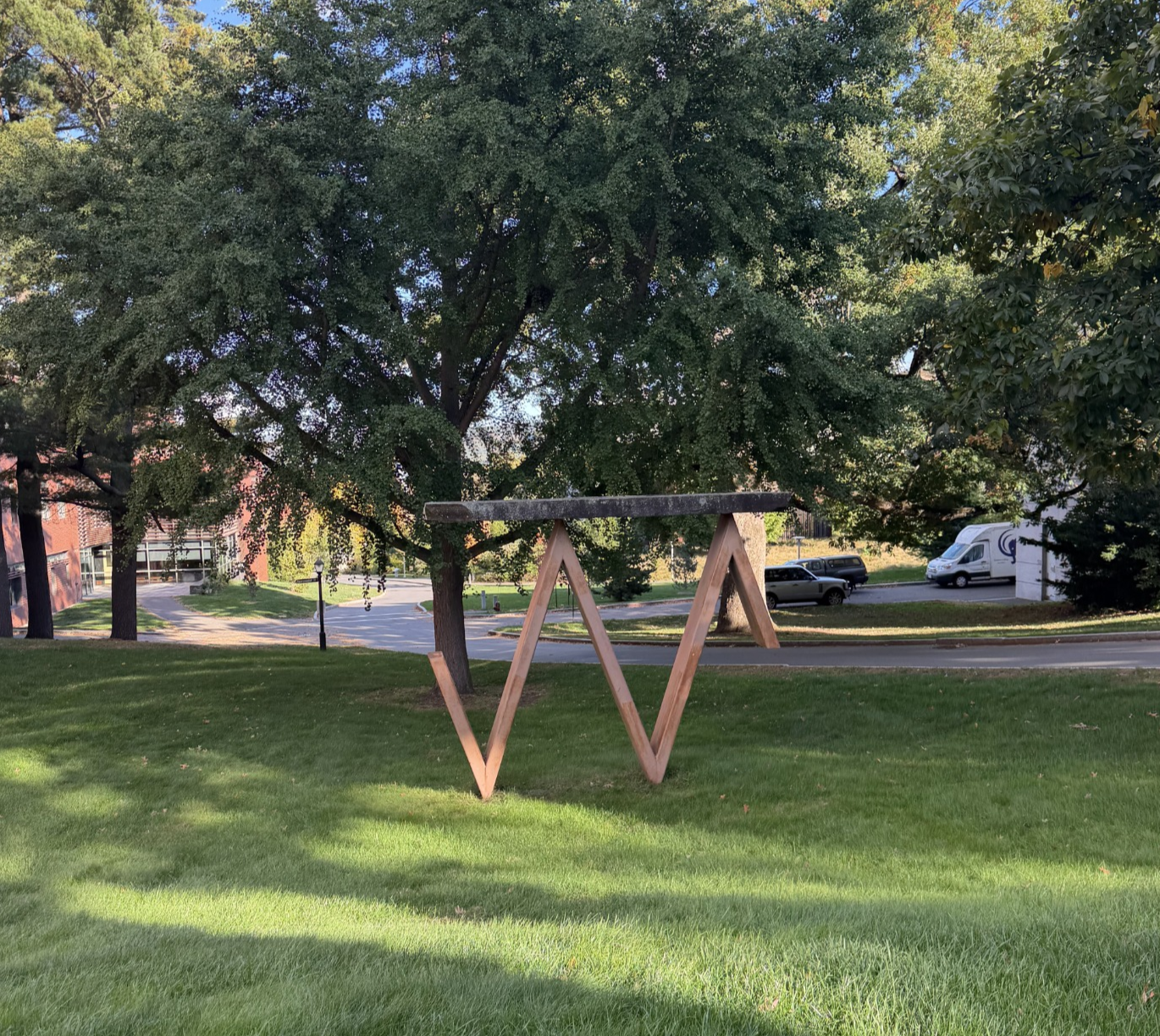
Painted steel holds up a slab of bluestone rock to create an enigmatic shape. Some students may walk past this sculpture and marvel at it, while others may pay no mind. I have speed-walked past this sculpture innumerable times, but whenever I began to speculate about its meaning, a more concrete thought diverted my attention. In the two years that I have attended Amherst College, my thoughts on the sculpture have always remained unfinished.
The sculpture is named “Arch Homage IV” by Ernest Shaw and was dedicated to Amherst on Sept. 1, 1983. Shaw’s work draws on his childhood fascination with crafting, and his body of work explores different mediums and techniques to challenge typical concepts of gravity and balance. Shaw places bluestone, a material often used in buildings and landscaping, on top of steel, which he paints an earthy brown-red. The pigment makes the sculpture appear congruent with the background, seamlessly fitting in and creating a sense of unity with the surrounding environment.
As an art history major, I study many works of art in the classroom, so it’s ironic that I haven’t engaged with a sculpture I walk past every day. I wondered if others had the same experience, so I asked some friends about their thoughts on the sculpture. All of them shared the uncertainty they felt when they looked at it, prefacing their interpretation with something like “I’m not sure” or “I don’t really know.” While some friends did not move beyond this hesitation, others were fascinated by the question and became more curious about forming an opinion on the piece. One student observed that the structure resembled an electrocardiogram, thus evoking the image of a heartbeat. Others have said that they see the letter “W.”
For me, the heaviness of the stone resting on a less visually dense zigzag structure embodies the weight of academic and personal responsibilities on students’ shoulders. The sculpture exists within the space of an “elite” liberal arts institution and could therefore be seen as a medium for creating a certain image for the college. What the exact image and intent are, I am unsure; however, the sculpture’s setting makes my personal reckoning with it focus on its ties to the undergraduate experience. This interpretation can also be extended to other college campuses, as Shaw’s work is held in many university collections nationwide.
Abstract art, which this piece most certainly is, is a particularly personal form of art. It molds form, color, and material to present an image where the story or message is unclear, and its ambiguity invites the viewer’s interpretation; these interpretations are based on their individual life experiences and emotions. Unlike other genres of art that require particular cultural capital (knowledge of iconography or historical understanding) for meaningful engagement, abstract art does not beg you to do homework. Instead, it invites the viewer to embark on spontaneous thinking and exploration. Art happens now.
At a liberal arts college like Amherst, students are often confronted with discourse and ambiguity in classroom settings, so it is curious that some would avoid the discomfort of sitting with the sculpture’s equivocal nature. It makes me wonder whether we have created a culture in which we are so frightened of sounding naive or saying something incorrect that we avoid the conversation entirely. Perhaps we have.
In his article in The Atlantic from earlier this year titled “College Should Be Way More Fun,” President Michael Elliott points to a classroom conversation about the ambiguous ending of “The Turn of the Screw,” where students debate their antithetical perspectives in a lively discussion. Elliott argues that this was a meaningful and collaborative process of intellectual engagement and inquiry that also takes place when confronting the bigger questions and concerns facing our humanity. No interpretation is incorrect because there is no single correct answer. The same principle applies to abstract art: There is no prescribed way of seeing or understanding an artwork; the act of looking itself is enough.
Neville Scarfe, an academic scholar and professor at the Institute of Education of the University of London, says that the highest form of research is “play.” “Play” can be thought of as the act of being experimental and creative in the absence of a predetermined answer, particularly when motivated by curiosity and pleasure. When learning is a form of play to explore and understand the world, being correct is not the primary objective — having fun is, which Scarfe argues provides a deeper engagement. Scarfe and Elliott are substantiating a similar idea: that we ought to give weight to the explorative and joyful aspect of learning, beyond viewing education as a means to an end (where the end is knowledge of the “right” and “true”).
While the object material exists independently of the social relations that surround it, those conversations can add another layer to interpreting the abstract. One particularly interesting conversation was with Brooke Kamin Rapaport ’84, former artistic curator at Madison Square Park Conservation in New York and adviser to the Amherst Public Art Working Group. As a graduate of the college and recipient of an honorary degree for her contributions to contemporary art, Rapaport was invited to deliver a talk titled “Why Public Art?” at Commencement in 2022. In her talk, she criticized Amherst College’s art as representing an outdated stage of modernism, arguing that contemporary art has moved beyond the particular phase of modernism — an artistic movement from the late-19th and early-20th centuries characterized by experimentation with new materials and ideas — that “Arch Homage IV” exemplified when it was first installed.
For that reason, it is intriguing that “Arch Homage IV” has stood the test of time and criticism, remaining in place for 43 years and, every time I walk by, if only for a moment, prompting me to wonder not just about the conversations, interpretations, and reflections its 43 years have generated, but about what new discussions and meanings it will continue to inspire in the years to come.
Comments ()