

Ayres Warren: Exploring With Positivity
Having conducted extensive research on cancer survivors and natural disaster response, Ayres Warren hopes to explore the intersections between anthropology, ecology, and public health.
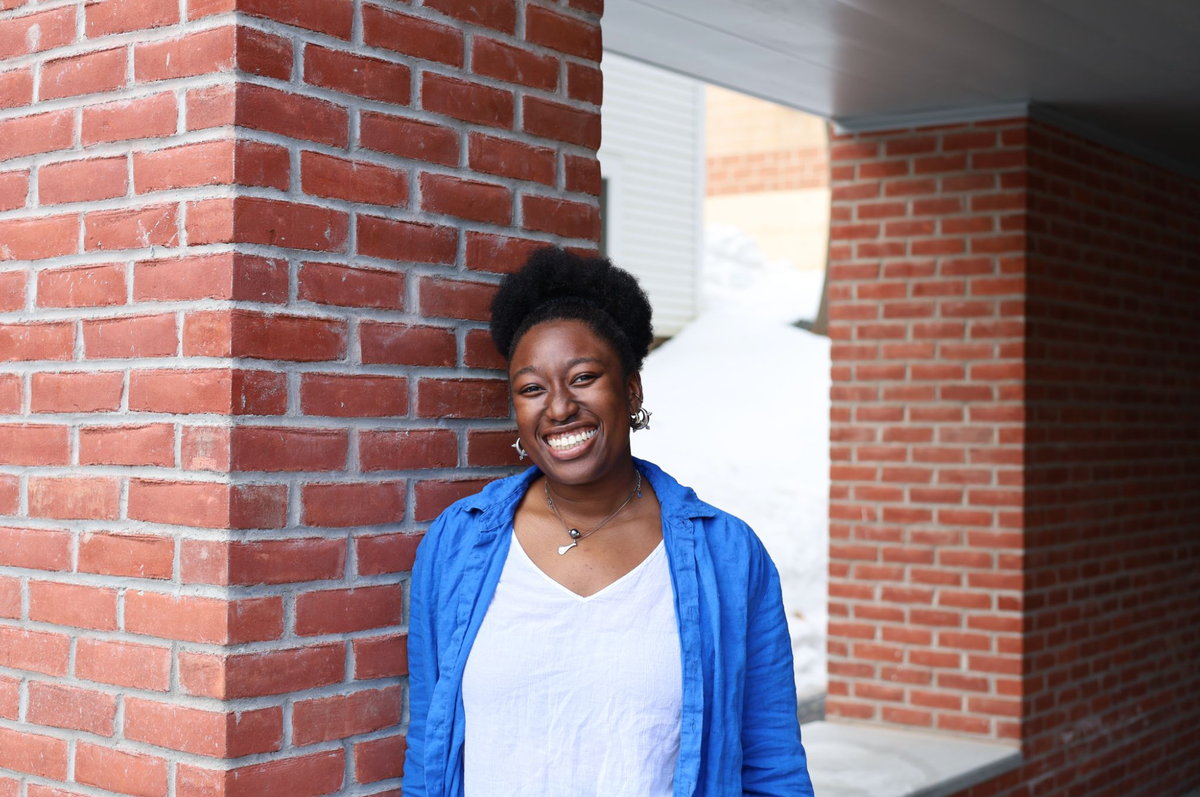
You may have heard of Ayres Warren ’26 in relation to her many different roles at Amherst College. In the classroom, she is a biology and anthropology double major focusing on human response to environmental factors. In the Red Room, she is a dedicated student senator who worked to bring the much loved raves back to campus. In meetings in the Octagon, she is an executive board member of the Black Student Union (BSU), bringing cultural celebrations and education to campus.
But minutes into our interview, Warren admitted that she did not even consider Amherst at first.
What Amherst?
Growing up in Eden Prairie, Minn., Warren never expected to end up in western Massachusetts for college. As she joked, “I actually did not know that Amherst existed until the summer before senior year.”
During a meeting with her college counselor in her junior year of high school, Warren expressed a list of desirables with some especially important features: a mid-size school located in a city. When her counselor’s recommended list of colleges came back including the name Amherst, Warren was shocked. “I was like, ‘okay, did we listen fully to everything that I just said?’”
In the end, Warren and her mom ended up touring an array of schools on the East Coast, including many of the other Five Colleges. She quickly realized that it was a small liberal arts education — not a larger college environment — that suited her best. Amherst in particular stood out; as Warren put it, “I just felt this vibe.”
Due to lingering Covid restrictions, she was unable to enter any buildings or come within six feet of anyone else on campus, but the school made such an impact that she attended both the Access to Amherst program — where she was finally able to interact with other students, albeit over Zoom — and Be A Mammoth after being admitted during regular decision. She grinned as she recalled in our interview that “everything just worked out.”
Mammoth Learnings
Warren knew since high school that she wanted to pursue a career related in some way to the sciences. She initially planned on studying a hard science, with dreams of becoming either a veterinarian or a conservational biologist. By the end of high school, however, Warren recognized that she wanted to blend her love of the sciences with her aptitude in the humanities. When it came time to submit a post to her high school’s Instagram college commitment page, she remembered debating what intended majors to list, knowing for certain she wanted to study both biology and something else in the humanities. She ended up listing anthropology as her second major.
At Amherst Warren found herself torn between anthropology and Black studies for an extended period of time. During her first semester, she took “Sociocultural Anthropology” with G. Henry Whitcomb 1874 Professor of Anthropology Emerita Deborah Gewertz. She loved the class, and officially declared her second major as anthropology during the fall of her junior year. As it turns out, Warren had demonstrating impeccable foresight through her commitment post — she even wrote her senior thesis in the anthropology department.
While she prioritized meeting the requirements for both anthropology and biology, Warren also took full advantage of the Amherst liberal arts education. She recalled in our interview that, “[the] third thing that I’ve taken the most courses in … is religion.”
As Warren progressed through the biology major, she began to recognize that her interests fell more on the environmental and ecological side. While most biology students at Amherst tend towards the cell and molecular biology end of the spectrum, Warren maintained in our interview that “both areas in the biology department are really strong.” In fact, one of her favorite classes during her time at Amherst was “Ecology” with Professor of Biology and Environmental Studies Ethan Temeles, so much so that she took his “Seminar in Ecology” as well.
One of the most influential courses throughout Warren’s entire Amherst experience was “The Garden: Nature and Religion in the Mediterranean,” taught by Visiting Assistant Professor of Religion Matthew Westermayer. The course focused on human connection to plants and the development of gardens and religious architecture in the growing Mediterranean world; she described the aim of the course as the evaluation of “the roots that we’re seeing in religious texts, and how … that manifests [in] people’s connections to their environment in the modern day.” Warren particularly enjoyed visiting Smith College’s botanical gardens as part of the course, and highlighted the importance of not only taking courses outside one’s major but also those taught by visiting professors to obtain a truly unique Amherst experience.
Warren extended her academic prowess outside of the classroom by taking “Black Feminist Health” with Assistant Professor of American Studies and Black Studies Jallicia Jolly. Warren had arrived at Amherst with aspirations of contributing to the field of public health, so the class was a “core course for [her].” Warren formed a close relationship with Jolly, who connected her with a colleague from graduate school whose work focuses on disparities and interventions with Black and brown breast cancer survivors. She spent the summer after sophomore year working on the project, eventually earning co-authorship when the work was published.
Warren cherished getting to engage in scientific literature beyond the classroom and learn the intricacies of the publishing process. She credited Amherst and its encouragement of student-faculty connections for her ability to engage in this unparalleled opportunity. “Being able to work in a … different school, in a different department, and make those interventions there was key,” she said.
Warren spent the rest of her Amherst career bettering public health outcomes. She spent her senior year working with Jolly in the Black Feminist Reproductive Justice, Equity, and HIV/AIDS Activism Collective, a medical humanities lab founded in April 2023.
When it came time to decide on a thesis topic, Warren knew that she wanted to combine influences from her two majors in an interdisciplinary look at real-world anthropological issues. Taking inspiration from her discovered love of environmental studies in previous courses, Warren’s thesis, entitled “Unprecedented Past Towards Flooded Futures: Katrina, Helene, and Narrating the American Flood in the 21st Century” focused on the climate and social impact of the titular storms. Warren explored the concept of disaster narrative plasticity in her research. She explained that people’s conceptions of natural disasters are “always in flux … [which] drives conversations, policy and funding surrounding flooding and some of these climate-related events.”
Warren found great fulfillment in the ability to integrate her passion for research with her diverse course background in the completion of her thesis. She recalled that throughout her time at Amherst, the combination of biology and anthropology seemed unusual, but upon concluding the thesis process realized that the intersection between the two was much greater than she expected. “I think the more courses that you take, you realize that everything truly is interconnected,” Warren said.
This Isn’t Western Massachusetts
Between completing her course requirements, research commitments, and eventually a thesis, Warren spent the spring semester of her junior year abroad in Christchurch, New Zealand. She joked in our interview that her choice of location was due in part to a desire to “get as far away from Amherst as possible,” although she quickly clarified, “not in a bad way.” The particular draw for her was the opportunity to meet a wide array of people from different backgrounds at a much larger school and to engage in an academic system run much differently than the one she was used to at Amherst.
Warren studied at the University of Canterbury in an environmental anthropology program, which met the niche of her two majors perfectly. The program, Landscapes and People, was based out of Skidmore College and was run for the first time when Warren participated. She valued the opportunity to be part of the trial — she became close with all the other participants testing the waters together, adding that she traveled to Skidmore multiple times during her senior year to visit the friends she made.
While at Canterbury, Warren took classes across multiple disciplines that allowed her to engage deeply with both local culture and the environment. As part of a documentary film requirement, she explored the live music scene and became familiar with the people and places of Christchurch, so much so that locals began to recognize her out on the town while filming. Warren also took a course on environmental anthropology, and while she noted that “we have such a good breadth of anthropology courses here [at Amherst],” it was incredibly eye-opening to study the material in a different country, “which is already grounded in very different cultural practices about the way that [we] relate to the environment.” She appreciated the chance to look back at her own habits from a more global perspective and to step back and use the U.S. as a “case study” for how to, and how not to, engage with the environment.
Looking back on her time in New Zealand, Warren recalled “it was just great to be out and to see a new place … [especially] to miss Massachusetts winter.”
Creating Campus Culture
Warren’s impact on her community at Amherst cannot be overstated. She spent all four years of college as a student senator on the Association of Amherst Students (AAS), bringing meaningful projects to the student body like the revival of the semesterly rave. She deeply valued the chance to represent the student body on a higher level: “Everyone kind of knows [AAS] for discretionary and the budgetary allocations … but I think just being able to understand … administrative inner workings of the college has been really cool.” She especially appreciated getting to see each incoming class of freshman senators bring new ideas to the table and the overall evolution of the senate during her time at Amherst.
Warren also served as the treasurer of the BSU, which she described as a grounding experience for her in the wake of challenges to affirmative action in admissions. The ability to take on a leadership role in BSU gave Warren an immediate sense of belonging on a campus so far away from home. A resident of the Charles Drew Memorial Cultural House during her sophomore year, Warren found comfort in the ability to connect deeply with other Black students at Amherst. “One of the reasons that I came to Amherst was because I saw such a diversity of students and experiences, and felt that the Black community here seemed to be really strong,” she explained.
Alongside her freshman year roommate and friends, Warren was also invaluable in bringing women’s rugby back to Amherst. She and the others recruited a member of the men’s team at the time as their first official coach to train them and other interested students. While Warren admits she “still kind of sucks at rugby,” she cherished the ability to restart a club from the ground up with her friends and connect with alumni from former teams. “The idea that you can just get a group of friends and do something random and out of your depth — and still have something come out of it — is a really important part of the Amherst experience,” Warren said.
Looking Forward
Following commencement, Warren plans to head home for the summer and regroup from what proved to be an intensely busy, yet incredibly rewarding and accomplished college career. She does not yet know her exact next step, but made light of the irony of her last month of senior year and the innumerable questions about post-graduate plans she received: “The first week of orientation, everyone’s asking: ‘What’s your name? Where are you from?’ … the last month of senior year it was like, ‘what are you doing [after school]?’… it parallels itself.”
Warren explained that in writing her thesis, she was exposed to a very different type of thinking within the field of anthropology, and that this intellectual broadening has led to her eventual desire to go to graduate school to continue exploring the connections between humans and the environment. She wants to pursue a masters in medical anthropology, “and then maybe down the line do a Ph.D” to study climate change interventions, human health, sustainability, and their intersections through both a community health and a policy lens. In the meantime, however, she looks forward to returning to Minnesota, and “not having to be running around and thinking about what’s the next thing right away.”
In a final reflection on her time at Amherst, Warren focused on two words: opportunity and experience. She found college a truly transformative place — one that facilitated immense growth and change in her global outlook. “You’re always evolving and becoming a new person, even if you don’t realize it,” she said. Warren now looks back at the person she was during her freshman year and laughs at how limited her perspective on the world seemed then. She described Amherst as a “catalyst” for change in her life, pushing her to explore interests and sides of herself she never even knew existed. “I feel like people get to Amherst and they feel like they have to be on a set path … if you want to explore and try so many different things, whether that be academically or club-wise, this genuinely is the best place to do it,” she said.
When asked what she hopes others will remember her for after her graduation, Warren simply replied: “I hope people remember that I really enjoyed my time here.”
Comments ()