

Ben Davis: Curiosity, Talent, and Dedication
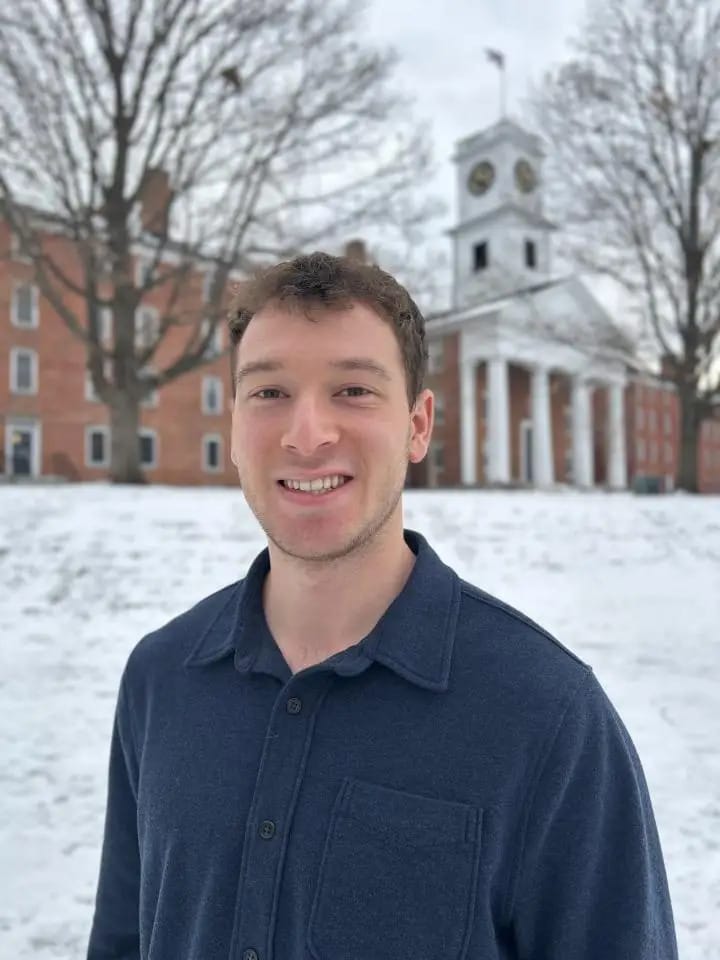
Ben Davis’s genuine curiosity and love of life elevates his sparkling natural ability and tenacious work ethic, propelling him into the rarefied Keasbey Scholar and All-American ranks while rendering him the ideal person to share a story with.
A handful of students recline on the furniture in Pemberton Lounge. In their hands lie open novellas, short stories, or poems, perhaps. The excitement of organic intellectual curiosity fizzes through the sitting room as a question about the session’s reading lingers in the air, unanswered, as of yet. It’s a Friday night, and the track book club is hitting its stride.
The scene is comically Amherst in nature: It’s a collection of varsity athletes reserving a weekend evening to discuss a literary work and the impact it’s having on them — the freezeframe could well belong to one of the college’s many promotional brochures. Those in the room appreciate the archetypal humor of the moment, aware they are partaking in a borderline satirically Amherst College experience.
“We joke that this is what professors wish their students were doing,” said Ben Davis ’26 — a Keasbey Scholar, co-captain of the track team, Amherst College Emergency Medical Services (ACEMS) responder, and a researcher in Professor of Chemistry Sheila Jaswal’s lab, etc. — who has organized these informal book club gatherings since last fall. Davis may kid — he does so easily when he so chooses — but the book club clearly genuinely excites and matters to him.
When discussing the club in our interview, he spoke easily, reminisced fondly, and landed repeatedly on just how much fun it has been for him. That fondness goes hand in hand with a staunch commitment to the group — he admitted, if a little coyly, to having been the sole participant who read the entirety of the lengthy books the club used to assign, precipitating a shift to shorter forms of writing.
Davis invests his time and energy into the book club, one of his “a little more unserious” commitments, as he will smilingly own up to. He handles the logistics behind group gatherings, rallies teammates to join the club, and shows up as prepared as anyone, delighted to engage in a fun, and hopefully meaningful, discussion.
That recipe — practical leadership, flowing intellect, and investment imbued with a genuine interest — creates a book club environment that people want to be a part of and have a fun time in, evinced by the jokes they tell.
Textbook Davis.
The Epitome of Consistency
I interviewed Davis in late April, days before the outdoor track NESCAC conference meet. It was a moment of reflection, with a defining aspect of his college experience approaching its close.
“It’s bittersweet,” he said.
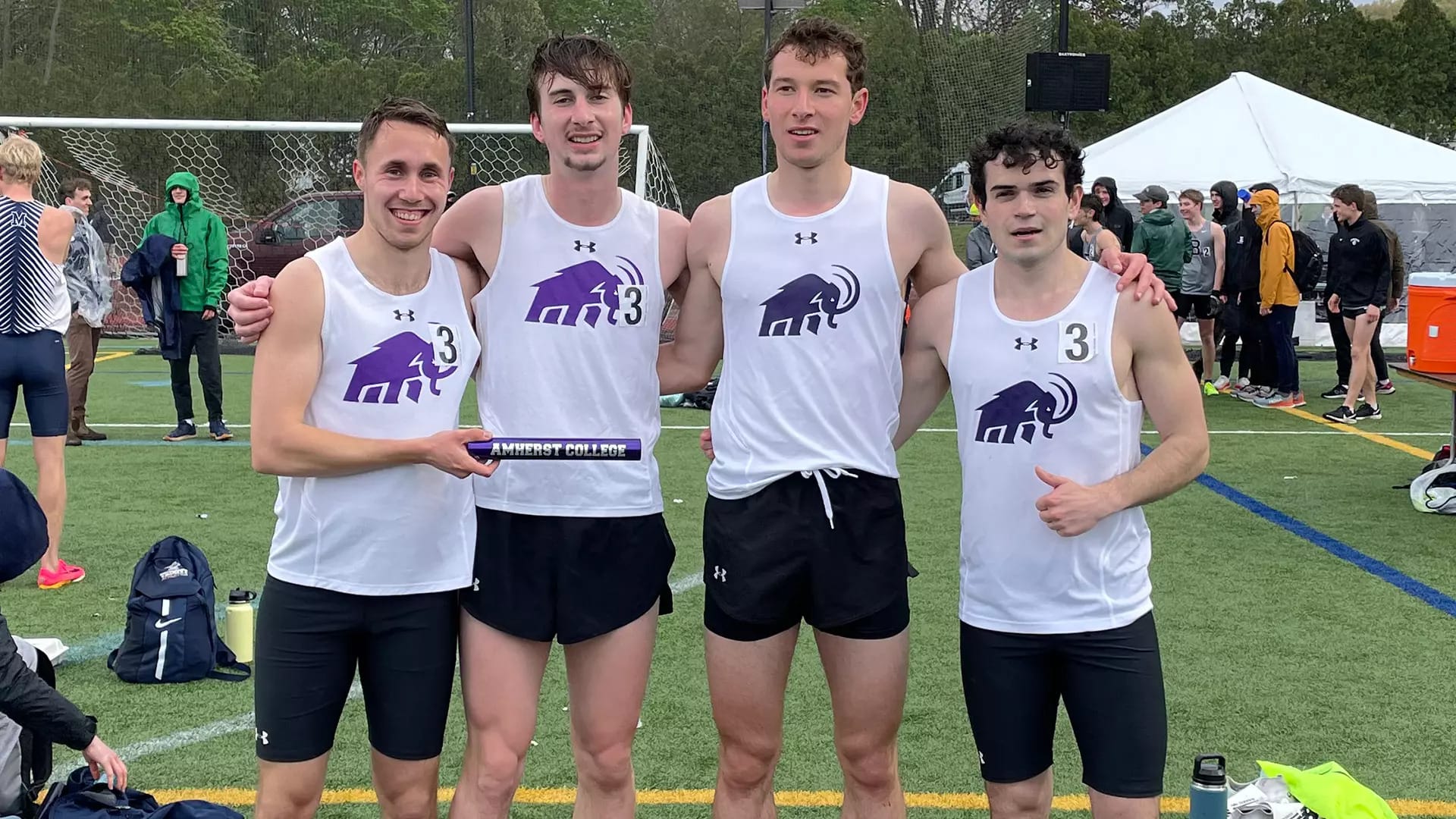
He began running in seventh grade, competing for the close-knit K-12 school he attended while growing up in New York City. Early in our interview, he enthusiastically recalled racing through Franklin Field at the University of Pennsylvania during the Penn Relays, a meet which featured teams from across the globe (for those wondering, the Jamaican fan section was the rowdiest). He was a stand-out runner, and loved the team aspect of the sport — tellingly, the memories which stood out to him most from his high school days all involved relay races, the only team events in track.
At Amherst, his speed has continued to be a weapon. He is a two-time All-American, having placed fifth and fourth in the 800-meter and distance medley relay respectively at Division III Nationals last year. This season, he’s been a vital component of the first ever Amherst men’s track team to win both indoor track regionals as well as outdoor track NESCACs, two milestone achievements.
“He’s a once-in-a-decade kind of athlete,” Assistant Coach Hannah Chappell-Dick said. And, as much as her comment addresses Davis’s on-the-track ability, it maybe more so reflects his person off the field. Davis assumed track’s co-captainship this year, but Chappel-Dick said it’s been clear for a long time that he was fit for a leadership role.
“Ben has always been someone who commands significant respect from his peers … he’s someone [they] look to,” she said. He approaches his work the right way, his friend and teammate Aidan Gemme ’26 commented, adding, “whether it’s on the bus or in the locker room or in practice … if you don’t really know what to do, you can just look over at Ben.”
Davis is an exceptional role model for the team, someone who has run 1:52 in the 800 with regularity for four years (that’s rarefied air — for context, he took fifth at nationals with a time of 1:52.23). Unlike some others, he hasn’t had a, as he puts it, “big breakthrough” in which he burst onto the scene. Rather, he consistently performed at a remarkably high level by “putting himself in it all four years,” going about the work the right way — something he’s proud of.
Crucially, Davis approaches running as a respite, as something to be enjoyed. “For me, [running] feels like a nice reset,” he said, “where I can go to [Valentine Dining Hall] and go back to the lab and feel very refreshed.”
That relaxed approach to running frees up his underlying natural athleticism and work ethic, much in the same way his earnest interest amplifies his intellect and dedication in the lab.
An Unforgiving Passion
Talking with Davis right before outdoor NESCACS, I also managed to catch him mere days after he had submitted his neuroscience thesis. Running and science are commitments 1a and 1b for Davis and, like his relationship with running, his affinity for science dates back to high school.
Davis recounted taking “all the science classes in high school.” He was captain of the Science Olympiad team, devoted himself to the Biology Olympiad as well, and, when prompted on how he spent his free time then, ventured that he and his friends did a lot of biology studying on their own.
It’s a passion.
In college, Davis has been in a neuroscience lab almost continually since his freshman year: first through the Albert Einstein College of Medicine his freshman summer, then at Weill Cornell Medicine during his sophomore summer, and with the Jaswal Lab for the past six semesters and junior summer.
At each step, Davis has dealt with neurodegenerative disease.
“I’d say it initially started with my great aunt,” Davis said of his area of concentration.
Davis’s great aunt passed away from multiple system atrophy (MSA), a neurodegenerative disease clinically similar to amyotrophic lateral sclerosis (ALS). He described that moment as formative in directing his focus early on. This interest only intensified when he later arrived at Amherst.
“I was interested in why there’s no effective cure or therapy for this whole class of diseases,” Davis said, recalling his thinking in an introductory neuroscience course at Amherst. “Parkinson’s, Alzheimer’s, ALS, a bunch of other ones, why are these all so tricky?”
It was that curiosity which drove him to the Jaswal Lab. Jaswal, who eventually became Davis’s thesis advisor, remembered taking a waiver on Davis, letting him sit in on lab meetings thanks to the petitioning of one of his friends. Davis took that opportunity and ran with it.
“He was just so positive, determined, cheerful, curious,” Jaswal said. “My research manager was meeting with him weekly … and she was like, ‘oh, this guy, you’ve got to really make sure that you keep him, he’s so good.’”
Davis grew his small initial role, teaching himself R, learning the lab’s homegrown protein folding algorithm, and starting the work which would become the center focus of his thesis: analyzing the folding patterns of different isoforms of Apolipoprotein E, which has been associated with Alzheimer’s, with people possessing the E4 genetic variant having a higher risk of developing the disease.
It’s an unforgiving focus. Past the dizzying complexity of neuroscience itself, the very attributes which initially intrigued Davis about neurodegenerative disease can bedevil his research. There are many questions, few answers, and ever-changing core assumptions.
But Davis’s research has already furthered the cause, providing clarity in areas of previous uncertainty. Now, he’s off to Cambridge University as a Keasbey Scholar and then the Icahn School of Medicine at Mount Sinai to continue research in the field. He is Amherst’s first Keasbey Scholar since 2011, an honor that will allow Davis to continue doing what he has already done: Wielding his talent, dedication, and curiosity to keep placing pieces in the puzzle of solving neurodegenerative disease.
A Person First
Now it’s Sunday afternoon, and, on the Amherst track, a couple dozen kids are running around. They’re playing sharks and minnows or being taught the bare bones of proper running form, but really, it’s just raw energy expenditure. Nothing but a fun time.
Davis and a handful of track teammates launched a Run Your City chapter at Amherst last fall, putting on free, hour-long sessions for children to run around and participate in camp-like activities during. It’s a selfless commitment, one which is focused on culture building for the track team and community service in Amherst at large and one which has “been a lot of fun” for Davis.
He keeps an eye towards the future with Run Your City, hoping to leave behind an infrastructure which can be solidified and built upon after he leaves. It’s the same with his research, where he optimistically discussed the possibility of another student picking up his work where he’s left it off, and the same with his track co-captaincy, where he hopes the friendly team dynamic continues to congeal after he’s gone.
With Davis, it is easy to get lost in his concrete achievements, scholarships, awards, titles, etc. — he makes that very easy with the laundry list of accomplishments he has compiled. But doing so overlooks Davis’s substance: the curious, fun-loving attitude he brings to his endeavors which underpins his successes.
His all-time track results page does not include that he plays bass for the team band. His polished thesis does not include the fact that he also serves the medical community as an ACEMS responder on campus and as an EMT in Central Park over the summers. Nothing on his resume can reflect the fact that he is “the best person to share something new with,” as Gemme puts it.
Davis has been a leading figure in the running and science communities at Amherst during his time here. What he accomplished in the lab and on the track cannot be overlooked. But his impact as a person has been the greatest.
At one point in my conversation with her, Jaswal choked up while speaking about Davis. She had recently experienced a moment of difficulty, and Davis had risen to the occasion beautifully, offering his support in a moment of need.
“He’s not just a good student,” she said. “He’s a good friend.”
Comments ()