

Ben Williams: Curiosity Without Borders
Known by those close to him for his ability to maintain a positive attitude in the face of any challenge, Ben Williams is not afraid of embarking on adventures around the world. After Amherst, he is set to foster cross-cultural understanding between China and the rest of the globe.
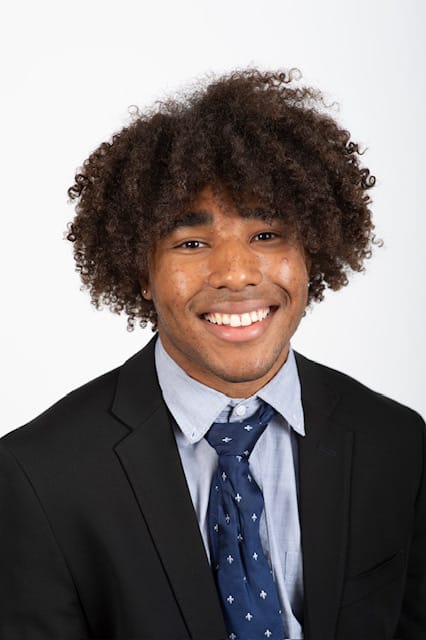
With curious eyes, Ben Williams ’26 asked me why he had been chosen to be interviewed for a senior profile in The Student’s commencement issue when we sat down for our interview in front of Frost Cafe. Although I initially didn’t know much about Ben — besides maybe that he was an athlete and had some type of interest in education — within a few minutes of the interview, I started asking myself why he wouldn’t have been chosen.
Playing football and basketball, running track & field, speaking Chinese, being a part of the Mellon Mays Undergraduate Fellowship (MMUF), and being selected to pursue a master’s degree in one of the most competitive programs in the world — these are just a few of the things that make Ben a person worth knowing. Those close to him value even more his inclination to ask the right, important questions and his capacity to maintain a positive attitude despite any challenges. He is not the type of student you meet every day — it’s hard to find someone who carries as much perspective, criticism, and reflection with himself, even within the brilliant Amherst College community.
When I spoke to Ben’s professors and friends, all of them told me they envision Ben creating some type of meaningful change in the world in the future. After writing this profile, I think so too.
Welcome Aboard
Growing up in Maryland and Washington, D.C., Ben came from a family that really valued education. However, although he was a strong student, active in sports, and earning high grades, he didn’t really like learning before coming to Amherst. The rigid, industrial model of education in American schools had failed to engage him.
Some of Ben’s early formative experiences actually occurred outside of the classroom, with a passport and a suitcase in his hands. In Ben’s household, traveling was more than just vacations and fun — it was also a means of education. Between the ages of seven and 17, his mom was very serious about showing him the world, believing that getting to know other places was a powerful way to expand one’s horizons.
“Growing up, she didn’t have a lot of money, but she was very intense about traveling as a medium of education,” Ben said. “I think closed-mindedness and being in a bubble are big weaknesses she didn’t want me to have. She wanted me to be very holistic with my understanding of the world.”
Ben’s mom achieved her goals: Through this early exposure to different realities, Ben became interested in understanding social inequalities, humanitarian issues, and broader world dynamics.
Emmanuel Odim ’26, who has known Ben since his freshman year, described that this deep sense of care for people is exactly what he believes to be Ben’s “superpower.” They were roommates during their sophomore year, and discussing international events was often the topic of their late-night conversations, which Odim felt really “eye-opening.”
From being a fun friend to go out and watch sports with, to being there for Odim even when he got sick, Ben cares not only about the big issues but also about those people close to him. Odim joked that, even when they were forced together in double in Cohan Hall, he wouldn’t ask for anyone else to be his roommate under those conditions — anyone who’s lived in Cohan knows that speaks to the strength of their friendship.
Landing in the Purple Land
At Amherst, Ben was able to find the kind of intellectual environment that really matched his curiosity. He decided to pursue a double major in political science and Asian languages and civilizations, as well as the International Relations Certificate.
During his time at Amherst, Ben also made sure to take advantage of the Five College Consortium. This allowed him to leave the emblematic “Amherst bubble” and explore what a larger campus had to offer — different food, friends, and classes at the University of Massachusetts Amherst (UMass). His involvement with UMass didn’t stop at the academic level, however — as a politically engaged person, he was very participative in the pro-Palestinian activism on the university’s campus.
Given his political activism, interest in geopolitics, and his curiosity about social inequality and humanitarian issues, the political science major and the international relations certificate felt like very natural choices. The Asian languages and civilizations major, however, which has a language requirement, wasn’t on Ben’s radar before he came to Amherst.
Ben started taking Chinese as a teenager, when he lived in an area with a large Chinese population, which led him to take three years of classes in middle school and one year in high school. The decision to continue studying the language on campus, however, only came after a playful interaction with a friend.
“I was competing with my friend to see whose Chinese was better. So I was like, I’ll just enroll in the class and show you that I’m better at speaking.” Ben said.
After that, he didn’t leave the Chinese department anymore. He also wasn’t wrong to claim he had a pretty good level of Chinese: I had the chance to speak with Ben’s Chinese instructor, who taught him for three semesters, and attested to his incredible commitment and achievements.
His instructor said they were always impressed with Ben’s perseverance and commitment to studying not only the language but also Chinese culture, society, and politics. They described Ben as a very honest, responsible, and thoughtful young person who takes his studies very seriously.
His instructor admitted that, when Ben took a break from his Chinese classes at Amherst (spoiler: he went abroad somewhere), he expected Ben to be a little bit behind with his writing skills when he came back to campus to take “Third-Year Chinese II,” one of the most intense and challenging classes in the department. To the professor’s surprise, however, Ben didn’t stay behind at all: He continued taking the class very seriously and working hard to catch up. Indeed, they said that during the three semesters they taught him, they continued to see steady progress in Ben’s Chinese, even in his last semester of senior year.
Ladies and Gentlemen, Welcome to China
As previously mentioned, Ben decided to immerse himself in Chinese culture after multiple semesters of Chinese classes at Amherst, boarding a plane for a semester abroad in Shanghai, China. There, he taught English to migrant children, joined an adult basketball league, played Chinese chess in public parks, and even traveled independently to Tokyo and Seoul during breaks.
Although he took classes with other American students in his cohort, he was quickly able to branch out and meet people from different parts of the world. He got particularly close with the community of international African students studying in China by going to their events, interacting with them in their student group chats, playing sports, and getting haircuts together. “You know, Black people can build communities like that,” he said.
Having experienced strong racial discrimination in America for his identity, Ben reflected on his experience as a Black man in China. Pairing that with his interactions with the community of African students in China, he decided to learn more about Sino-African relations and the experiences of African students in China.
“When I went to China [to] study abroad, I met so many African people. I was like, ‘wow, this is worth studying about.’ Also, I’m Black as well, but I’m African-American, so it’s a bit different. My experience is different, and my positionality globally is so much more different,” he said.
Is It Not a Joy to Have Friends Coming from Afar?
Influenced by his experience studying abroad, Ben wrote his honors thesis on Sino-African relations, titled “‘Is it not a joy to have friends coming from afar?’ Reflections on Geopolitics, Racial Construction, and the Experiences of African University Students in China.” His thesis culminated in a 120-page intellectual work, in which he explored “the process of racial formation in China by examining the experiences of African students from the 1960s to the present,” as well as broader geopolitics between China and the African continent.
While writing his thesis, Ben received funding from the Asian languages and civilizations department to fly back to Shanghai, this time with the goal of conducting interviews with African international students to better assess their experiences studying in the country. Ben emphasized that building a support community in China during his study abroad was essential to this process. He conducted 14 interviews for his thesis, which wouldn’t have been possible without the friends he had initially made, “who introduced [him] to other people who were willing to do the interviews.”
Associate Professor of Political Science Kerry Ratigan, Ben’s thesis advisor, shared that he was extremely self-directed, passionate, and thorough in his approach to his thesis research. She was always impressed with the copious notes he took and the “many, many tabs and documents open on his computer.” Even when she had to give him challenging feedback, he “always had an exceptionally positive attitude and persevered.”
On the topic of Ben’s thesis, Ratigan shared that “he tackles an emerging topic in political science and China studies: racialization processes in China and the experiences of African students.” On his results, “[Ben] finds that African students’ experiences are far more positive than the conventional wisdom suggests, and racial narratives in China may be more malleable than previously assumed.”
The Road Towards Teaching
Ben is interested in using his honors thesis and study abroad experience to possibly enter academia someday. He taught English to migrant children in China through an internship with a program called Stepping Stones, which only solidified his conviction that he wanted to go into educational spaces.
At Amherst, Ben is also a Mellon fellow through MMUF, a program committed to “broadening the range of scholarly perspectives in the U.S. academy” and tailored to undergraduates who want to pursue graduate programs in the humanities and humanistic social sciences after college. Before switching to Chinese studies, Ben initially focused on prison abolition and mass incarceration in the U.S. for his MMUF research. Beyond MMUF, Ben is also a part of the Education Professions Fellowship on campus, an initiative of the Loeb Center that aims to develop the skills of students who desire to pursue careers in education.
Assistant Professor of Black Studies and Political Science Jared Loggins shared with me how he played a role in supporting Ben through his exploration of education as a career. He found out that Ben wanted to be a professor at a group dinner that they had together with other students at the end of the spring 2023 semester.
“I candidly told him what I thought about this and gave him recommendations on how he might organize his time at Amherst to make it happen,” Loggins said. “From that moment forward, I have seen him develop his calling.”
A Thousand Miles of Discipline
Ben shared that his involvement in Amherst’s sports teams was essential for his discipline and mental resilience. Athletics have always been important to him; in middle school and high school, he played football and basketball. College recruitment, however, required his own initiative: Ben reached out to coaches on his own.
“I had to just email coaches from every school I was interested in and send them tape and all that stuff — in contrast to some of the private school kids at Amherst, the athletes, whose coaches always have a connection system,” he said.
Ben was eventually accepted to Amherst through the conventional application process, and he joined the football team as soon as he arrived as a freshman. Although he enjoyed football, Ben eventually decided to switch to track & field after his freshman fall, where he found a better balance between schoolwork and a more diverse community.
“Football wasn’t as diverse, surprisingly,” Ben said. “So I was excited for a more diverse team, and [to have] more freedom to be social and just have more time for myself. Track [& field] is more liberal with the time you have.”
Ben explained that “it’s just good to have some discipline in your life [in the form of athletics]. And the structure, the discipline, the mental battle.” He explained that running track “is like going up against yourself.”
Beyond developing his discipline, running track has helped Ben overcome his anxiety before races. “It’s good to be uncomfortable sometimes and [to] get used to that feeling. [Track has helped me] stay disciplined and battle that anxiety.”
Given how far Ben is going on his journey and all his accomplishments, I don’t doubt that discipline and resilience have extended well beyond his athletic life. He was never afraid to work hard and take initiative, even going so far as to work as a DoorDash driver during breaks to make extra money.
“The most impressive thing [about Ben] is how even-keeled he is. [...] He never loses his cool and always wears a big smile. It is quite impressive,” Associate Professor of Political Science Eleonora Mattiacci shared.
Make Sure You Have Your Passport
After a stellar academic journey at Amherst, Ben has some pretty exciting plans ahead of him: After college, he’ll head off to Yenching Academy at Peking University in Beijing, known for having one of the most prestigious and selective academic programs in the world. The academy hosts the Yenching Scholarship, a fully funded global scholarship program designed “to cultivate leaders who will advocate for global progress and cultural understanding.” The two-year-long program will be divided into one year of coursework and one year focused on developing a thesis, in which Ben plans to research labor management in Chinese corporations in East Africa. The Yenching Scholarship is often compared to Tsinghua University’s Schwarzman Scholar’s program because both are modeled after Oxford University’s Rhodes Scholarship.
Given the current political climate in the U.S., Ben said he is excited to take a break from the country and doesn’t see himself returning in the foreseeable future. As a Black man, he is also “looking forward to not receiving that sort of systemic and social discrimination or discriminatory treatment that [he does] in the U.S. in China.”
Mattiacci shared her hopes for Ben as he prepares to move to a different side of the world.
“I am so excited for Ben ... My hope is that he continues to follow his curiosity and to ask the big, important questions about China, East Asia, and global affairs,” she said. “I have no doubt he will contribute thoughtfully to our understanding of these regions and build bridges across cultures.”
Ratigan echoed this sentiment. “Ben stands out in his dedication to fostering cross-cultural understanding between China and the U.S. Regardless of the career path that he chooses, Ben will certainly help move China-U.S. relations towards greater peace and understanding,” she said.
Looking back on his journey, Ben is proud of sticking to the things he believed in during his time at Amherst. “I have become a person who can be more proud of myself now than I was then, you know?”
Comments ()