

Cheryl Harris Discusses Interdisciplinarity and Law
On Wednesday, following a global security incident that exposed PHP, a programming language used on the college’s websites, the college revoked access to its internal tools. IT’s initial assessment shows their procedures worked reasonably well in the face of the attack of global extent.
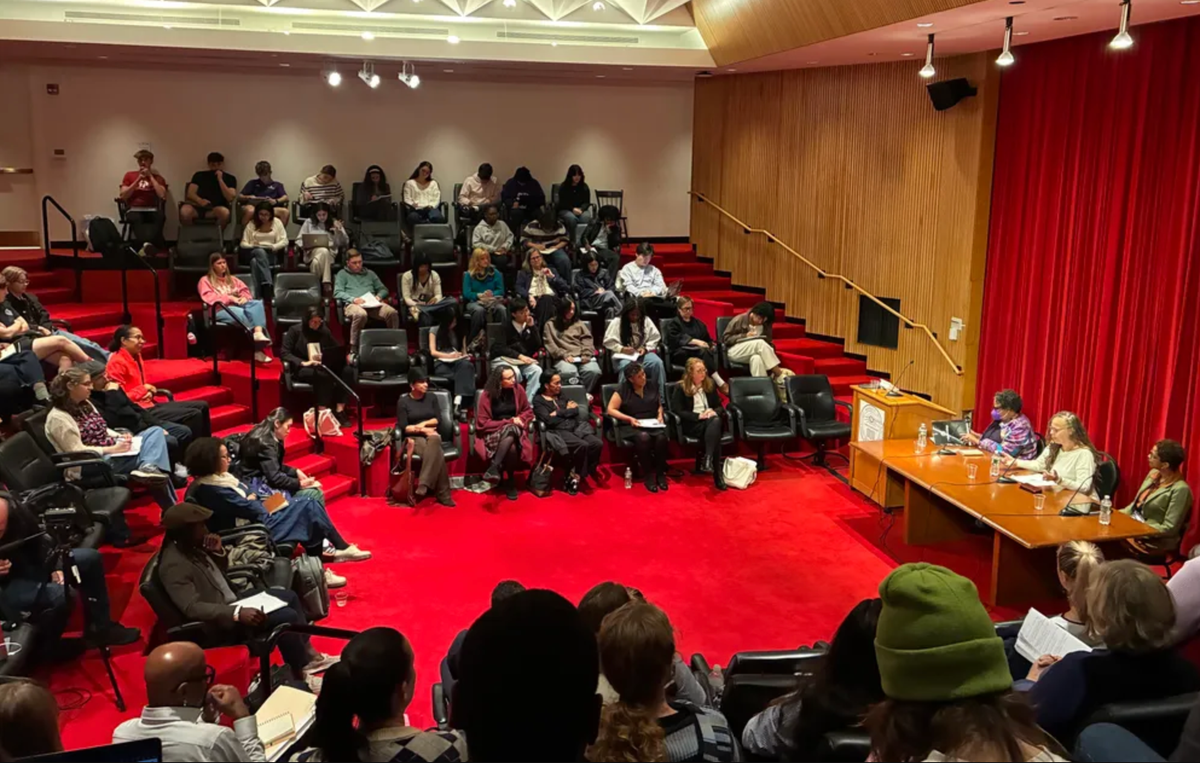
On Tuesday, Oct. 20, the Harris Seminar and Dialogues: Whiteness as Property, held a panel discussion between Cheryl Harris, University of California Berkeley School of Law’s Rosalinde and Arthur Gilbert professor in civil rights and civil liberties, and Kim Hall, Barnard College’s Lucyle Hook professor of English and Africana studies. The discussion was moderated by Nicole Aljoe, Northeastern University’s Professor of English and Africana studies. The event was sponsored by the English department and took place in the Cole Assembly Room.
Associate Professor of English Amelia Worsley introduced the talk, explaining how the event “goes beyond the occasion of this conference,” as an international collective of community organizers, museum professionals, and scholars of pre-1900 cultural studies have met together online over the past two years to discuss Harris’s “immensely influential” Harvard Law Review essay from 1993, “Whiteness as Property.”
Following Worsley’s introduction, Patricia Matthew, associate professor of English at Montclair State University and developer of the Race and Regency Lab, introduced the members of the panel. Matthew developed the Lab, which is a coalition that brings together scholars and the public to understand how race is conceptualized in the nineteenth century until now,to “provide a space where people could come together and talk to one another, free from some of the burdens that can weigh down intellectual conversations.”
Hall began the panel discussion by discussing how it was appropriate to hold the event at the college, as she acknowledged that Amherst alumnus Peter Erickson ’67 was inspired byPresident Kennedy’s visit to the college in 1963 to become a “college civil rights activists working in voter registration efforts in Raleigh, [N.C.], and assisting with the census in Greenville, [Miss.]”
Hall first provided context on scholars who set the foundation for her work, and how these individuals come from “planet Premodern Critical Race Studies (PCRS).” Hall explained that PCRS and “planet Critical Race Studies (CRT) orbit each other” through their “common genealogy,” such that both are “in dialogue with Black feminist historians, theorists, and activists outside of our disciplines.”
Hall then pivoted to explaining the complexity of work that critical race theorists undergo, such that the citation style is similar to the hairstyle called the “braided helix.” Scholars therefore are “weaving Angela Davis, Deborah Gray White, Patricia Collins, Arju Lord, with [their] own grandmothers, aunts, and mothers, and with classical texts” to find “where we are all intersecting.”
Harris began her portion of the conversation by saying that she agreed to come to the college for the event because she is an “interdisciplinary interloper,” and that “critical race theory itself comes out of the commitment to interdisciplinarity.” She emphasized that law is not “a self-contained system that only deals with things like legal materials, when in fact it’s far more.” Harris also acknowledged that this event is occurring at a “particular moment where the law is itself facing a particular crisis.”
The crisis that Harris considers is that “in this period now, the law more broadly is invoked in service of lawlessness,” such that the “law has been fully enlisted in the project of being weaponized against the people subordinated by racism.” Harris asserts that the U.S.Department of Justice is “both invoking law to undermine the project of anti-racism and actively disobeying it.”
In line with her love for interdisciplinary thought, Harris states that “narrative is actually an intrinsic part of law, although it is often denied to be such.” Harris offers that the narrative quality of the law is showcased by the reading of it, because “if you read any case, it begins with a narrative. It begins with an account. It begins with a story. It tells you who the characters are, what the actions are, what the conflict is, and what the resolution is.”
Harris acknowledges that some forms of studying the law “ignores the way in which the law itself depends upon and is always constructing narratives of facts, of ideas, and of histories. Ultimately, she asserts that “we cannot stay within the form and find the answer,” and suggests that “ narrative is part of one of many multiple entry points into exposing how law is operating to entrench racial capitalism and the protection of whiteness as property.”
To help the audience consider her assertions, Harris read out a portion of a poem and narrative that she wrote. In the poem she asks: “What is the function of whiteness in a period of crisis?” The answer she offers is: “The disintegration of order, the integration of disorder.”
In her narrative “A Recent Short History of the Present,” Harris considers a trip she took in 2014 to visit family in Huntsville, Ala., where she encountered billboards that contained rhetoric against diversity and anti-racism, such as “anti-racist is a code word for anti-white.” When considering the origins of these signs, she found that many of the signs had been funded by the White Genocide Project, an organization identified as a hate group by the Southern Poverty Law Center. Harris connected the billboards hanging from the highway to the “ideological underpinning of national policy into legal doctrine,” ultimately “exposing the role of the law in constructing and continually reimagining whiteness as a feature of capitalist accumulation.” To a more just future, Harris argues the need of “interdisciplinarity as a mode and a method to break the false bounds of law.”
Following the talk, there was a Q&A session where Harris and Hall considered how utilizing one’s own narratives to understand the law can be discounted as a “story,” rather than the “law,” stating that their experiences have, in fact, “became clues to [them] about how certain things in law are structured.”
Harris and Hall further emphasized the importance of maintaining a “certain degree of humility,” when ingraining personal narratives into scholarly work. They suggest that others may have not utilized the same “humility,” as there are groups such as “tech bros” who want to become experts on culture by attempting to access archives, such as attempting to buy into the Folger Shakespeare Library. The panelists shared that this example foreshadows a broader political goal of controlling cultural institutions, such as President Donald Trump’s attempt to close the Kennedy Center, as a key component to their “legitimacy comes from claiming the past.”
Fiona White, a student at Mount Holyoke College, thought the talk was “eye-opening,” as all members of the panel “[spoke] with such passion, eloquence, and confidence,” about their areas of expertise.


Comments ()