

Color Theory, T-Pain, and the Long Game
As part of the Fall 2026 Visiting Writers Series, poets Noel Quiñones and Julian Randall spoke about their respective careers and philosophies regarding writing. Staff Writer Daniel Shen ’30 offers his takeaways from the event.
“Color theory is so gay!” Noel Quiñones exclaimed behind the Center for Humanistic Inquiry podium.
“Y’all like T-Pain?” Julian (pronounced hoo-lee-Ahn) Randall asked the crowd roughly 15 minutes later behind the same podium.
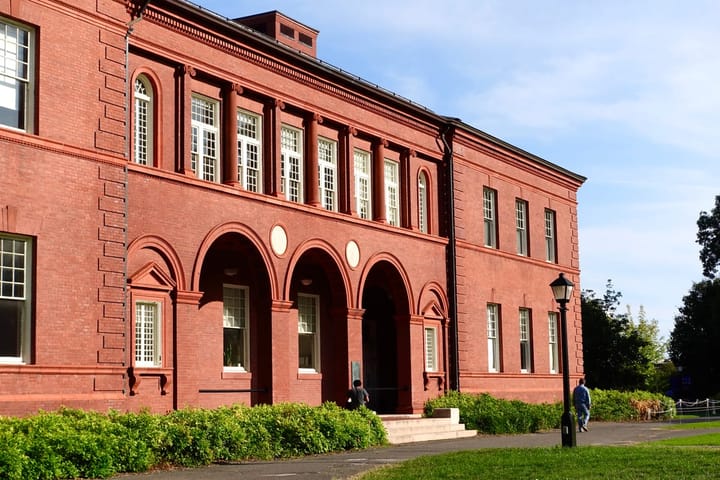
The two writers’ voices carried across the large glass room on the first floor of the Aliki Perroti and Seth Frank Lyceum, lingering in my mind long after their reading and discussion on the evening of Oct. 27. Their event was part of the Creative Writing Center’s Fall 2026 Visiting Writers Series, which hosts emerging and accomplished writers to read excerpts from their works, followed by open-ended discussions about their creative journeys.
Here’s what I took away from the event: Writing is an action fed by living. I hope that this article will prompt some readers to attend the last two events of the series, which will feature distinguished poets Kimiko Hahn in Frost Library’s Friendly Reading Room on Thursday at 7 p.m., and Mandy Moe Pwint Tu in the Lyceum next Monday, also at 7 p.m.
Lecturer in English Dennis James Sweeney’s “Community, Context, and Creative Writing” first introduced me to Randall, whose work was assigned as inspiration for the creative nonfiction, fiction, and poetry units. Quiñones’ acclaimed collection of poetry, “Orange,” released this May, was also recently featured in our poetry unit. Sweeney hadn’t read any of these authors beforehand and included them because they would be visiting on the invitation by Abraham. They are both known for their inventiveness in form and for their numerous interpolations. Quiñones’s footnote poem, “Monday Night Mass with Complete Citations,” for instance, was directly inspired by Randall’s poem “Pregame Prayer with Complete Citations.” Sweeney describes the two authors as having a maximalist writing style, which they believe is expansive and generative for a class encountering poetry for the first time. “Bursting at the seams … overflowing its bounds,” Sweeney said.
Randall, Quiñones, and Abraham all studied at Swarthmore College in the early 2010s. Later, Randall and Quiñones reunited at the University of Mississippi for their MFA studies, where their shared experiences sparked an enduring friendship and further literary collaboration.
Abraham introduced Quiñones and their book “Orange” first, commenting on their inventiveness, on tying social practice to poetry and the inheritance of forms, and on themes such as family conflict, Latinx identity, and sexuality.
Quiñones read with articulation and gusto. They enunciated every word strongly, projecting their voice — with a more nasal sound than in regular conversation — and opening their mouth wide. They would introduce each of their poems with context, sometimes transitioning from one poem to the next, making poetry that’s often accused of being obscure incredibly accessible to readers.
Introducing “The Bronx River Forest,” Quiñones described their upbringing in the North Bronx, a region rich in nature that runs counter to common perceptions of New York City and the Bronx as a concrete jungle.
”Orange” took Quiñones five years to write, and they said their editors were indispensable in the process. One of them pointed out that their book was about hiding, which they hadn’t realized, but it enlightened their perception of their own poetry. With her comments, they realized that forms are a way of hiding, not showing, to “dance the delicate line between truth and the poetic truth we always yap too long as poets.”
Quiñones sparked laughter when they said that in college they realized writing poems about people they knew and then performing them publicly was a mistake. In their case, it was their dad. For “Orange,” their entire writing process was collaborative with their parents, ensuring that the poems honor the complexities of their relationships.
The titular poem “Orange” deals with Quiñones’ parents’ 10-year divorce after their father came out as a gay man. It is a nuanced poem, as friendship and romantic relationships are often complex. This is where they introduced color theory as “so gay,” elaborating on the ongoing debate about whether color is real, its histories of assigned meaning, and their view that colors, in fact, change as we change. Orange, they said, was the last major color named in any civilization, often associated with slippages since it’s so close to other colors.
They read their last few poems from an even more interactive version of seven selected poems, a 3D booklet made by their friend, a paper engineer. Afterward, Abraham yelled with applause, and Randall dapped Quiñones up with a side hug as they exited from under the lights.
Randall was also easygoing, despite a tough student crowd that laughed only sparsely at their jokes. They read excerpts of different lyrical essays from their nonfiction debut and widely celebrated collection, “The Dead Don’t Need Reminding: In Search of Fugitives, Mississippi, and Black TV Nerd Shit.”
Randall’s voice, similar to Quiñones’s, projected farther and higher after they began reading. They read with a similar energy that seemed to pick up as they went, their reading pace increasing as the timer they had set to track their reading ticked down. When they read a section of “Return of the Electric Sad Boy,” in which T-Pain is used as a recurring motif to explore Black masculinity and mental health, they sang, “I like the bartender,” breaking into the prose.
Randall similarly prefaced their poems with preambles, discussing their grandmother’s passing and their hunt for legacy, as well as their light-skinned uncle who had passed as white for decades but was then driven out of a racist town. In the next excerpt, their voice grew especially loud when reading a passage in which a prejudiced white woman stutters through racist remarks.
Unlike Quiñones, Randall looked up less when reading, a limitation of reading dense prose rather than poetry. Despite that, Randall engaged the audience with their voice, its stops and inflections, paired with hand gestures that Quiñones rarely used.
Randall finished their reading with a passage from the last essay of “The Dead Don’t Need Reminding,” which Quiñones had helped to write: “I’m a boi doing an impression of a man, doing an impression of a man, doing an impression of a man, each of them, each of us, trying desperately not to get killed, by ourselves … F--- it, I tell him aloud. I want to survive; I want our ghost story back.” The crowd burst into applause.During the Q&A segment, Randall and Quiñones sat together on tall chairs by the podium. The first question asked what they would tell themselves when they were less accomplished, to which Quiñones responded, “This is such a long game.” They shared interesting stories, like when the two stretched their biographies by saying they read at different colleges, but in fact they read their poems to themselves while walking through campuses. They live by the belief that we are always getting better and accumulating lived experiences that feed our writing.
Randall approached it from a more communal perspective, which certainly put a smile on Sweeney’s face because of its direct conversation with our class. Randall believes we must stay near our people, noting that they got into writing to stay close to their friends.
After a few more questions, I asked about their creative processes. Before I arrived at Amherst, I read and heard about the creative processes of many different artists. Adam Brookes, a historical fiction author for whom I interned, shared that he maintains a rigid daily writing schedule, producing 500 words and revising the previous two days’ pages. Many other authors maintain intense schedules like this, such as Ernest Hemingway.
Randall, however, shared that they are not a scheduled writer and don’t follow a routine. They learned to craft an environment in which a poem comes naturally, as any other sentence. They build music playlists for different characters and books. Randall shared a sentiment similar to Quiñones’ regarding lived experiences; they said they don’t have to write every day but can do something every day that feeds their writing.
Quiñones agreed, saying that “it is so detrimental that we give the microphone to people who write every day.” They remarked that some of the rigid processes sounded horrendous, “cruelty as productivity.” They had spent years trying to create a schedule but instead developed an alternative process consisting of two elements. The first is a dedicated space in which they can write for days, such as retreats and residencies, and the second is someone who hovers over them as the due date approaches.
Walking out of the Lyceum, I realized that color theory and T-Pain had been delivered with equal joy, humor, and seriousness. Quiñones and Randall showed me that a writing life isn’t built only on word counts and rigid mornings, but also on staying close to the people and things that make us laugh, grieve, and sing along. By turning the little details of life into threads that animate their words, they are reminding us that the work happens everywhere we’re paying attention.
Comments ()