

Connor Farquhar: A Quest to Take Flight
Connor Farquhar is a man whose interests precede him. This is the story of how they have guided him through his college career, and how they have made him into the icon that he is today.
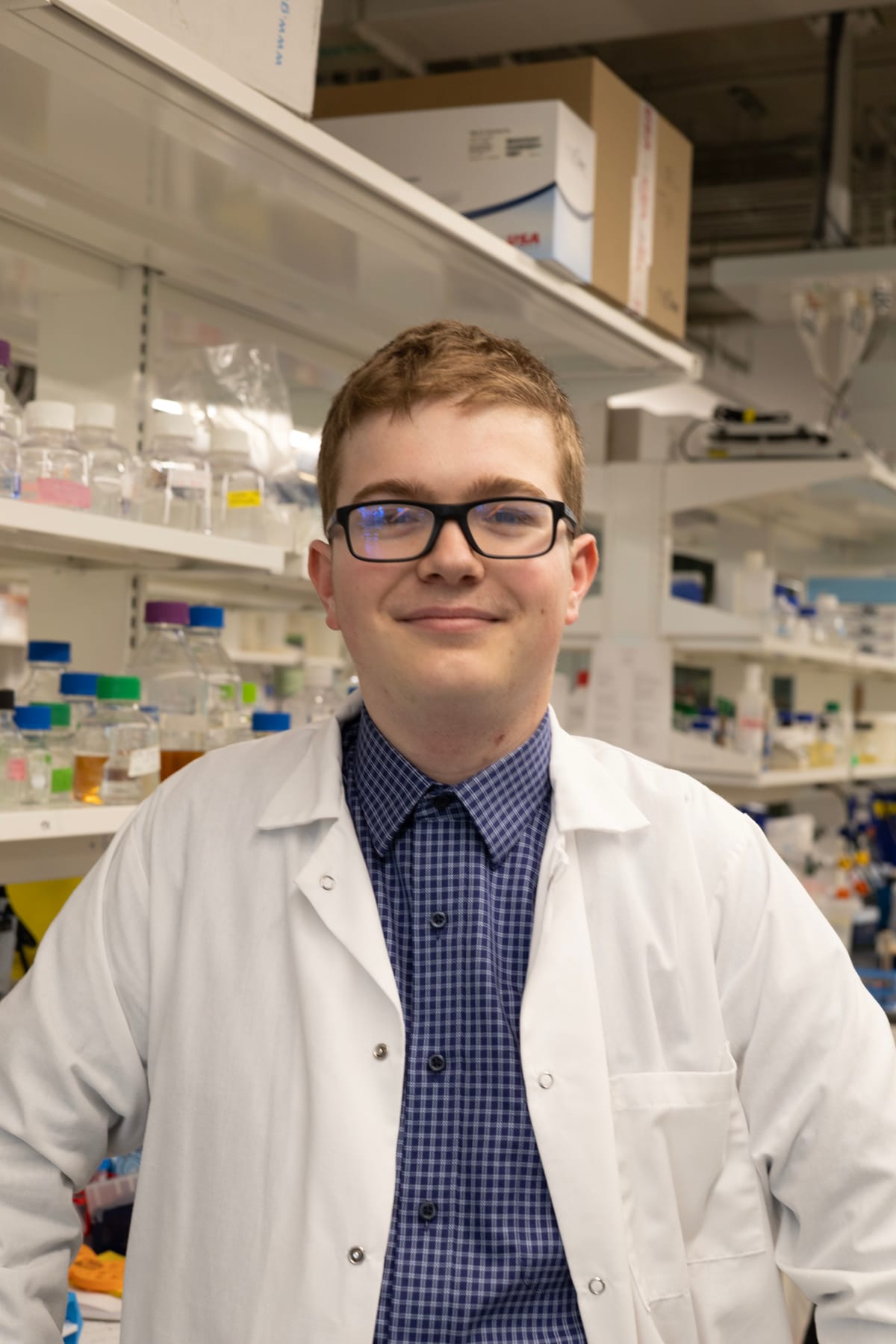
Connor Farquhar ’26 belongs in academia. He settled naturally into both Associate Professor of Biology Alix Purdy and Assistant Professor of Biology Mona Wu Orr’s labs, where he studied various avenues for gene regulation across all four years at Amherst College; easily into work at the Beneski museum, where he has been since his very first semester; effortlessly into quiz bowl (and related extracurricular pursuits); and seamlessly into hobby-ornithology.
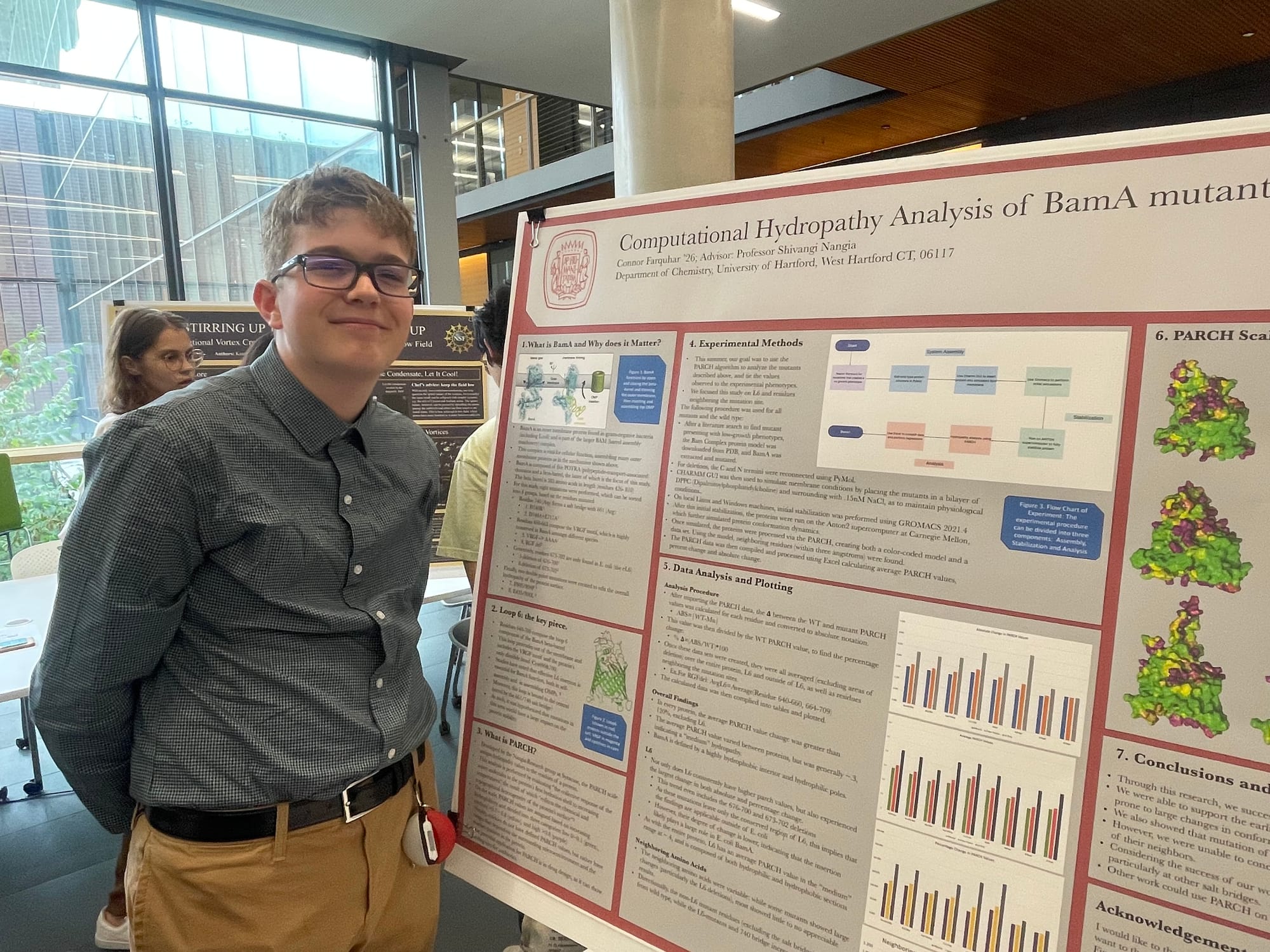
Before college, Connor’s aptitude manifested in copious “dual-enrollment classes” — so much so that by the time he graduated high school, in his own words he had enough credits to put him “three-fourths of the way through a chemistry degree” at the University of Michigan. Now, four years later and at the end of his time at Amherst College, he walked me through his freshly-completed thesis (which won the biochemistry and biophysics department’s Biochemistry and Biophysics Prize for the best department thesis) while swiveling around in the Wu Orr lab.
Connor takes on the kinds of interests that cannot be easily summarized by fascination, love, or fixation. When he talks about birds, diseases, proteins, “Magic: The Gathering,” evolution (on both macro- and microscopic scales), or even the obscurities of Yiddish cooking, there is an intense curiosity saturating every word. He’s the kind of person who ought to go on a speaking tour at some point in his life, because talking to him is like witnessing a fountain of intellectual excitement spew out endlessly in the time allowed by prescheduled meetings. It’s honestly incredible to watch.
Connor’s time at Amherst taught him how to translate his passions into communicable concepts, and shaped him into the academic juggernaut and future Ph.D. student he is today. He is a force unto himself.
Birding Around
Connor found his curiosity in birds in true researcher fashion: spending a lot of time with them. A lot.
By his own account, birds were the first thing that Connor really “got into” (note: “getting into something” for Connor also means writing an award-winning thesis, so it is a bit of an understatement). It began “when he was very, very young, after someone gave [him] bird food and a bird book.” This gift would spawn a fascination that has so far proven itself to be lifelong, which turned out to be intense enough to have led to the book’s destruction. “I carried [the book] around with me, and the binding fell off,” he said. “So it became just … string bound phases of images.” After only a few short months, Connor had memorized the entire book. Within the waxy shine of a swimming duck’s back and the careful artistry needed of a photographer to capture a young bird’s down, Connor found this drive to learn — this urge to know and to understand.
The discipline of birding, however, rarely stays confined to admiring the photographs in books. More often than not, it turns into an interest in bird-watching, and becomes more generally a mode of experiencing one’s environment. “Whenever my family and I would travel, I would just bird-watch,” he said. In the confusion of new places and the exhaustion of jet lag, Connor found peace in the familiarity of bird-watching. Whether in Spain, Tanzania, Ecuador, or back home in Connecticut, bird-watching required the same practiced patience — the same silent interpretation of nature’s cues. This hobby became a source of comfort in new places, and “a way to pass the time.” And it taught Connor the importance of listening to his surroundings and interpreting patterns.
When I asked Connor to name a favorite bird, he settled on the Hoatzin, a South American species also known as the “stinkbird.” “It also has a multi-chambered stomach, like a cow,” he said. “It’s kind of weird. When I was visiting Ecuador, I saw them in a tree. They’re very loud [and] kind of look like prehistoric chickens.”
On his other bird-watching adventures, Connor has seen thousands of kites and vultures crossing the Strait of Gibraltar, the rare yellow-billed cotingas endemic to Costa Rica, and the also prehistoric trogons — the only species with a heterodactyl arrangement.
“There’s other people who are way more into bird-watching than I am, who know all the calls and everything,” Connor said. “I think for me … it’s more of an enjoyable thing.”
The Little Guys
After birds, Connor said, he found another lifelong curiosity: epidemiology — the study of disease incidence, distribution, and control in a given population. In fourth grade, Connor read “The Hot Zone” (1994) by journalist Richard Preston, a book about the Ebola outbreak in West Virginia, and found himself once again fascinated by what he was reading. Connor focused on viruses, but really, he was fixated on “the molecular mechanisms behind disease” and their “regulatory pathways.”
Despite containing proteins and DNA, as well as being humanized like bacteria and cells are in pop culture, viruses technically are not alive. They are little more than fancy packets of genetic material that exist to and persist through hijacking a cell’s transcription and translation pathways. And, effectively unbound by the resource constraints of living systems, they spread, and evolve, and remain. Preston’s work introduced Connor to epidemiology and its central dilemmas, and by the time he entered fifth grade, he was checking out books on HIV and other viruses, diving deeper into this new world.
Though the two seem unrelated at a first glance, bird-watching and epidemiology have more things in common than one might imagine. One cannot successfully birdwatch without knowledge of a bird’s environment, tendencies, and preferences; one will also leave unfulfilled if they enter the hobby without awareness of a bird’s history, folklore, and mythology. It facilitates both ecological and anthropological insight, and teaches people that learning about the world is executed most effectively when informed by both. Epidemiology operates similarly, but on a molecular scale. DNA contains within it the story of every ancestor that came before it, and every mechanism composing it, as honed by millennia of evolution. Its existence answers what proteins were necessary, what imperfect genes or pathways were not fatal, and also leaves any scientist with a million questions. This is how Connor’s two passions inspired him to study the mechanisms underlying our messy world.
Mr. Docent
Connor brought these loves with him to Amherst College, and from there he began to evolve and branch out. His birding interest led him to the Beneski Museum of Natural History, where he met Museum Director Fred Venne. He was “just wandering around and looking for something to do,” but became curious about the museum when he realized that there were passenger pigeons, alongside other extinct birds, on display. According to Venne, “[Connor] was very quickly drawn to the birds, and immediately started sharing his thoughts about them.” The two discussed birds for quite some time that day, and from there Connor’s career at the museum began.
Connor came to the museum with extensive knowledge and with a clear desire to expand on that knowledge, but not necessarily with the ability to transmit that knowledge to the guests. In our conversation, Venne described Connor’s mind as “racing and racing,” faster than his words could keep up with. In the beginning of his work as a docent, Connor often spoke quite fast, leaving guests impressed with his brilliance but with little knowledge of the history that they had come to learn. Connor had soon realized that working at a museum required working with people of all ages, in all amounts, and with varying levels of familiarity with the subject matter. He wanted to meet people where they are so that they may have the most meaningful time during their visit.
Over these last four years, Connor has honed this adaptability and become an invaluable member of the Beneski community. In his youth, he learned how to acquire knowledge by listening to the world; in college, he learned how to relay this information to others and inspire within them their own curiosity. Now, he explains evolutionary biology to guests of all ages and across all mediums — in English or Spanish, as needed.
“The growth that I’ve seen is Connor has been able to go beyond himself and recognize the ability to look at everyone else’s world. And that’s a huge jump,” Venne said. “He can now look at somebody else, understand them, [see] where he would like to bring them, and help guide them.”
Connor himself also came to realize that the sciences are an inherently collaborative, inherently human discipline, far more than it is commonly advertised.
“I think there’s a certain way that I enjoy engaging with material, and I think I carry that through whatever I’m doing, whether that’s doing work in the museum, or research, or [in] classes I’m taking, or bird-watching,” Connor said. “How I tend to engage with things is saying, ‘I’m gonna get really invested in this.’”
Emerging Microbiologist
Connor’s thesis also required him to learn communication. The process of Connor’s thesis started in freshman year, when he met Wu Orr. He came up to her during orientation, while she was tabling for the biochemistry and biophysics department, and was so incredibly “enthused about bacteria” that it left a lasting impression on her. He later cold emailed her, asking to work in her lab. She had an opening; their academic partnership began not long after. She served as his advisor, mentor, and later, friend.
Connor worked in Wu Orr’s lab throughout his freshman year, and then in Purdy’s lab for his sophomore and junior year, before returning to the Wu Orr lab for his thesis. According to Wu Orr, Connor’s thesis looks for genes that encode proteins that were previously unknown to be important in infection, and also for new small coding regions that were previously unknown to be important for infection in a pathogen called Pseudomonas aeruginosa. In many ways, this thesis was a testament to the patience, curiosity, and systemic study that he had been cultivating ever since he received his first birding book.
To Wu Orr, Connor’s interest in the pathogen came from its metabolic diversity and adaptability. Pseudomonas aeruginosa’s varying infections across patients with different conditions appeared to be the result of extensive gene regulation, and the bacteria embodied many epigenetic questions in several novel ways begging for further study.
Wu Orr supported Connor throughout this project, even as it spanned several different labs. Connor’s thesis work required help from Purdy as well as Edward S. Harkness Professor of Biology Caroline Goutte since he was working on developing adequate models for studying bacteria, which would have been impossible without extensive cross-lab and cross-scientist communication. Connor was the common thread between all of these moving parts, and it was his job to articulate what precisely he needed in this highly specialized subsection of a highly specialized field of study. Once again, the baseline knowledge was there, but through his thesis, Connor further learned how to convey his knowledge to others and how to build it into something workable.
“I think what’s really impressive about Connor is that when he either personally identifies or somebody else points out to him an area where he can [have] more growth, he doesn’t shy away from that,” Wu Orr said. “He’s like, ‘okay, I need to do better at this,’ and then [he does] better at it.”
Wu Orr added that she is “very impressed” by Connor’s dedication. He has become a “master [teaching assistant]” in her course, “Biochemistry,” by providing helpful explanations for students across different levels of understanding. “He’s grown in leaps and bounds, being able to … gauge where that other person sits, so that he can then target his explanations to that level,” she said.
It seems like Connor’s motivation and strong intrinsic drive has gotten him pretty far. But Connor humbly credits Venne and Wu Orr for helping him grow.
“I’m very excited about things, but I think my love and engagement in the things that I’m good at wouldn’t [have] happened if it weren’t for people who shared that excitement, whether that be Fred [or] Mona,” Connor said. “All these people … support my excitement for things. And I think that’s what I’m gonna miss the most about Amherst.”
The Early Bird Gets the Worm
Connor’s interests inspire him to learn, and in college they have inspired him to grow as a person. He will continue to see the world as millions of years of evolution, as code expressed in different ways depending on the situation, and as something that is always inherently worth loving and investigating.
Connor told me how, in the days after our interview, he planned to wake up before dawn and watch the morning birds — just to sit with them as they broke the nighttime silence and as the dawn painted the dew. Though his time at Amherst is ending, Connor’s sun is still rising over the mountains, and we have yet to see the true extent of what his daylight brings.
Comments ()