

Faculty Votes to Consider Lecturers as Faculty Members
Following a faculty vote, lecturers and senior lecturers are now considered faculty members. The motion was brought forward by the Faculty Executive Committee and centered on the faculty handbook’s definition of faculty members.
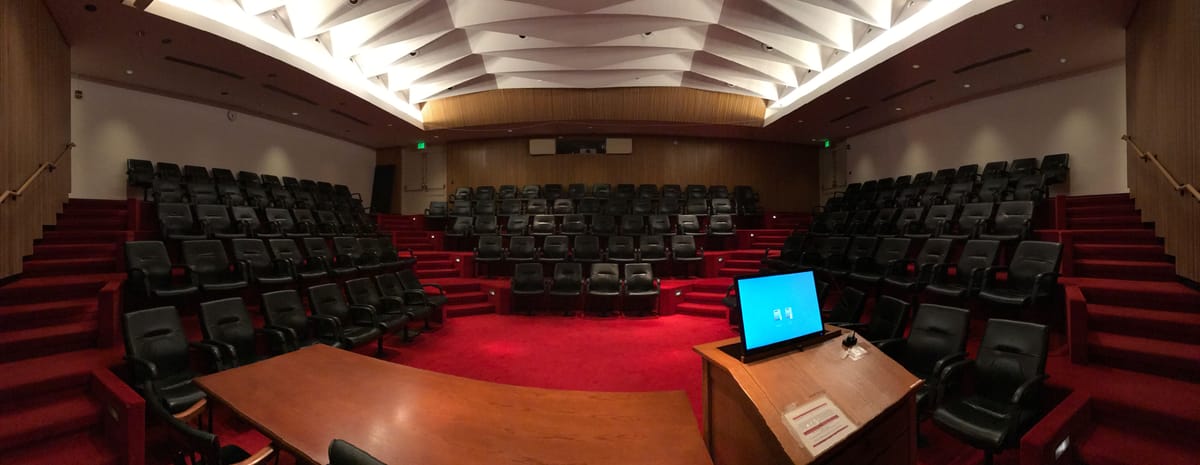
Lecturers and senior lecturers are now formally codified as faculty members following a vote during a faculty meeting on Oct. 2. The vote, 133 to 13, amended the faculty handbook to explicitly name lecturers and senior lecturers as faculty members. The faculty also voted 158 to 3 to approve a measure allowing lecturers to apply for additional sabbatical leave.
The number of lecturers, who have non-tenure track teaching roles at the college, has grown significantly since their role was initially defined in the faculty handbook in 1990. The motion to explicitly name them as faculty, brought by the Faculty Executive Committee (FEC), was motivated by a contradiction in the language used in the handbook. Professor of Asian Languages and Civilizations Timothy Van Compernolle explained that the handbook’s language in the “faculty” category — which covers “non-tenure-track individuals on renewable contracts who teach regularly in the curriculum” — already reads as the definition of a lecturer, but the title “lecturers” was listed under “other instructor personnel” instead. “So I think we are trying to grapple with what looked like a contradiction to us, where lecturers are defined in,” said Van Compernolle.
The discussion over this motion centered on the status of other instructional staff who are not lecturers. Some faculty argued that if the faculty handbook would explicitly name lecturers as faculty members, lab instructors and academic managers should similarly be recognized as well.
“I am really concerned about excluding them from our categorization of who is a member of the faculty,” Associate Professor of Astronomy Kate Follette said.
Van Compernolle, speaking for the FEC, said the committee had explicitly discussed the issue but believed it fell outside its purview because the positions are departmental. “[The FEC] asked the Dean and Provost [of Faculty Martha Umphrey] to look into it to see if there is something that should be done,” Van Compernolle said.
Umphrey said these non-lecturer positions are not intended to regularly teach, and rarely do.“The distinction that occurs in this situation is that lecturers are hired as instructors of record,” she said.
Others pushed back. Professor of Chemistry Sheila Jaswal said the conversation was missing what distinguishes a lecturer from other staff as faculty, noting that academic managers and lab instructors invest in professional development and take part in the pedagogical efforts that faculty are paid to partake in. “So maybe it’s not an instructor of record, but maybe there is another way to recognize and honor, and also give advancement possibilities or at least professional development,” she said.
Follette echoed this concern, stating that the roles of lab instructors and academic managers have teaching loads and duties very similar to lecturers. Excluding them from the faculty body “is quite a disservice, and I really would object to anything that explicitly cuts them out of the classification as faculty because they are faculty,” she said.
Peter R. Pouncey Professor of Mathematics Greg Call offered some historical context on academic managers. The positions were created as staff roles because of limits on the number of faculty lines and budgetary constraints. “I’ve always considered them to be faculty,” Call said.
The FEC and Umphrey then urged faculty to remain focused on lecturers. Umphrey said the committee’s remit was the role of lecturers, and that recognizing other staff would raise harder and more complicated questions about qualifications, hiring, and how those employees are assessed. “That isn’t to take away anything from the importance of the work, the respect that we give those folks, but it does mean that these kinds of inquiries, if we take them further and further away from the instructor of record, are going to get more and more complex,” Umphrey said. She added the committee is happy to discuss concerns about other employee categories separately.
Before the final vote, Assistant Professor of Law, Jurisprudence, and Social Thought Youssef Ben Ismail added that no one seemed to oppose the move on its merits. “To me that indicates that the matter of whether lecturers and senior lecturers are faculty members is self-evident, it certainly feels self-evident to me,” he said.
The meeting then moved to the second motion of whether lecturers and senior lecturers should have additional sabbatical leave.
Van Compernolle, speaking for the FEC, explained that under current practice, a lecturer is reappointed after three years, reappointed again after another three, and then promoted to senior lecturer, at which point they are eligible for one semester of sabbatical leave for individual advancement or pedagogical research. “We would like to codify that in the faculty handbook, and [offer] an additional sabbatical leave after an additional 12 semesters of teaching,” he said.
The motion passed with little discussion. “In my mode of true confessions, years gone by, I just want to say I’m delighted to see this come forward,” Call said.

Comments ()