

From Paper Cards to Workday: A History of Amherst’s Registrar’s Office
Though every Amherst student is familiar with the biannual registration process, few know how it has changed throughout the years. Staff Writer Julie Lui ’29 highlights the way technology has shaped the Registrar’s Office’s role in her investigation of the office’s history.
As Amherst College students scroll through Workday to plan their courses for next semester, it’s hard to imagine a time when registration meant standing in line outside Converse Hall. In the early 2000s, students arrived clutching yellow paper cards listing their desired courses, each bearing an advisor’s signature. Inside, Registrar’s Office employees waited at computer terminals, ready to enter each student’s selections by hand.
“It would literally be a line out the office, out the front door of Converse,” recalled Assistant to the Provost and Dean of the Faculty Marie Fowler, who worked as a registration assistant from 2000 to 2010.
Today, most Amherst students probably don’t even know where the Registrar’s Office is located (Converse 101, for the curious). Beyond course registration, the office handles much of the administrative work behind an Amherst education, from maintaining academic records to processing grades and issuing transcripts. Over the decades, new technology has brought new conveniences, new frustrations, and a changing relationship between the Registrar’s Office and the students it serves.
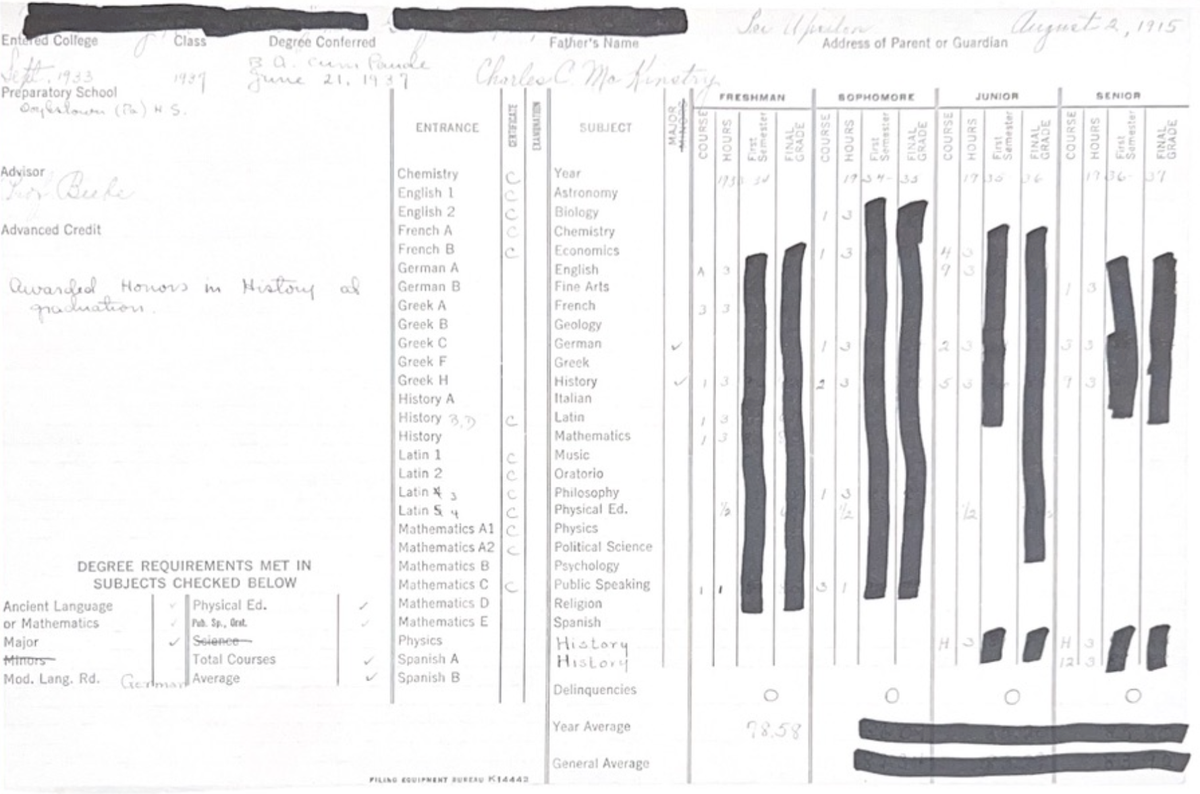
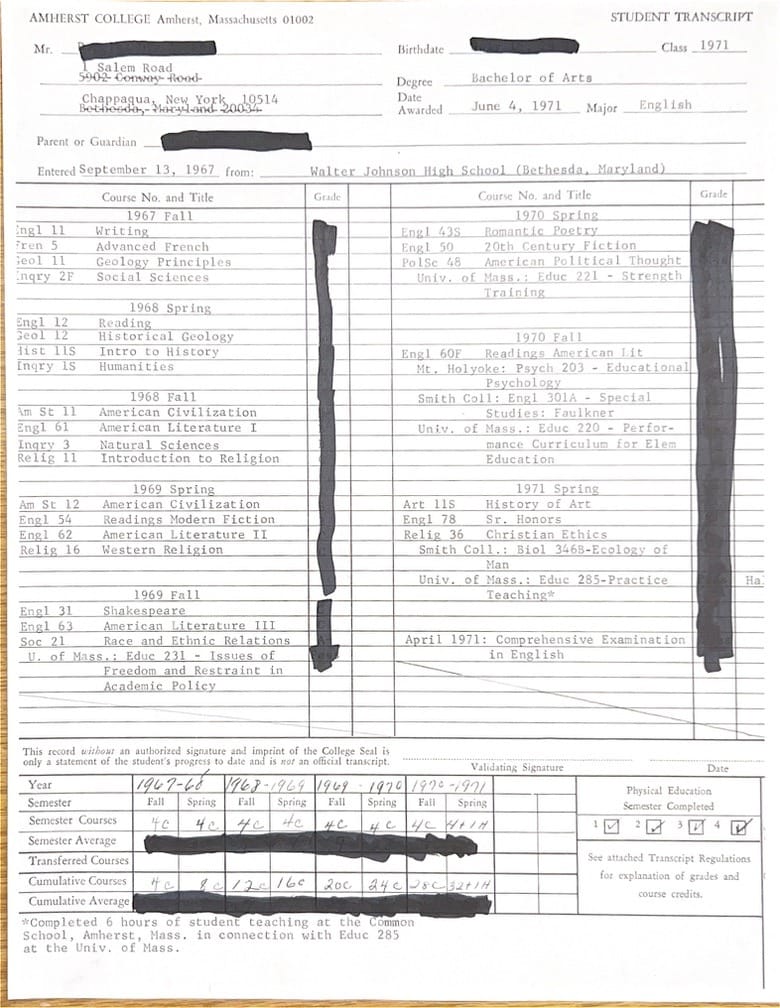
I recently sat down with Assistant Registrar Syd Cooney, who has worked in the Registrar’s Office since February 2001, to trace the office’s technological evolution. During our conversation, Cooney also took me inside the office’s “vault,” which contains decades of student transcripts. Among the records was an original academic record from the Class of 1937, containing handwritten grades, checkmarks, and notes squeezed into narrow columns. Beside it was a cleaner, standardized version of the same student’s transcript, created when Amherst first computerized its records and transferred decades of academic information into the new system. A transcript from the Class of 1971 showed another stage in record keeping, with typewritten course titles and grades organized by semester.
When Cooney arrived at Amherst in 2001, they had just graduated from Smith College, where online course registration was already available. Amherst, however, was still operating with an older system.
“When I started, I sat down at a desk that had a dumb terminal,” Cooney said. The monitor was connected by a cable running through the floor to a large mainframe computer downstairs.
The office operated on Mantis, a homegrown, text-based computer system developed by Harrison Gregg, an Amherst employee who later became the college’s associate registrar. Mantis stored student academic information electronically, but it did not offer online access for students. Registration still required students to bring signed course cards to the office, where staff entered their selections by hand.
For Fowler, who joined the office in 2000, much of the job involved this kind of manual data entry. Each semester, staff also assembled approximately 1,800 individualized registration packets, complete with printed schedules, add/drop cards, and academic requirements.
“We used to hire students to actually help us stuff the packets,” Fowler recalled.
Amherst began moving toward online registration through the platform Ellucian Colleague (called Datatel back then) in the early 2000s. Unlike Mantis, which had been developed in-house, Colleague was a commercial student information system used by colleges and universities. It eventually supported AC Data, Amherst’s online portal through which students and faculty could access academic records. In spring 2011, students began registering for courses online through the portal without needing to visit the office at all.
The transition required extensive work behind the scenes. For the staff at the Registrar’s Office, much of their time went toward transferring decades of student records into the new system, checking for errors, and ensuring the accuracy of academic information. Cooney recalled how staff printed transcripts for all students before transferring records from Mantis to Datatel, keeping paper copies as a precaution against errors or lost information.
The move to Workday in 2021 brought another round of data conversion. This time, Cooney spent hours reviewing spreadsheets and checking records alongside Amherst’s information technology staff. Even small formatting errors risked transferring incorrect information into the new system.
Workday also introduced new challenges. Unlike Datatel, which allowed Amherst programmers to customize features, Workday offered less flexibility. Cooney said the change had frustrated faculty, who lost access to certain functions available through the previous system.
Another challenge stems from Workday’s origins. The software primarily serves large corporations, which use the platform to manage employees, finances, and other operations. Now, the software has expanded into higher education: As of April 2026, more than 200 colleges and universities were using Workday Student, its academic management system. Yet, Cooney said that software designed for larger institutions often struggles to accommodate Amherst’s more individualized approach to education.
For example, Cooney shared that Workday initially sorted academic departments by the number of courses offered rather than alphabetically. Music lessons appeared first because of the large number of individual course listings.
“This is not how academia works,” Cooney recalled telling Workday representatives at conferences. After requests from Amherst and other colleges, the company eventually changed the feature.
Other problems proved harder to resolve. Workday’s academic planning tools are designed to help students follow a prescribed set of course requirements toward graduation. Amherst’s open curriculum, however, gives students considerable freedom to choose courses outside their majors, making the software less useful for planning their academic paths.
Despite these limitations, Cooney believes the transition has benefited students. Workday gives students greater access to their academic records and allows them to update information without visiting the office.
“I definitely think it’s easier for the individual,” they said.
The office itself has changed less in size than in function. According to Cooney, staffing at the Registrar’s Office has remained relatively stable at five or six employees, even as decades of digitization have reduced manual paperwork and streamlined registration.
At a time when fears of AI replacing human workers dominate conversations about technology, the office offers a small but interesting counterexample. Workday itself is introducing AI tools to automate routine administrative tasks such as processing transcripts and managing academic requirements, but rather than eliminating jobs, these systems simply reshaped employees’ responsibilities. Staff now spend their time managing digital records, resolving registration issues, and handling cases beyond the software’s capabilities.
Yet, while technology has not displaced the Registrar’s Office staff, it has changed their relationship with the campus community. For Fowler, one of the most rewarding parts of working in the office was getting to know students personally. Students regularly stopped by to register for classes, change their schedules, or resolve academic issues. Over time, staff came to recognize familiar faces and follow students through their four years at Amherst.
Fowler misses this “personal touch,” a sentiment Cooney shares. “We used to get to know students. You’d follow them through their four years and you’d get to have that connection to them,” Cooney recalled.
Still, Cooney believes the benefits of online registration outweigh the loss of daily interactions. Students no longer need to wait outside Converse Hall for the office to open. They register from their dorm rooms, from home, or even while studying abroad.
“All of that is of net benefit to the students, which is ultimately who we’re here to serve,” Cooney said.
After decades of technological change, the Registrar’s Office continues to employ roughly the same number of people, performing many of the same essential responsibilities. The staff remains indispensable to Amherst’s academic operations, even as the systems they manage allow students to go through college with fewer reasons to meet them.
As Cooney put it, “if we’re doing our job right, technically at this point, you would never know we exist.”

Comments ()