

Giovanna da Silva: Accidents of ‘Luck’
Giovanna da Silva defies the odds, questions the possibilities of reality, and shares her story of belief in education, dedication, and staying true to your beliefs.
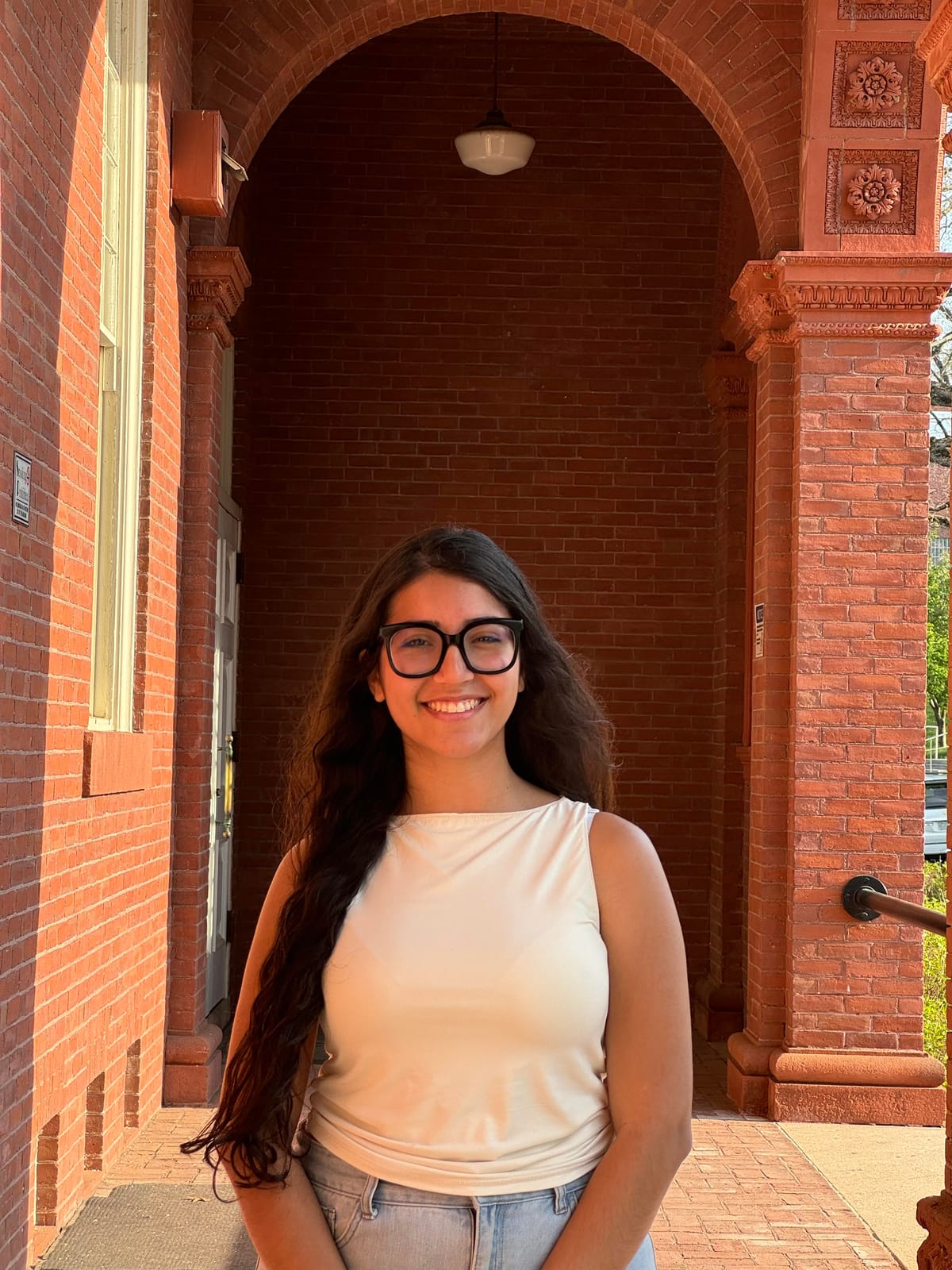
My interview with Giovanna da Silva ’26 couldn’t have started any better. We were sitting in Valentine Dining Hall (Val), warm and sunbathed in. She was talking to Eloy, a Brazilian gentleman who works for the Amherst College IT department. She introduced us to each other, and we all talked about how comforting it was to be able to speak in Portuguese after sticking to English for so long. With graduation coming up, Gio wanted to invite Eloy, as she was trying to find as many Brazilians as possible to introduce to her parents, who were visiting Amherst for the first time, “maybe we can put together a lunch, or a dinner …” Gio, as per usual, carried her simultaneously calm and exciting presence. Giovanna is the kind of person who manages to bridge worlds, brighten the room, make plans for the future, and still instill calm and reflection in a seemingly grim world.
When I asked her to tell me about where she came from, and how she ended up sitting next to me at a Val table for a senior profile in The Student, she pulled up a Google Earth page and asked me to “share nothing but the naked truth.”
The Places We Come From
The Google Earth page showed a skinny street, up the incline of a hill — like most of the uneven terrain of our shared home city, São Paulo — with raw brick houses stitched together and the occasional burnt cement fences. Giovanna lived her whole life in the same street in Morro do Piolho, the favela slum in the southern zone of São Paulo. Giovanna explained that it was important for me to see where she was from, the unregulated houses, the uneven pot-holed streets. As a product of the large socio-economic and racial disparities of our country, people like Gio rarely ever have access to dignified public education, let alone to schools like Amherst.
“It’s a funny thing,” she told me. “When I moved here, people had a really hard time understanding where exactly I came from, what my life was like. That’s why I make such a big deal out of showing my home … There is something about the spaces that we get to be in and come from that tells us, whether we want to know it or not, exactly who we are.”
Giovanna told me about her home, about her parents’ distrust of the police, the violence on her street, the out-of-law legal system the residents had put in place, and the loud Funk dance clubs that played music into the late hours of the night. “I am an accident of luck,” she said.
Accidents of Luck
Giovanna’s parents were probably her first “accident of luck.” Having lived most of their lives in the favela, they saw how important, yet unattainable, education was: It changed lives, yet most people in the hill, including themselves, never even managed to complete high school. “For as long as they could,” Gio continued, “My father promised that he would pay for the best education they could afford for my sisters and me.” That was how Giovanna ended up studying at her neighborhood’s Seventh-day Adventist private school, a small school sponsored by the local Evangelical church, whose R$500 monthly pay ate up almost 80% of her parents’ income. The church was another “accident of luck” in Gio’s life; it was reading the Bible that led her to discover her passion for books. The church’s selfless mission helped hire teachers for the neighborhood school, and the youth program there pushed Giovanna to teach herself English on Duolingo, play piano online, and even practice some playwriting.
Even at the “bottom of the pyramid” where she once stood, Giovanna was lucky to have parents who believed in education, a mother who dedicated herself to her children and ensured they always had food on their plates, and came straight home after school, and a church and guiding faith that made even the impossible a little closer to reality.
But not everything in Giovanna’s life is filled with luck. By the time she was supposed to start high school, money ran short, and the three daughters were taken out of private education. Even at the best public school her parents could find, Gio struggled with her education: there were no chemistry or physics classes, no students nearly as passionate as she was, no teachers for most essential subjects, and those that did often doubted her abilities and right to attend a public school of “high caliber.”
But Giovanna made the most out of an unfortunate time. She got to participate in the student government, organize social projects, and even had the luck of having a math teacher who gave her private lessons for free so that she could learn more advanced subjects. That same math teacher, however, told her to give up on pursuing private education and just make it through the next three years.
More Than Luck
I am inclined to believe that Giovanna is not just a product of luck. Or rather, luck is not quite what we think it is. One could think of luck as no more than a blessing sent from the heavens — and sometimes it is — but more often than not, luck is what happens when preparation and effort meet opportunity. Giovanna was always prepared.
When her math teacher told her, “just to give up,” she could’ve listened. Instead, against all odds, she tried to get scholarships for private prep schools in town through their entrance exams, “vestibulinhos,” a Brazilian equivalent of the SSAT (but harder). That year, she was admitted to a school with a 95% scholarship. She ran home, excited to tell her parents that she could finally attend private school for no more than R$200 ($40) a month. But there was no accident of luck this time. That day, Giovanna told me, her mother shook her head and said they could still not afford $40 a month. It was the day she became “completely disillusioned and revolted” by her own reality.
Too late to back out, Gio told me that she still tried for a third vestibulinho, that her chest hurt as she walked through the gates of the school she knew she would never be able to afford. Her grade that day had only been high enough to grant her a 50% scholarship. But a stroke of luck happened in that testing room. It turned out that, after finding out that Giovanna had declined the spot at the school, the principal, who had read her exam herself, found Giovanna’s father’s phone number, asked him why his daughter wasn’t in school, and offered her a full scholarship and, in many ways, a ticket to a better life.
Sometimes, the stars align in just the right position to make things happen, but other times, like in Giovanna’s case, we find it within ourselves to cross the whole universe to place them where they need to be.
The Life You Want
To Giovanna, some accidents of luck were only possible because of the forced migration to the online world brought by Covid. Classes online meant the end of three-hour commutes, time to catch up on all the things she hadn’t learned before, and, studying for the national entrance exams for public universities in Brazil, which, to us, are the most prestigious of higher education options. On top of studying to rise from the bottom to the top of her class she joined the Opportunity Funds initiative, a U.S.-sponsored program that funds the education of students in “Opportunity Zones” of underdeveloped nations.
Giovanna got into her dream school, the São Francisco Law School of the Universidade de São Paulo (USP), as soon as she graduated from high school — an achievement that is quite difficult to explain to people outside of Brazil. USP is considered the best university in Latin America. Giovanna was within 5% of the students from all of Brazil who were admitted, and she did it all on her own.
USP had been a dream. But when dream meets reality, we often grow disillusioned. Giovanna’s case was no different. The reality of public education in Brazil is harsh — even at the best university in the country, teachers went on strike often, classes got canceled, and students had to make group chats to make sure none of them took the metro on their own (as it was, and still is, a space prone to violence).
“After only a few months, I was exhausted,” Gio told me. “I worked as an intern at a small tech company during the day, went to [university] at night, and still had to worry about whether or not I was gonna get robbed on the way there or even have class.”
Between going to school, finding side jobs, and looking for employment in the top law firms of the city, Giovanna knew of quite a few people her age who committed suicide. “That was not the life I wanted,” she said as she recounted those few months. “I was exhausted, and that place was hellish. I didn’t want that for my life.”
Just then, Opportunity Funds program provided her with another boost of luck. Around March of her first year in law school, she was accepted to Amherst College with a full scholarship. She packed her bags and left Brazil for the first time to build the life she wanted.
A New Place
“I often found myself as a messenger between two worlds when I decided to come to Amherst,” Gio explained. “My family didn’t understand what the Opportunity Funds were — that I could legally study at an elite university in the U.S. for free. I had some family members tell me not to go.” Of course, Giovanna followed her own instincts and explained that she would do exactly as her conscience told her.
When her bus arrived at Amherst, Giovanna said it felt like “the heavens were really shining down on Earth.” “I smiled,” she said, “walked to my dorm in Stearns [Residence Hall], changed out of my airplane clothes, and just cried.” The São Paulo she had known as the whole world for most of her life was nothing at all like Amherst, and feeling out of her element, tears felt like the only appropriate response.
But Giovanna is not at all a sad person. In fact, not even two minutes after telling me about how much she had cried the first day, she proceeded to tell me how her first week had her feeling like “a child in an amusement park,” with a dining hall where you could get whatever food you wanted whenever, the enormity of a campus one could get lost in, all the classes with their scholarly descriptions.
A Love for Words
Giovanna took two language courses in her first semester: Greek and French (one of her three beloved majors). Giovanna is a true polyglot: She speaks English, Portuguese, French, Spanish, and even learned enough Greek to read the Bible in a fifth language. As a language lover myself, I really admire Giovanna — not only because she speaks so many languages, but also because she learned most of them on her own.
It was through her passion for languages that Giovanna met Laure Katsaros, the Armor Craig Professor in Language and Literature, a figure whom Giovanna describes as one of the first to not only help her in this new environment but also to believe in her potential and ability to make a name for herself at Amherst. During those last few weeks of summer, Katsaros and Giovanna had a chain of emails in which Giovanna shared her doubts about her French not being formal enough. Giovanna described her French knowledge as a mix of “Duolingo lessons and shower monologues.” Unsurprisingly, Giovanna was being humble about her language skills, and in Katsaros’s own words, “it looks like these shower monologues paid off.”
I am, myself, a student of Katsaros, so I know that she did not mean it lightly when she told me that “Giovanna worked harder than anyone else in the class,” or that “she outshone her more experienced peers with her impeccable preparation, stellar class participation, engagement with the course materials, and collaborative spirit.” Giovanna bleeds those qualities from the moment you meet her.
Giovanna’s first year at Amherst was marked by doubt. Doubt of her abilities, her knowledge, and even her right to belong. Professors who were particularly stringent about her English grammar mistakes made her doubt whether she was meant for this place. But amongst all this doubt, Giovanna met Bertrand H. Snell 1894 Professor of American Government in Law, Jurisprudence, and Social Thought (LJST) Martha Umphrey, and the LJST department (the second of her three majors). It was in writing essays about law that Giovanna realized that “[her] worth and skills were not demonstrated in her knowledge of the grammar minutiae of a third language, but in how [she] crafted her words, how [she] put them together, and got [her] point across.”
If you ever get a chance to debate with Giovanna, you will quickly realize that she knows a lot about the power of words. But her words are also gentle, kind, and, as Katsaros said, humble and empathetic. “Giovanna signs all her messages to me with ‘kind regards,’” Katsaros wrote to me. “Kindness and consideration for others are part of her DNA.”
If I Don’t Do It, Then Who Will?
A new understanding of what it meant to be a citizen of the world came to Giovanna as she applied for jobs during her sophomore summer. If all jobs were promised to be equal and fair to all applicants in the selection process, how could questions like “what is your citizenship status?” and “do you require sponsorship?” guarantee that? Giovanna’s idea for her LJST thesis began then and continued to develop as she pursued her junior year abroad in France, England, and Oxford.
Abroad, Giovanna learned “what it meant to be a citizen without a home, a constant other, in a world that shouldn’t really have an owner. In that year abroad, “[she] really understood what it meant to be a non-citizen.”
Inspired by her experience abroad and mentoring by professors like Umphrey and Senior Thesis Advisor in Law, Jurisprudence and Social Thought, Michaela Brangan, Gio told me she came back to Amherst “more than motivated to write [her] thesis. [She] was ready.” While international students and the academic world faced the full backlash of the second Trump administration, Giovanna found nothing but fuel to keep writing her thesis, “The Citizenship Divide: Dismantling a Regime of Lawful Discrimination.”
Her work, which she had the care and pleasure to show me, challenges the idea of citizenship and the formation of nation-states, exploring how our notions of nations and belonging create baseless discrimination and have often been at the root of racial and gender inequality. How can “all men be created equal” if their birthplace determines their set of rights? And what makes an immigrant any less worthy of the rights reserved to citizens of a certain country they may visit or live in?
As an international student, approaching such a tension-filled topic was often daunting, especially when her proposal and critique seemed to be “so radical” to many. Giovanna said she thought a lot about switching topics to something “safer.” But her professors, Brangan and Karl Loewenstein Senior Lecturer in Political Science and Sexuality, Women’s and Gender Studies, Manuela Picq, convinced her that, whatever the consequences, it was worth it to stand by her principles.
“I was scared,” Gio told me, “but these women really made me think. If no one ever says anything because they are too scared, then who will? What would our world be like if we let fear keep us silent? Being an outsider, a lesser-than, all the time, radicalizes you. It radicalizes you beyond fear. And I decided: If I don’t do it, then who will?”
Bigger and Better Things
“I don’t see myself anywhere right now, but returning from where I came,” she told me when I asked if she had thought at all about staying in the U.S. “I believe it would be hypocritical of me, considering where I came, the things I study, and my beliefs about the world, to never return and try to help people who are just like me.”
Gio’s goal after Amherst is to return to Brazil and work in politics and advocacy for her country. As a proud education studies major (her third major), Giovanna believes in bringing better education to lower-income communities and finds her forever job to be a mix of academia, law, and advocacy that studies the patterns that shape our current consciousness and seeks to bring about change for the better.
Politics, advocacy, and education in Brazil, especially when with the right intentions, are an honorable but challenging path. Giovanna shared that, while Amherst is known as a well-established and recognized elite institution in the U.S., our small liberal arts college is still little known in Brazil, which makes finding jobs, mobilizing people, and carving a space for herself very difficult upon return.
I’m not worried about Giovanna or what the future holds for her. If there is anything I’ve learned from meeting with her and writing this profile over the last month of her college career, it is that no challenge is insurmountable for an open, curious, and willing heart. Giovanna wants to make the world a better place and bring people closer together, and, as Katsaros told me, she “knows how to connect with people and how to connect people,” which is nothing short of a “precious gift.” We will all miss Giovanna as we know that she leaves Amherst for bigger and better things.
Comments ()