

Hampshire College to Permanently Close
Hampshire College announced that it will permanently close by the end of the fall 2026 semester. Declining enrollment and debt tied to the land were some of the factors that led to the Board of Trustees' decision on Tuesday.
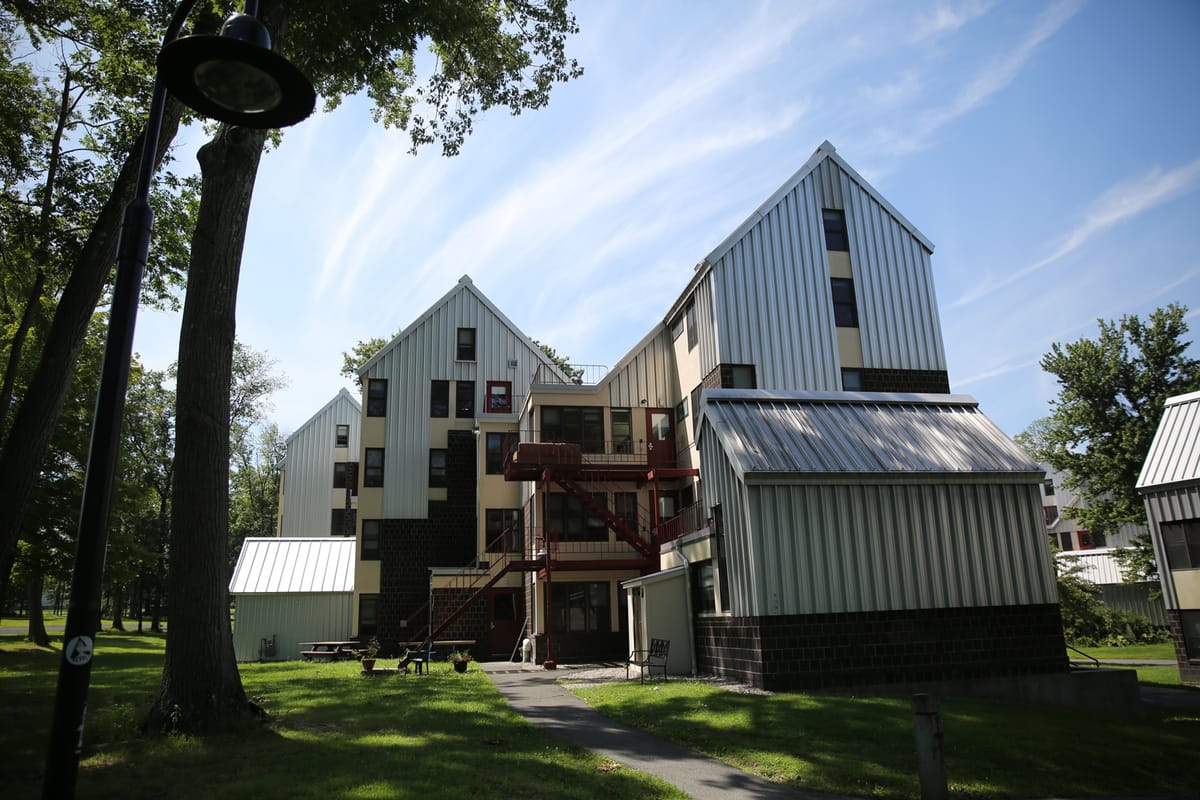
Hampshire College announced that it will permanently close in December 2026 after years of financial challenges. In recent years, the college worked to increase enrollment, refinance existing debt, and gather revenue by selling a portion of its land. Ultimately, declining enrollment and debt tied to the college's land severely constricted Hampshire’s ability to continue operating, leading to the Board of Trustees’ decision on Tuesday.
Hampshire College President Jennifer Chrisler gave an address regarding the closure at Robert Crown Center on Tuesday. The college also held breakout sessions led by Dean of Faculty and Vice President for Academic Affairs Gary Hawkins to field questions from students, faculty, and staff. However, many questions remain unanswered.
“Since its founding in 1965, Hampshire College has been home to deeply curious, creative people who have radically reimagined what a liberal arts education can be. We have kept our commitment to one another — leaving no stone unturned, no solution unexplored, and making many sacrifices along the way,” Chrisler wrote in an announcement on Tuesday.
Hampshire has been on the “edge of financial viability for [its] entire life,” Chrisler said in her address Tuesday.
In 2019, college leadership announced that Hampshire was seeking a merger, and that it might not admit a new freshman class. In the end, only 13 freshmen enrolled that fall, facing the risk of the college closing during their time. Then-president Miriam Nelson resigned shortly after. When she left, the college abandoned the merger proposal, elected a new president, and raised $9 million.
Since then, Hampshire has welcomed New College of Florida students and graduated hundreds of alumni. “We kept saying yes when it would’ve been easier to say no,” said Chrisler, who was appointed president in October 2025.
Hampshire is one of many struggling institutions of higher education: A new estimate from Huron Consulting Group projects that 442 of the nation’s 1,700 private, nonprofit four-year colleges and universities — with a combined 670,000 students — are at risk of closing or having to merge within the next 10 years.
Current third-year students will be able to complete their degrees by the end of 2026, aided by a summer field study. All students who complete their degrees at Hampshire will obtain a Bachelor of Arts degree from an approved, fully accredited college.
In the fall, Hampshire will follow a “teach-out” model — meaning that support staff and professors will be around, but students will not be able to take classes on campus with them. Housing, career planning support, and mental health services will still be available.
Even though fall college transfer deadlines have already passed, Hampshire has transfer agreements in place with the soon-to-be Four College Consortium, as well as Bennington College, Massachusetts College of Art & Design, The Massachusetts College of the Liberal Arts, and Prescott College.
Despite the institutional support from surrounding colleges, Hampshire students said they still have questions about the transition process.
Since Hampshire students are given evaluations rather than letter grades, this “presents obstacles” for transfer applications, junior Ananda Kinkaid said. Kinkaid, who came to Hampshire from Montana, said she was drawn to the college because students have the ability to take control of their own curriculum. The school also offered Kinkaid, who is on a pre-medical track, a generous financial aid package.
“I’m still trying to wrap my head around it,” said Kinkaid, who is on track to graduate by December 2026 under Hampshire’s accelerated program. “My mom is really pushing me to transfer, so I just need to find out more information.”
After Dec. 31, 2026, Hampshire’s transcripts and academic records will be held at the University of Massachusetts, Amherst. Cultural institutions like the Eric Carle Museum, Hitchcock Center, and the National Yiddish Book Center will remain open, because they are independent from the college.
President Michael Elliott shared the news with Amherst College students, faculty, and staff in an email on Tuesday: “I know it will be especially painful news to those of you who have studied on Hampshire’s campus, who have worked closely with Hampshire’s students, or who have partnered with extraordinarily talented Hampshire faculty and staff.”
Amherst has been intimately connected to Hampshire College since its founding. An Amherst alumnus’s gift of $6 million provided the money to purchase the college’s land and set up Hampshire, according to its website. Hampshire’s second president was Amherst alumnus Chuck Longsworth ’51.
Elliott added that Amherst will be working with Hampshire College as they wind down their operations.
Gus Tingley, a Hampshire sophomore from Virginia, hopes to transfer to Amherst. Tingley, who studies physics, said he is sad that he will not be able to ring Hampshire’s Division III bell. At Hampshire, students can only ring the bell when they graduate, otherwise it is bad luck.
“But I guess we already have bad luck,” Tingley said.

Comments ()