

Hedley Lawrence-Apfelbaum: A Modern Classic
Hedley Lawrence-Apfelbaum is a Marshall Scholar and future Harvard Law student who blends classic sensibilities with modern complexity — bridging eras, faiths, and perspectives to shape a reimagined vision of American leadership.
“Everything is different — and everything is the same.” — George Packer, “Our Man: Richard Holbrooke and the End of the American Century”
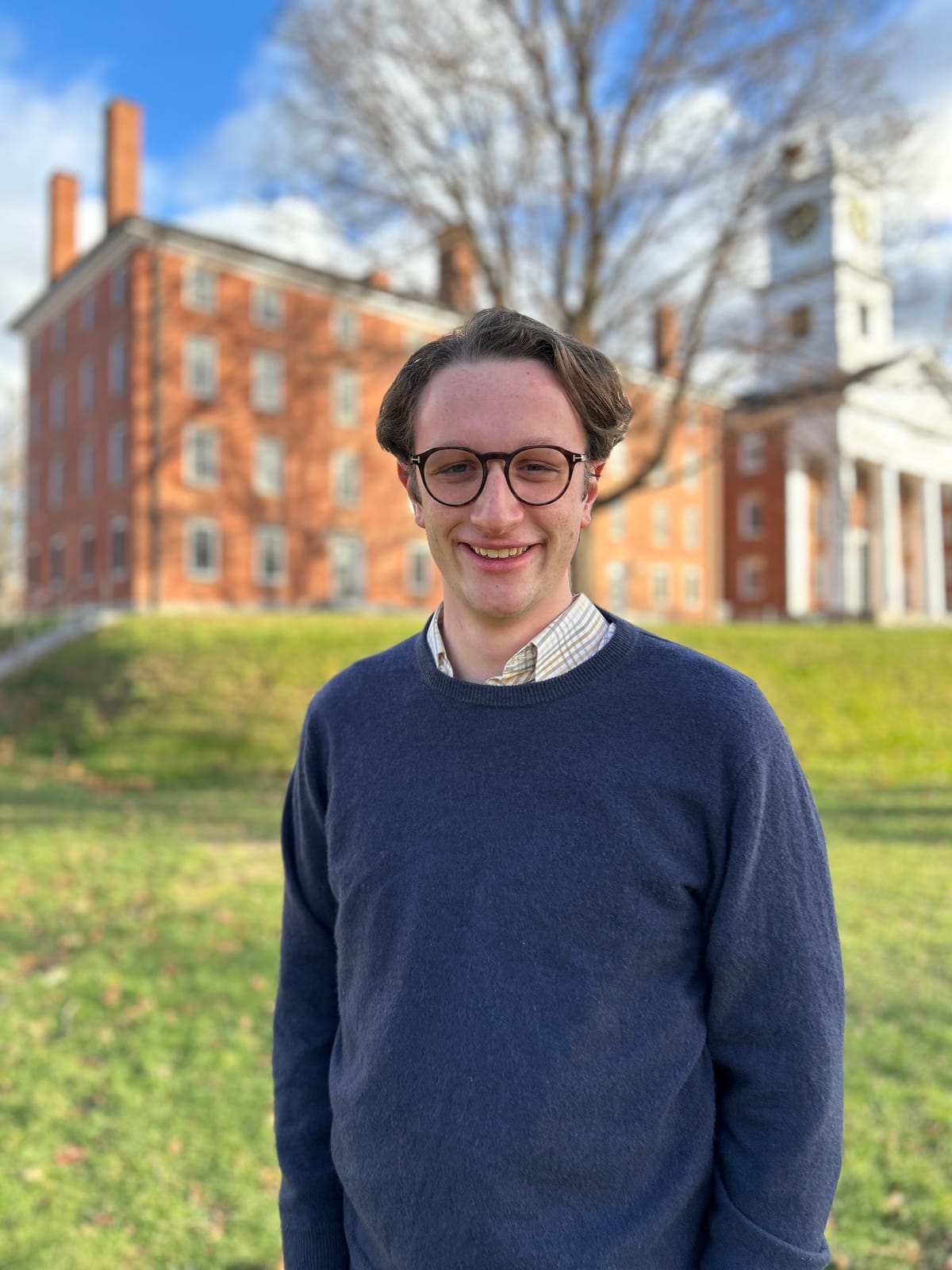
I learned the term “restomod” the other day — it refers to a classic car that’s been restored to its original aesthetic beauty while being upgraded with modern technology, components, and performance parts. There is something indelibly “restomod” about Hedley Lawrence-Apfelbaum ’26. He’s got a 20th-century face: clean-cut and open, neatly parted hair, round wire-rimmed glasses, and an easy, sincere smile. He’s a slender 6’5”, and it’s something to watch the way he settles in — his long limbs making the couch his own, one ankle resting casually on his knee, like Ted Kennedy or John Kerry holding forth on “The Dick Cavett Show.” Even his name, HED-lee LAW-rence-AP-fel-baum, gloriously polysyllabic, projects a certain 20th-century gravitas: John Fitz-GER-ald KEN-ned-y, FRANK-lin DEL-a-no ROSE-uh-velt, and so on.
Lawrence-Apfelbaum, though, recently named a Marshall Scholar and, thanks to Harvard’s Junior Deferral Program, set to attend Harvard Law School thereafter, is more than just an image from a bygone era. I interviewed him in the only context I’ve ever known him: a small suite in the basement of Stearns and James Hall — affectionately known as the “Jew room” by Amherst College’s Jewish community. Lawrence-Apfelbaum is Jewish, the vice president of Hillel on campus, a group I also help lead, but he’s also more than that. With a Catholic mother and a Jewish father, he exists somewhere between the two traditions. He spent most of his childhood in New York, a quarter of it in Spain, and, thanks to his polyglot mother, he’s fluent in English, Spanish, and French, sprinkled in with some Hebrew prayers and Catalan. Even his clothes slip between worlds. Sometimes you will see him in those wire-framed glasses and a preppy “Take-Ivy” style dress shirt; other times, you will see him in one of those 2009 Justin Bieber-style zip-up string hoodies and a screen-printed t-shirt. Everything is different, and everything is the same. That’s part of the charm.
Amherst, Mass; or, the World
Lawrence-Apfelbaum picked Amherst over several elite schools, including Oxford University. But he felt a strong desire to return to his home country after spending several years abroad:
“A lot had happened in the U.S. ... between 2018 and 2022,” he said. “I wanted to come back.”
When it came to picking Amherst, his mother, an Amherst alumna, put the college on his radar, but his ultimate reasoning was remarkably simple: He visited the campus and, quote, “it seemed like a place where people were happy.”
Lawrence-Apfelbaum recalled walking into the club fair during his first year, expecting to sign up for just a few activities so he could focus on his classes. But he found it nearly impossible not to put his name down for 30. He had no intention of joining the Association of Amherst Students (AAS) until someone suggested it during orientation week, and he had never rowed before deciding to tack crew onto his schedule during his second year. Reflecting on this tendency to dive in, he said, “I think it’s good to go into things and kind of maybe do something that feels like a little too much, and trust yourself to make it work.”
Rigorous and Sprawling
During Lawrence-Apfelbaum’s first year, he checked out George Packer’s 2019 book, “Our Man: Richard Holbrooke and the End of the American Century,” from Frost Library. The book is a biography of Holbrooke, a larger-than-life American diplomat who played a key role in major American foreign policy events of the late 20th century.
“Hedley mentioned that he had read George Packer’s biography of Richard Holbrooke,” James J. Grosfeld Professor of Law, Jurisprudence and Social Thought Lawrence Douglas said. “He rather sheepishly confessed that he hadn’t read it for an Amherst course; [instead] he had devoured the six-hundred-page tome … [on his own time]. I promptly hired him as my research assistant.”
Packer describes Holbrooke as a kind of whackjob: “bullying, cajoling, needling, analyzing, one-upping you — applying continuous pressure like a strong underwater current.”
Lawrence-Apfelbaum is nothing like Holbrooke. As former AAS president Shane Dillon ’26 told me: “There isn’t a mean bone in his body, maybe a sarcastic one hidden in there … but not mean … when it comes to him, I can’t help but think of the words judicious and benevolent.”
A bit like Holbrooke, though, you’ll notice, Lawrence-Apfelbaum pelts you with information, forcing you to keep up. During our two-hour-long conversation, he spoke about “The Weary Titan: Britain and the Experience of Relative Decline, 1895-1905” by Aaron L. Friedberg; “The World in Depression, 1929-1939” by Charles Kindleberger; David Halberstam’s 1972 book, “The Best and the Brightest”; “The Fog of War,” a 2003 documentary about former corporate “whiz kid” and eventual U.S. Secretary of Defense Robert McNamara; the Smoot-Hawley Tariff Act and President Herbert Hoover’s protectionist trade policy in the 1930s; the 1948 Marshall Plan; the 1992 North American Free Trade Agreement; the 1994 Rwandan genocide; 1999 U.S. Involvement in Kosovo; President Barack Obama’s 2009 “troop surge” in Afghanistan; and the 2016 Trans-Pacific Partnership Agreement. In doing so, Lawrence-Apfelbaum didn’t rely on platitudes; rather, he crafted cogent historical parallels between materials and then hurled them at me, seamlessly connecting disparate centuries, policies, and authors with unerring fluency.
“When we do research, we all swing between ecstasy and misery in predictable, if unavoidable, arcs … few ride them as fearlessly as Hedley,” Associate Professor of Political Science Eleonora Mattiacci said. “It is exhilarating to watch him pursue an idea. Voraciously curious and doggedly focused, he is unafraid of what it takes to learn: reading, outlining, plotting, writing, rewriting, then beginning again the next morning, always game to become a stronger writer, a swifter thinker, a bigger human.”
For all these reasons and more, Lawrence-Apfelbaum’s intelligence is both rigorous and sprawling — like a heap of mismatched auto parts scattered across a garage floor, which, through some improbable engineering, he assembles into a beautifully purring engine.
Likewise, Lawrence-Apfelbaum is drawn to figures like Holbrooke — even the polarized and broken America he returned to in the early 2020s — not because these subjects are perfect or unquestionably good, but because, as he puts it: “It’s not about idolizing someone or something flawless — it’s about wanting to wrestle with the mess, to actually manage all the contradictions and imperfections and try to make something better out of them.”
“What’s interesting,” his brother, Beckett Lawrence-Apfelbaum ’29, said in a phone interview, “is that you might think it’s ironic to come back to the U.S. during [President Donald] Trump’s first term and see what’s kind of falling apart, but instead of meeting that moment with cynicism, Hedley paved the path for me and showed that you can believe in this country and still work to make it better.”
“A Big, Adventurous Heart”
When asked directly about his future career plans — such as whether he wants to, as his parents did, either clerk for a judge or work in a big corporate law firm — Lawrence-Apfelbaum admitted that he “doesn’t really know” yet, noting that those specific decisions are still a “long way off.”
Lawrence-Apfelbaum’s academic and extracurricular trajectory, however, points strongly toward the fields of law, politics, and international relations. He is the vice president of AAS, co-president of Amherst Students for Democracy, and a double major in economics and political science. His thesis explores the unprecedented shift in U.S. trade policy toward protectionism beginning around 2017. And after graduation, he will use his Marshall Scholarship to pursue a two-year master’s degree in international relations at Oxford before attending Harvard Law School.
“Last summer, sitting across the table in my office while he described learning to write a thesis and to apply to graduate school, Hedley’s ferocious grit kept reminding me of an Emily Dickinson poem: ‘Not knowing when Dawn will come, / I open every door,’” Mattiacci said. “Embracing learning as openly as Hedley does takes a capacious intellect. And, above all, a big, adventurous heart.”
As one may glean from all this, Lawrence-Apfelbaum aspires to make an impact: “I want to do something meaningful,” he said, “work that genuinely improves people’s lives and tackles big problems. That’s hard, and it depends on certain preconditions, which is why I’ve focused on studying how those conditions emerge — and where past efforts have gone wrong.”

“Good Pressure”
Lawrence-Apfelbaum describes feeling a kind of “good pressure” amid all his achievements — a concept he first introduced as we discussed the crew team, which he now co-captains.
The sport is a significant time commitment — about three hours every day — which makes it seem like a difficult sacrifice. Lawrence-Apfelbaum, however, views this as a source of “good pressure” because it forces him to structure his day more efficiently. That is, by having to work around a demanding athletic schedule, Lawrence-Apfelbaum must become more productive in other parts of his life, allowing him to better manage his time and, in turn, make practice. “I often feel overworked and tired,” he said, “but I have to go; it’s taught me a lot.”
Lawrence-Apfelbaum emphasizes that crew isn’t just “for yourself”; if he decides to bail on practice, his boat — unbalanced without him— physically cannot go out on the water. This creates a tangible responsibility where skipping practice means directly letting down four or eight other teammates, ensuring he consistently shows up and honors his commitments.
“When it comes to being a captain, it’s not just about being the strongest guy, which he isn’t,” Beckett Lawrence-Apfelbaum, who’s also on crew, said. “It’s about being a mediating voice, someone people trust to carry concerns and speak to different issues. He’s really trusted on that end … a real leader.”
Much the same thing can be said about the responsibility that comes with the Marshall Scholarship, one of the most coveted postgraduate opportunities on the planet. The scholarship, which accepts only about 4% of applicants every year, allows American students to pursue graduate studies at any university in the U.K. It was first established as a gesture of gratitude by the British government to the U.S. for its support through the Marshall Plan after World War II. By enabling outstanding American students to study at leading U.K. universities, the scholarship aims to strengthen the bonds between the two countries, foster intellectual leadership, and promote greater understanding across the Atlantic.
For Lawrence-Apfelbaum, that mission carries real and personal weight. In his words, being chosen as a Marshall Scholar is “a major responsibility” — not only an honor, but also a call to serve as an informal ambassador for his country. “When I’m in the U.K.,” he said, “I am representing my country. Not in some Olympic sense or majorly public sense, but in the people I meet and the work that I do — it represents this relationship in this time.” Indeed, the high expectations that come with the scholarship — like the “good pressure” one experiences in crew — are deeply motivating, and Lawrence-Apfelbaum is determined to reciprocate the goodwill.
Holding Contradictions
Toward the end of our interview, I asked Lawrence-Apfelbaum this: “Given the current wave of criticism and even demonization of liberalism — both on college campuses and in broader discourse — where do you see yourself fitting, given that your perspective is so classically influenced by liberal ideals?”
Lawrence-Apfelbaum — a walking restomod — said this: “The best answer to those who claim liberals just defend the status quo is to be self-reflective and self-critical — to openly recognize our flaws, and stay committed to making things better.”
In many ways, Lawrence-Apfelbaum is of a bygone era, an “Amherst man” of the past; he’ll say so himself — Harlan Fiske Stone, class of 1894; Calvin Coolidge, class of 1895; Charles Hamilton Houston, class of 1915; Joseph Stiglitz ’64. While he may not agree with all of their politics, they share something in common: a sense of purpose, a belief that ideas can (and must) shape institutions, and a faith — however battered — in the possibility of progress, and in a quietly resilient kind of American optimism.
But what Lawrence-Apfelbaum possesses, more so than many of these figures, I suggest, is what the great English poet John Keats calls “negative capability” — being “capable of [existing] in uncertainties, [m]ysteries, doubts, without any irritable reaching after fact and reason.”
While Lawrence-Apfelbaum wasn’t familiar with the Keatsian term when I brought it up during our interview, he did recall a quote from F. Scott Fitzgerald, an admirer of Keats, who said: “The test of a first-rate intelligence is the ability to hold two opposed ideas in the mind at the same time, and still retain the ability to function.”
It was the perfect ending: Fitzgerald was both well-read and cutting edge, American and Anglo-Irish, wildly successful yet deeply insecure, a believer yet a skeptic; likewise, Lawrence-Apfelbaum is both old and new, Jewish and Catholic, cogent yet messy, brilliant yet accessible. Like a classic car rebuilt for modern roadways, Lawrence-Apfelbaum embraces the legacy of those who came before him — not by keeping it as a collector’s item, but by adapting it to run stronger than before. Everything is different — and everything is the same. He is at once a product of the past and a prototype for the future: striving, questioning, and — despite it all — believing that the American experiment, faulty though it is, can still go further.
“I hope that makes some sense?” Lawrence-Apfelbaum said, smiling.

Comments ()