

Homer and Hygiene: Historically Required Courses at Amherst
In a time before the open curriculum, Amherst College curricula required all students to engage with epic poems and exercise. In honor of this week’s add/drop period, Managing Features Editor Talia Ehrenberg ’28 dives into snapshots of past course catalogs.
For almost 100 years, all Amherst freshmen were required to read Homer’s “The Odyssey.” With the absence of any ancient language requirement since 1941, instead of an ability to sight-read the original ancient Greek, the vast majority of Amherst students now only have a Matt Damon-infused understanding of the text — thanks to the highest-grossing R-rated film of all time.
As the 2026 Christopher Nolan film “The Odyssey” resparks debates about the value of teaching the over 2700-year-old text, it is worth noting that the text was no less contentious when it was “only” 2600 years old. College course catalogs as archaic as 200 years old document changes in how “The Odyssey” was taught as early as 1824, showing an ever-changing dynamic between what’s expected of first-year students and the content designed to shape them.
The centrality of “The Odyssey” in collegiate education is not all a relic of the past, though. In 2023, New College of Florida announced a new class centered on the epic, just days before the start of the fall semester. Now part of the core curriculum for all New College freshmen, the course embodies the “Logos/Techne Curriculum.” This change was part of a larger plan by President Richard Corcoran, who was appointed by Gov. Ron DeSantis’ 2023 selected Board of Trustees. According to InsideHigherEd, Corcoran’s development of the new curriculum is a part of DeSantis’ attempt at “remak[ing] the liberal arts institution with a conservative bent.” Prior to DeSantis’ seizing of the institution, New College was compared to Hampshire College’s progressive, non-traditional model.
Despite the two century-long gap between an 1820s Amherst education and the political takeover of a non-traditional liberal arts college, this ancient tale has been central to defining institutional identity. Beyond “The Odyssey,” Amherst’s course offerings and requirements since its establishment in 1821 are particularly insightful as to how the academic everyday took shape in this same space across time.
First Year Required Courses
The only required class remaining today within Amherst’s famously open curriculum is a first-year seminar (FYSE) course. Thus, the joy of add/drop. From the early years of a shared schedule for the entire grade, to requiring freshmen and sophomores to take at least one course per “division” in 1941 — Language, Literature and Arts; Social Studies and Philosophy; and Mathematics and Natural Sciences — the throughline remains: There are certain skills or content that are pertinent to all who embark on their personal odyssey through Amherst College.
The curriculum’s strong emphasis on Greek and Latin persisted until the turn of the 20th century. First the college required a class in both languages (unless tested out through “presentations”), after which the college allowed students to choose a single ancient language track through the 1920s and 30s, then the school simply required any language (modern or ancient) through the postwar division model, and now, students do not have to take a language class at all.
While both the Greek and Latin majors are under the classics department today, listing ten non-thesis courses across Greek, Latin, and classics majors on Workday this semester, many humanities courses still invoke ancient Greek and Latin texts as the inheritance of the Western canon. Last fall, for example, five first-year seminars mention ancient texts in their course descriptions, and humanities courses more broadly rely on authors like William Shakespeare, Herman Melville, and Hannah Arendt, who continually embed both Latin and Greek references in their works. While cohorts of Amherst students today still read the same texts as first years did in 1821, many other elements of the curriculum have changed.
Professorship of Hygiene
Classics wasn’t the only department to blanket the college curriculum. In 1860, “the professorship of Hygiene and Physical Education” was established. In 1861, Physician Edward Hitchcock Jr. — son of President Edward Hitchcock Sr. — held the position and boasted that his physical education courses instructed exercises that “can be performed without undue effort or risk of injury.” Described as “first of its kind in the nation,” the program was designed by President William Augustus Stearns (succeeding President Hitchcock Sr.) for a number of reasons including concern that — as Archives and Special Collections Preservation Manager Mariah Leavitt wrote in 2017 — students “spen[t] all their time hunched over their books.”
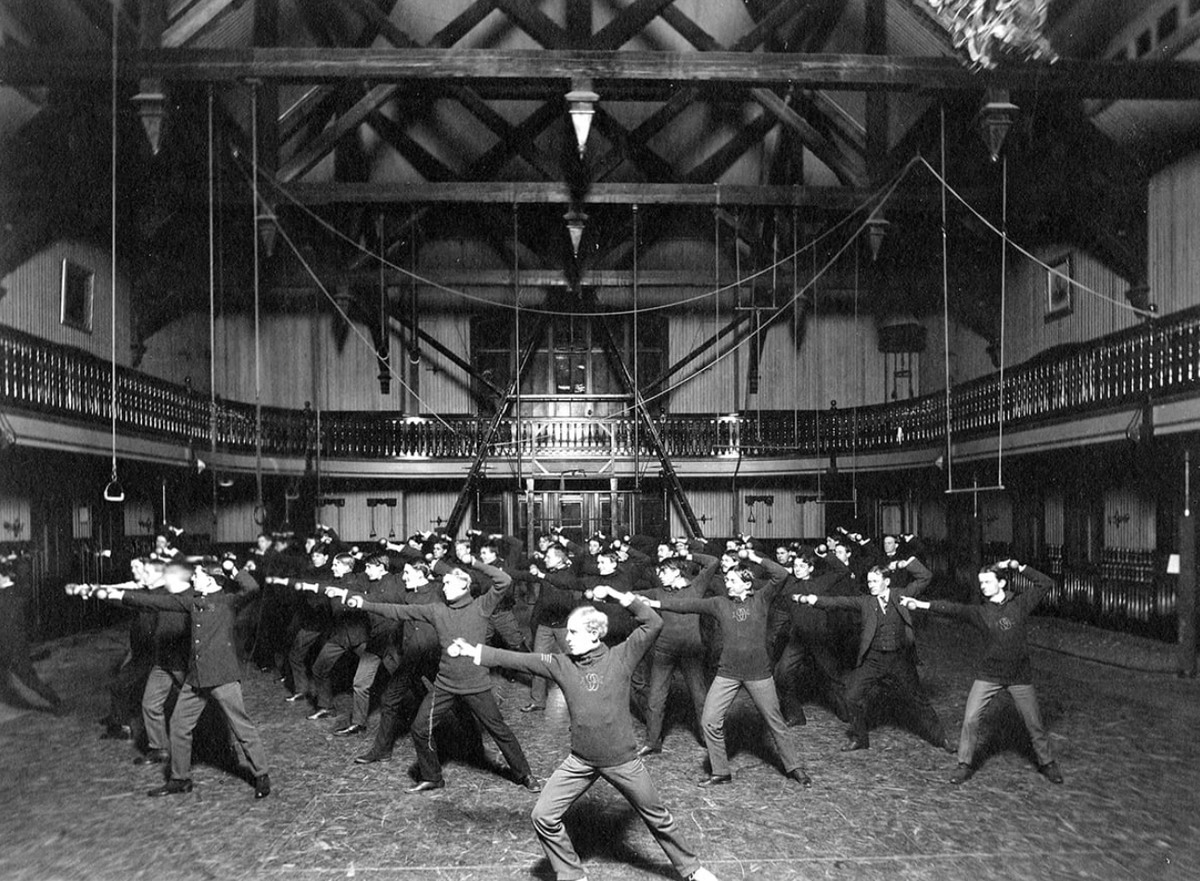
Pratt Gymnasium became the space for “a class of one hundred members to receive drill-practice with light dumb-bells, and to execute certain marching movements,” according to the 1891 catalog.
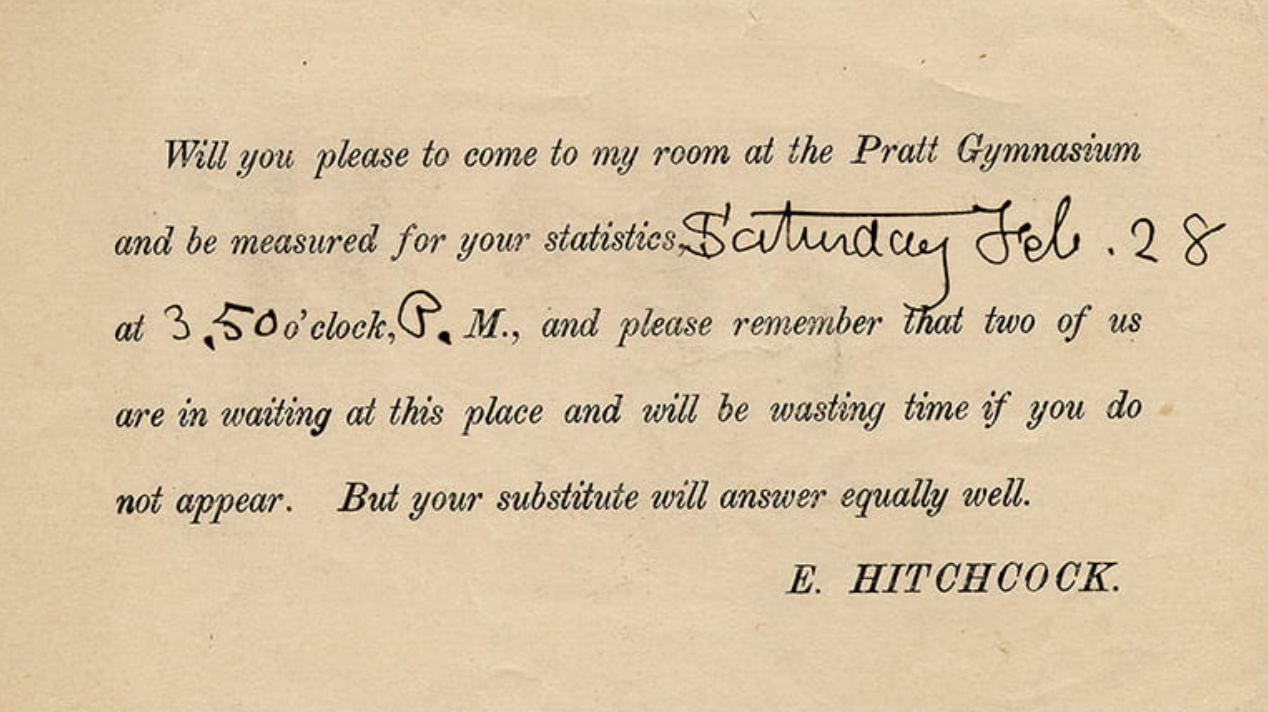
Terminologies such as hygiene, or “cleansing,” were deeply connected to the eugenics movement. The wellbeing regimen included physicians “minutely examin[ing]” students’ body parts with a tape measure a total of three times throughout their Amherst experience. After which students were given a comprehensive document of their measurements of everything from literal head breadth to instep (as well as data on the average Amherst student). Amherst’s use of anthropometry — metrics of human proportions — along with columns for students’ familial nationalities and ethnicities, was celebrated by The Eugenics Record Office of the Carnegie Institute of Washington in a 1919 correspondence. While the program disbanded in the 1930s, its decades-long existence is part of a larger history of race science taught as part of the Amherst curriculum.
On the Old New Curriculum and the New New Curriculum
After the “hygiene” program and mandatory courses on “The Odyssey” were both discontinued (and other substantial national and global events unfolded through the 20th century), further debates regarding what ought to be institutionally required ensued. In 1947, the “New Curriculum” was established. The postwar revamp required “reading knowledge” of French or German and shifted to only four classes, rather than five, each semester. But this only lasted through 1966. As part of the Amherst student protests of the late 1960s, the “New Curriculum” was overturned and replaced with a new “New Curriculum,” functioning as the open curriculum.
An open curriculum where no two students have identical academic journeys, nor are they even all forced to encounter the same “core” texts, may have seemed inconceivable to Amherst founders in 1821. But as the line between the “real world” and the classroom are blurred, Amherst’s shifted sentiment toward student academic agency is clear. On its website, the college writes that, with the open curriculum, “students take full responsibility for their intellectual growth, in the same way they will take responsibility for important choices later in life.”


Comments ()