

Insider Interview with Law Professor Cheryl Harris
Staff Writer Rizwan Ayub ’27 interviewed University of California, Los Angeles School of Law’s Rosalinde and Arthur Gilbert Professor in Civil Rights and Civil Liberties Cheryl Harris about her career and how her theory of “Whiteness as Property” can be applied today.
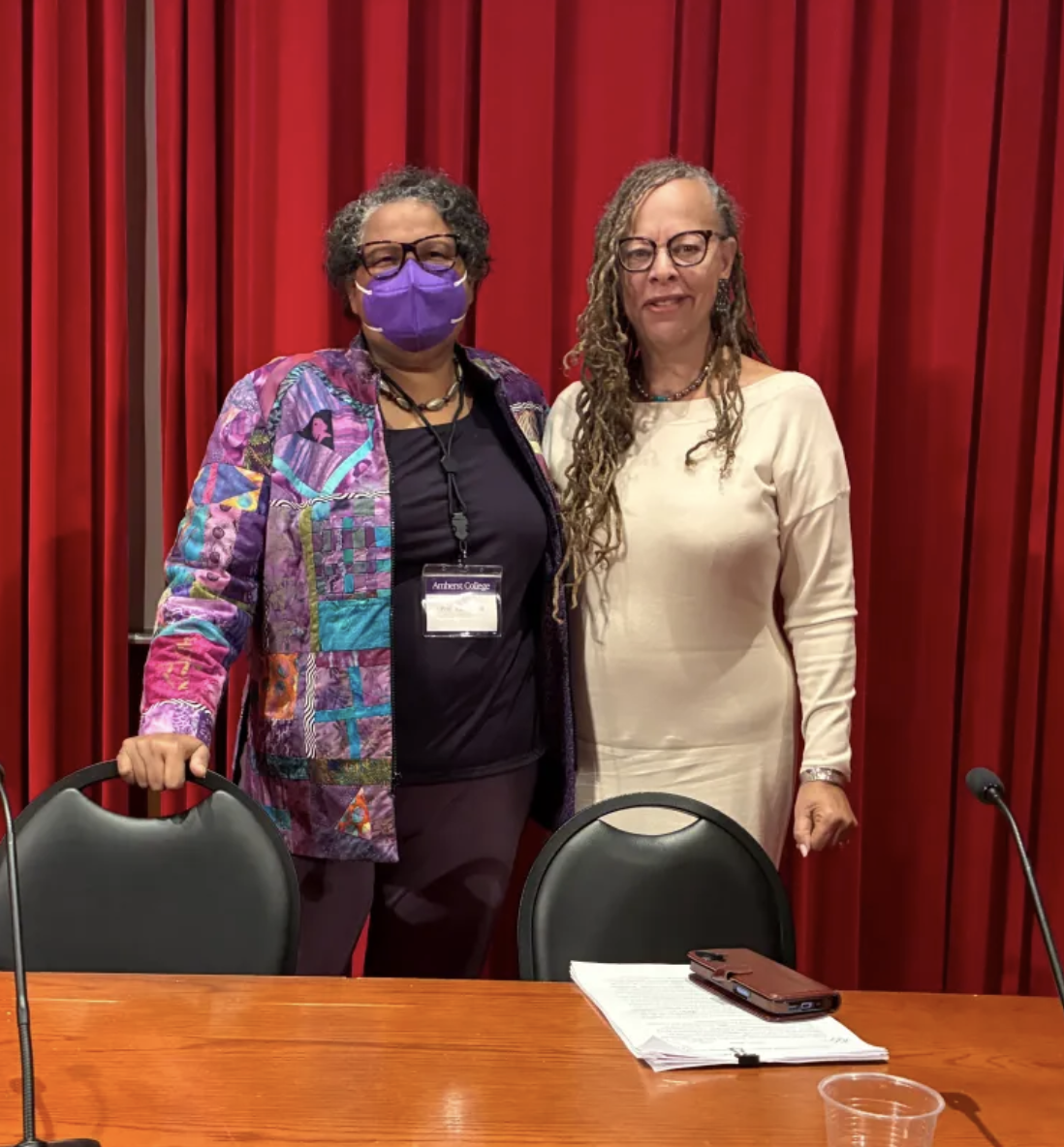
Rosalinde and Arthur Gilbert Professor in Civil Rights and Civil Liberties at UCLA School of Law Cheryl Harris visited Amherst College last week to participate in the “Whiteness as Property: Reflections and Retrospectives” seminar, hosted by the Race and Regency Lab in collaboration with the English Department. The Lab is an academic initiative that examines the links between race and early modern literature. Harris is best known for her influential 1993 Harvard Law Review article, “Whiteness as Property,” in which she argues that, throughout American history, white identity has been treated as a valuable form of property, protected by law even after the formal end of legal discrimination in the 1950s and 1960s. Staff Writer Rizwan Ayub ‘27 spoke with Harris about her personal and intellectual experiences as well as the relevance of her 1993 argument to today.
Q: You attended a small liberal arts college, Wellesley College. How do you think that attending Wellesley shaped you intellectually and personally?
A: I think Wellesley was a challenging environment for me in one way, but a very important environment in another. It was challenging in the sense that it was a small, elite, predominantly white institution set in the suburbs that, at a certain level, really represented a kind of elite aspect of American education with which I was unfamiliar. I was not a first-generation college student — my father and mother had both attended college — but the setting of Wellesley and the degree of its wealth and privilege were quite challenging for me to settle into.
However, I benefited from the fact that [my] class had a significant Black population. It was one of the largest cohorts of Black students that entered the school at that time, and so I had the benefit of entering at a time of community building. Many students like me came from working-class backgrounds, and I think we were able to come together to find community, work on projects and [share] social justice interests. In addition, the fact that it was an all-women’s college was also beneficial to the extent that it didn’t remove questions of male dominance, but the day-to-day aspect of life relieved a certain kind of gender dynamic in the classroom.
Q: Very interesting! Today, you are best known for your 1993 article “Whiteness as Property.” How relevant do you think the core arguments from that paper are today, in 2026?
A: One of the interesting things that my visit here today has brought is an opportunity to listen to new generations of scholars in different fields think about the resonances of whiteness as property not only in the context of law, but in the context of history, culture, literature, and the like. That has been very rewarding to me. I originally wrote the paper out of a particular political moment, and I was looking at the ways in which certain kinds of debate around affirmative action reflected what I identified as a kind of expectation interest that the law was protecting like a kind of property in the racial status quo, and that affirmative action was seen as being illegitimate because it was disrupting a racial status quo. And yet, the underlying question is: “Why should we treat the racial status quo, the existing distribution of goods, services, and power as correct, when it in fact was the product of an apartheid regime?” If we have had an unequal regime that has set the stage for the present, why would we treat that status quo as just and fair, when it had been the product of and was the product of both historic and ongoing patterns of exclusion?
The patterns of exclusion in the past were explicit … post-Brown v. Board of Education and a period of extensive struggle, we removed the labels over the bathroom, but the structural exclusion still continued. So, without the labels, the sorting of people into the racial hierarchy still continued, and so the question on the table was, “How do we intervene in this?” Affirmative action was actually a relatively conservative approach to thinking about how we might deal with the problem of the maldistribution that had occurred under racial separation, and it was a policy that was initially embraced by [President Richard] Nixon in the context of some aspects of government contracting. It was also a policy that had come to some degree out of the Black trade movement, when they were seeking to break the stranglehold that the trade unions had over skilled jobs that had historically excluded Black people.
So, affirmative action in education was actually part of a broader approach of thinking about how we might right this situation apart from having individual people file individual lawsuits claiming discrimination, which is a very expensive, laborious, and slow way. There are many injuries that people have, injuries that occur to people that might be subject to legal remedy, but they can’t really access the system because it’s too expensive, too long, and doesn’t bring a clear result soon enough.
I would say there are definitely differences in the economy and in the political situation between now and then, but I would say that the underlying problem of structural racism is still present. My article attempts to identify this relationship between racial hierarchy and opportunities and material inequality. And the question is: “How are we going to address this?”
Q: Interesting! Changing gears, in 2023, the Supreme Court overturned most race-conscious affirmative action programs. In the absence of any major changes from the Supreme Court, what steps do you think places like Amherst can take to achieve the outcomes that affirmative action was providing, now that race-conscious admissions are no longer an option?
A: I think the institutions of higher learning are going to have to face a number of crucial questions, including, “What is the mission of these institutions in contemporary society?” It’s true that the Supreme Court opinion in [Students for Fair Admission v. President and Fellows of Harvard College] (SFFA) overturned Harvard University’s and the University of North Carolina’s specific race-conscious admissions programs. It is not the case necessarily that SFFA should be read as saying that race can never be considered. I’m paraphrasing, but the idea [in the opinion] is that it is not an absolute bar to any consideration of race. What the court seems to be saying is that it cannot automatically be considered as a particular plus factor in the context of an admissions practice.
I think schools are going to have to think through what it is that they are prioritizing in the admissions process. How do they deal with the structural inequality in society that sorts people into those that are eligible for elite education and those that are not eligible? How can schools like Amherst connect themselves to other institutions that perhaps have a broader range of students from different backgrounds and connect to those schools as possible feeder institutions? Certainly, the University of California system, for example, has done a lot of work collaborating with community colleges. There are a lot of people in the admissions field who think about this all the time.
First, there has to be an institutional commitment to say that we are not simply interested in reproducing the kind of hierarchical structure that we have in the past. We are an institution that values not just diversity, but also holds itself responsible for addressing structural inequality in society, and we think that’s part of what we need to do. From that commitment, you can think of a range of opportunities and approaches to address these inequalities.
Q: Great! My final question: Many Amherst students, myself included, care deeply about issues like racism and inequality, but often struggle to translate what we learn in the classroom into real-world impact. What advice would you give to students who want to make a tangible difference on these issues beyond academia?
A: I think that goes to, in a way, the last question: “How might the institution open up space for that conversation?” What are the ways in which students might take back learning and thinking and engage in those issues, even from the location where they are? So I think part of the issue rests with students’ commitments, but also thinking about the institutional space that's being created for students to do this kind of work.
The second piece of what I’d have to say actually runs slightly differently, which is to say, I think sometimes, and I certainly had that view as a student myself, [students think] that the institution and the struggles in the institution were not real or not as important as what was happening outside the institution. I want to just point out that the knowledge production these institutions are engaged in is itself a sign of struggle. What I mean by that is students’ struggles over ideas, debates and information and knowledge production are themselves political struggles. So political struggle doesn’t just occur outside the institution; it’s occurring in the institution all the time. “Who gets in?” — that’s a political question. “What is the curriculum?” — that’s a political question. “Who teaches us?” — that too is a politicized question. All of our values end up shaping the answers to those questions, and struggles over those questions are themselves just as important as the question of how does this knowledge relate to the community.

Comments ()