

‘It’s The Little Things That Matter’ — Alumni Profile, Michael Elliott ’92
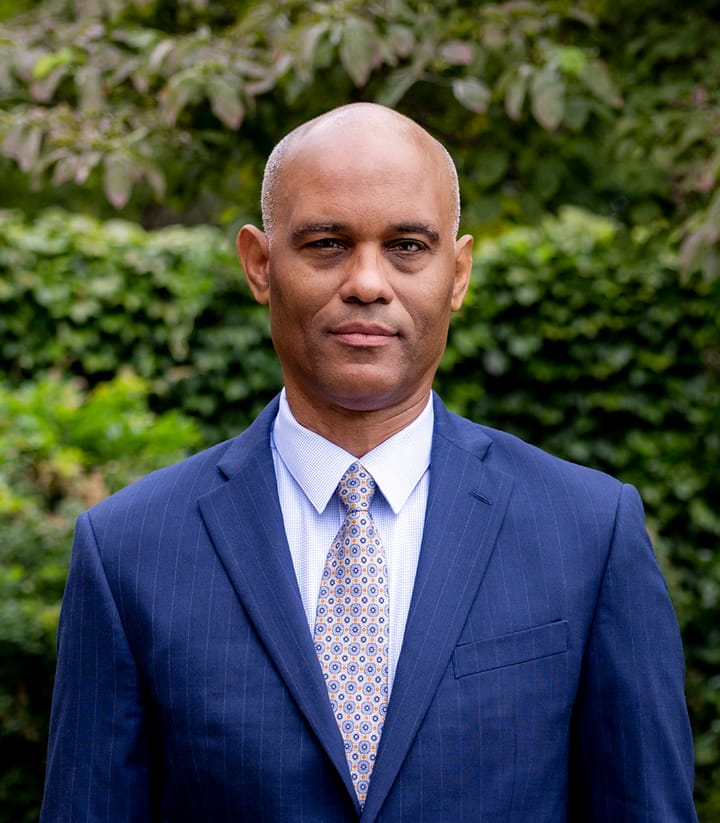
Michael Elliott ’92 is a lifelong scholar in 19th- and 20th-century American literature, a former Dean of Arts and Sciences at Emory University, and has served the Amherst community as the college’s President since 2022, searching for ways to build an Amherst culture on a post-Covid campus.
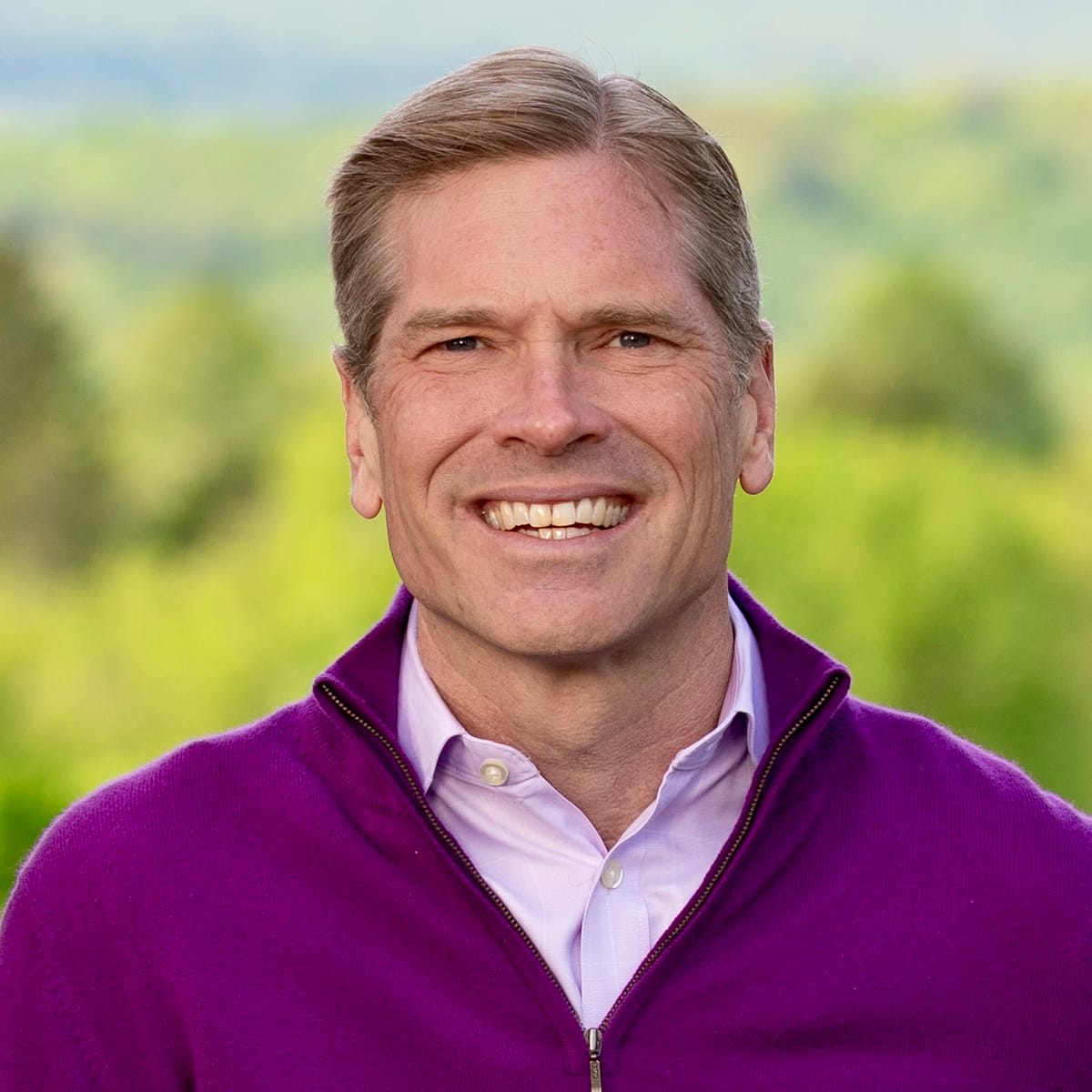
This past Friday, I ate lunch with Michael Elliott ’92, not for anything related to this profile, but because he wanted to have lunch with a few students. There was nothing in particular he came to ask or discuss; he just wanted to hear what was on students’ minds. I never thought about how unorthodox this sort of interaction would be at most higher educational institutions until I mentioned it to some of my friends at other universities and colleges around the nation. To me, it was simply how Elliott operated.
I also had the opportunity to interview Elliott one-on-one about two weeks earlier, on Oct. 4, in his office inside Converse Hall. During our conversation, Elliott was open and candid, sharing his personal background and insights with me.
Elliott grew up in Tucson, AZ, and attended a small high school while figuring out his college aspirations. “I had both ambitious ideas about my future and insecurities about whether or not I would be able to achieve it,” Elliott said. In the college search, Elliott specifically looked for a “very different set of surroundings” from Tucson’s desert and arid climate, along with a more walking-friendly area. Elliott’s criteria led him to New England and the plethora of colleges that fit the mold.
Despite the deliberate choice to go to this region for college, Elliott had never been to Massachusetts before Amherst’s admitted students day, nor did he have a familial connection to the college. “When I was a freshman in high school, I went to a college fair at a larger high school,” Elliott said. “I followed a student, whom I respected and whose father was a university professor, into an information session [and learned about Amherst for the first time].”
After applying to many colleges, Elliott did a trip around the country to several campuses. Elliott noted a few aspects that drew him to Amherst during his college touring. While Elliott mentioned the small school aspects and special faculty attention, his main love at the time was for the town. “I knew I would be coming without a car, and I wanted a place where I could get around when I have just two feet,” Elliott half-jokingly said. “That’s part of my stump speech now, but it’s a really true thing.”
Elliott’s love for Amherst continued to grow as he officially became a student in the fall of 1988. When discussing which extracurriculars Elliott did as a student, he primarily focused on his time working at The Amherst Student, mentioning pick-up basketball and DJ-ing for WAMH, too. Elliott told me that he had “the impression [or experience] that the students at the time did fewer extracurriculars and went deeper into them.”
Elliott’s time with The Student gave him valuable experiences in both breaking out of his introverted shell, through learning to pick up the phone and meet with different people across the college, and figuring out how the college and even town worked. “For my very first [article], I was assigned to [attend] the Amherst town meeting,” Elliott mentioned. “It was literally a different government structure, and you went into a large hall (the community center) and there were dozens of people bringing up different topics, lasting for three or four hours… I thought that was really interesting to be able to cover something like that.”
Elliott carried his journalistic curiosity into his courses and major interests, specifically in his English and Russian majors and occasional political science course. “All three [subjects] offer you the chance to reflect about power and society in the way that language and power intersect,” Elliott claimed. “It was a moment when all three were dabbling in some of the same philosophical questions, especially surrounding language.”
Elliott thought he would’ve majored in political science coming into Amherst, but he was captivated by how literary studies allowed him to think about the world. Elliott precisely told me that “literature offers us a chance to think empathetically about ways of organizing experience,” which led him to English.
Elliott’s political interest also led him down the Russian path, as he entered college toward the Cold War’s end, and witnessed its official end in his senior year. The political interest, though, was lost as Elliott continually pursued the literary side more and more. Elliott took Russian language courses from his first semester to his last, sticking with it despite self-proclaiming he was not the “most proficient major by a long shot.” Elliott said, “There are many people who were much better at the language, speaking and reading, and at a certain point I kept at it almost as a form of stubbornness to see if I could push my way through.”
As a Russian and political science double major myself, I was thrilled to talk with Elliot about Russian verbs of motion, which we both agreed were immensely difficult for non-native speakers. From my perspective, I also thought it was incredible that Elliott and I shared two professors central to our Amherst education: Howard M. and Martha P. Mitchell Professor of Russian Catherine Ciepiela ’83 and William Nelson Cromwell Professor of Jurisprudence and Political Science Austin Sarat. Elliott also mentioned L. Stanton Williams 1941 Professor of American Studies and English Karen Sanchez-Eppler as a notable professor who lasted from his time to mine, although Sanchez-Eppler retired from the English Department earlier this year. “The longevity of the faculty here is extraordinary, and the care that they have for their students is second to none,” Elliott said. “The faculty-student experience is really at the college’s core … The quality of attention, the quality of thinking that they bring to their pedagogy as scholars, is something that I see as a throughline of the Amherst experience through generations.”
Elliott took his Amherst teachings with him post-graduation, earning summa cum laude honors in 1992, traveling to Russia, receiving a Ph.D. in American Literature at Columbia University in 1998, and joining the Emory University faculty that same year. “The Amherst experience gave me the training to be able to do all those things and do them successfully,” Elliott stated. “What I carry with me is a strong belief in the value of a certain style of teaching, deeply engaged with undergraduates and centering academic life around that … One of the things that I admired about the faculty at Amherst was that they seemed very brave about taking on the questions, crossing disciplinary boundaries, and I wanted to carry that forward in my own path as a scholar.” Elliott also emphasized the importance of building relationships with students, noting that he keeps in touch with some of his first students and showed me a gift two of his first students gave him when he became Dean of Arts and Sciences in 2017.
Eventually, former Amherst College President Biddy Martin announced on Sept. 13, 2021, that she was stepping down as president at the end of the 2021-2022 academic year. While serving as the Dean of Arts and Sciences at Emory, the presidential opportunity “piqued” Elliott’s interest. We didn’t get too far into the specifics of his hiring in our conversation, but Elliott recalled the first meeting with the search committee over Zoom sometime around March 2022 and an in-person meeting in April. “It was almost like stepping into an Amherst seminar,” Elliott said. “They were asking big, complex questions, and they understood that the answers to the challenges facing the college were not easy.”
In those meetings, Elliott likely displayed the presidential qualities he believes are fundamental to the role. Elliott believed that his role requires that he is a great listener, specifically with what “people are saying and not just what they’re telling [me].” Elliott is also aware that his role will have him dealing with issues he may not be an expert on, which is a practice of humility and “learning to be comfortable with incomplete information.” Most importantly, Elliott believes a president needs to “articulate the aspirations of the institution.” Elliott told me that “[he] doesn’t mean [presidents] invent the aspirations, but rather speak on its behalf.”
“It has to be a vision true to the place and should nudge everybody forward a little bit,” he said. “You’re always charged with thinking on a longer horizon. It’s thinking about not just ‘how we’ll get through the next four years,’ but rather ‘where do we need to be in 10, 15, 20 years?’Are we making decisions now that will allow us to make sure we’re offering the same quality of education in the future that we aspire to offer now?’”
Elliott’s presidential vision won over the Board of Trustees and search committee, which led to his official appointment on Aug. 1, 2022. Much of our discussion from here focused on the many challenges he faced over the past four years, such as the Supreme Court striking down affirmative action, artificial intelligence, inflation, and skepticism about the value of liberal arts education, to name a few. Elliott identified the biggest issue as Covid, however, and how to cultivate the right Amherst culture coming out of a global pandemic. “When I came here, I quickly realized that Covid was more detrimental to a small college than a large university community,” Elliott said. “So much of what we do is in small groups, talking face-to-face, and Covid took that all away. In my first year here, I found many clubs didn’t always know what they were doing. There was a bit more of a suspicious attitude on the part of the students toward the administration, which makes sense considering the enforcement of Covid regulations for several years. And most faculty and staff meetings were still happening over Zoom. I think the last four years have been about building or rebuilding a culture for the college, which is a hard thing to measure.”
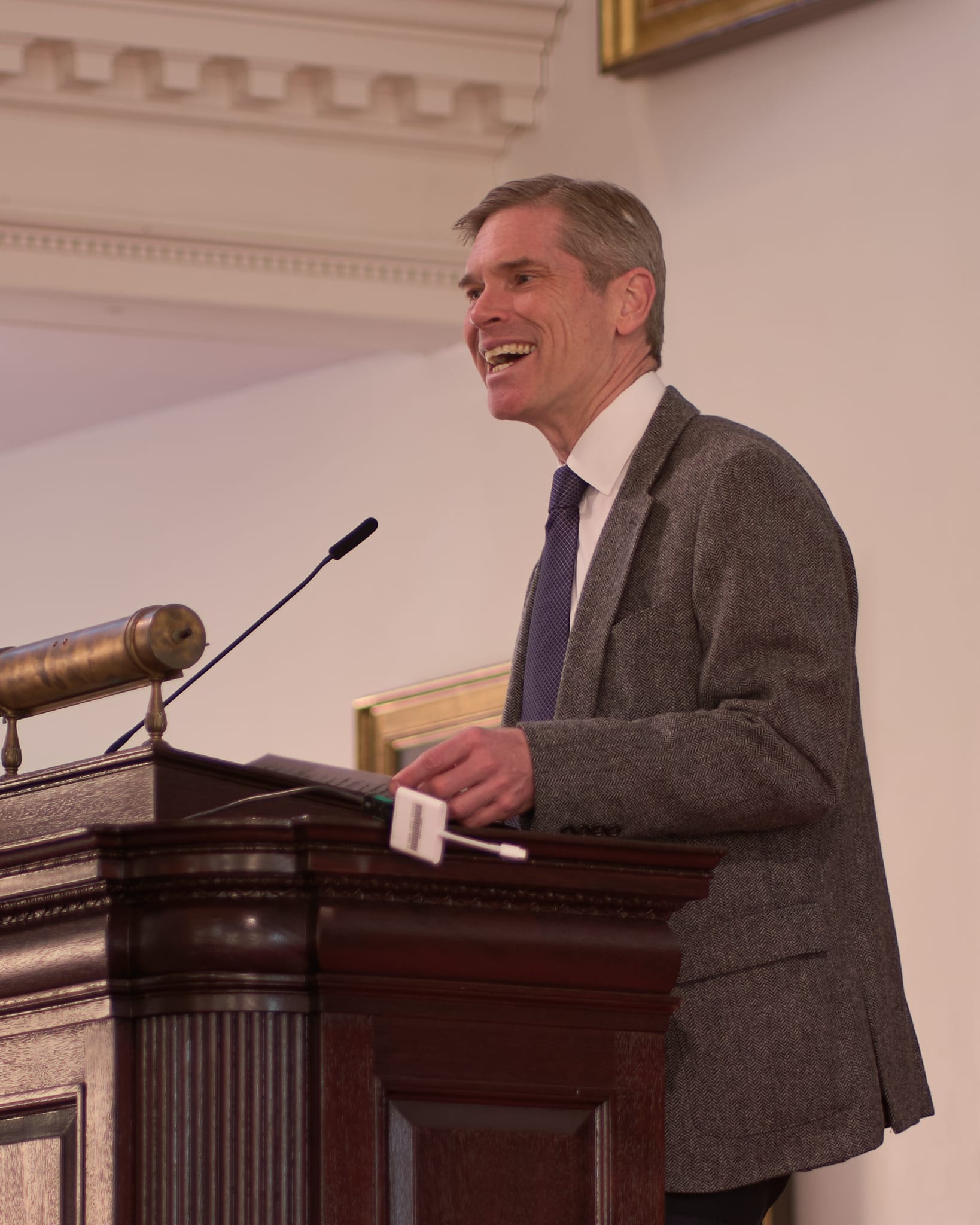
Despite the ongoing challenges, Elliott continues to take on difficult issues with enthusiasm and joy. One thing that keeps Elliott grounded and enthusiastic is what he calls “the little things.” Elliott said, “I love being able to see students progress over several years. I love hearing about the quality of their work, watching them come together for orchestra or on the sidelines of games … This is a community of learning, which means we have to talk and listen to each other. We’re not always happy all the time, but there are those moments of happiness and joy. That day-to-day stuff is a lot of fun.”
Elliott does, however, have criticisms of Amherst past and present. “One of the biggest disappointments [when I started] was the career center,” Elliott said. “There was a kind of assumption that it wasn’t providing the support necessary for students who graduated from Amherst. Now I feel much better about how we help students navigate what comes next.” Ironically, the critique here also fed into what he sees as another problem with Amherst students today. “The career center and, in turn, the anxiety that students feel about what they’re going to do after they graduate and how intense that is, I think, sometimes leads them to make sub-optimal choices during their time here,” Elliott said. “Amherst students are extraordinarily successful after they leave, and it’s not because of their GPA or extracurriculars, but because of what and how they’ve learned here. I wish students could enjoy and build into their Amherst experience more time to breathe and take risks. I think everyone would be better off, including students, if they would build in a little bit more time for reflection and not worry so much about doing everything.”
Elliott seems to embody this idealized mentality well in his daily role as president, considering how available he is not only to student leaders and faculty, but to the entire student body as a whole. Elliott carves out time specifically to “breathe and take risks,” whether for a La Causa event or lunch in Betty’s Kitchen. “I really like that I can be accessible,” Elliott said. “You see me walking around; I like being able to do that and walk across campus and know that people might stop me and talk for a few minutes. That’s the kind of thing you can do as president of a small college that you really can’t at a larger institution.”
Comments ()