

Jhumpa Lahiri’s Languages of Foreignness
Managing News Editor Ira Buch ʼ29 reports from the third annual Rhonda Cobham-Sander Lecture, where Pulitzer Prize-winning author Jhumpa Lahiri discussed her process of translating Ovidʼs “The Metamorphoses,” and her unique proto-feminist interpretation of the poem.
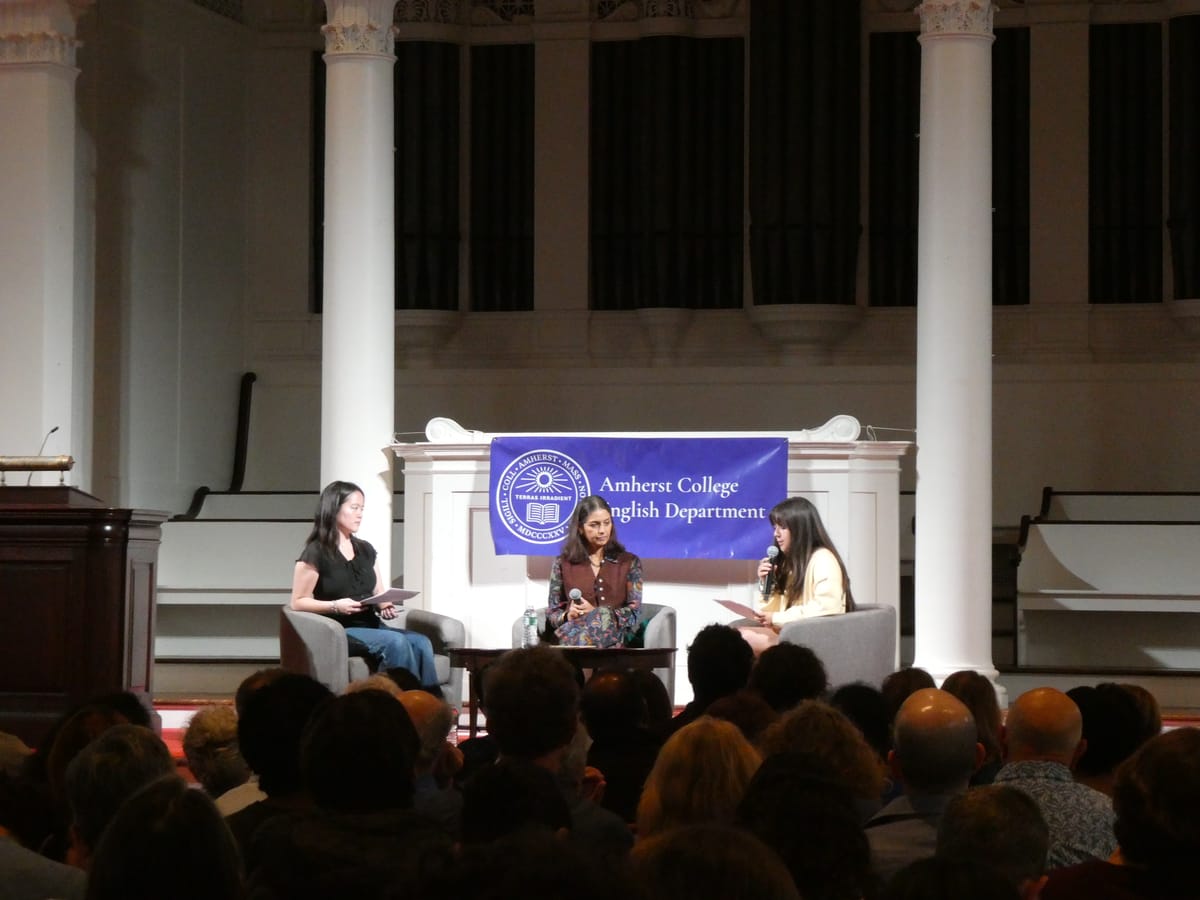
On Thursday, both floors of Johnson Chapel buzzed with anticipation as students, faculty, staff, and town residents came together for the third annual Rhonda Cobham-Sander lecture. This year, the campus welcomed Pulitzer Prize-winning writer, translator, and Millicent C. McIntosh Professor of English and Director of Creative Writing at Barnard College, Jhumpa Lahiri. Interns at The Common Mila Massaki Gomes ’27 and Rina Huang ’27 moderated the discussion.
Lahiri opened up about feeling foreign in both English and Bengali, and eventually, Italian, which she learned as an adult. She also shared her thoughts on her latest project — translating Ovid’s “The Metamorphoses” into English. Working alongside Kennedy Foundation Professor of Latin Language and Literature at Princeton University Yelena Baraz, Lahiri devoted nearly six years to the endeavor.
Lewis-Sebring Professor of Humanities and Latin American and Latino Culture Ilan Stavans introduced Lahiri, describing her as “an extraordinary writer,” whose works are “deep, probing, [and] insightful into the value of language and the endurance of the immigrant experience.” Yet, his description of Lahiri extended beyond her literary mastery. Stavans, a close friend, spoke of life beyond the page: “We have spent many evenings together. We have swam together. We have raised kids more or less together, and I have been able to see what happens outside of the page that infringes and projects itself in the page as well.”
The act of swimming — particularly the pond Stavans referenced swimming in — became a motif of the night. Stavans described a pond in Cape Cod where he and Lahiri sometimes swam across at dawn, a place that was, for him, “a metaphor and also a reality.” The image resurfaced (yes, the metaphor got to me too) when Lahiri later compared learning Italian to crossing another lake. This time, it was unfamiliar, cold, and unsettling, yet calling to her all the same.
Lahiri opened with a reading from her new translation of “The Metamorphoses”: a dramatic passage that describes Deucalion and Pyrrha, the last survivors of a flood, throwing stones against their shoulders and watching the rocks transform into human flesh. This passage, Lahiri explained, is one of the epic poem’s over 250 transformation scenes, which taught her how to think about translation itself. She described the art of translation as “a radical, fundamental transformation that is not about one thing substituting for another, but one thing becoming another.”
The theme of transformation carried into the author’s response to the first question about how learning a new language influenced her relationship with her first language, Bengali. Lahiri complicated the premise and rejected the distinction between “foreign” and “native.” She argued, “All languages to me are foreign and always have been.”
Growing up, the author drifted between two languages. Bengali, the tongue of her first words, filled her childhood home, yet she was never taught to read or write in it. English, the language of her schooling and the country around her, felt emotionally distant.
Lahiri did not associate this multitude with a loss; instead, she focused on the opportunities it opened — particularly, learning Italian as an adult and eventually publishing essays, poems, and short stories in the language. “I think that experience of really not feeling that I had a linguistic point of reference, a kind of unquestioned point of reference, opened up the space for this Italian experience,” she said.
The feeling of foreignness, according to Lahiri, followed her across her writing journey. “I think all my work has been about the same thing from the very beginning,” she explained. “I think that’s what writers do — they keep examining a few questions they have about life, about existence, about their place in the universe, or in my case, their lack of place.” Pick up any of her books, which I strongly recommend, and you will encounter themes Lahiri is strikingly familiar with: assimilation, integration, and immigration.
These themes are not necessarily a choice, she insisted, just like the writing itself. “Artists don’t make art because they would like to; they have to. So writing is a matter of life and death for the person who writes. And if they don’t write, they can’t live,” she said.
A similar theme of the refusal of a single, pure origin is also evident in how Lahiri reads “The Metamorphoses,” which manifests in her and Baraz’s unique translation of the text. For many scholars, the text appears misogynistic, thick with vivid violence against women.
Lahiri pushes back on that interpretation. Women in the poem, she argued, are not mere victims. Instead, Ovid is “extraordinarily attuned to the female voice and to the female body.” For example, take Medea, one of the most controversial (an understatement, considering she does kill her children) female characters. Rather than focusing on women as recipients of violence, Lahiri pointed to the fortitude of female creation through what Medea makes: She is a witch who is constantly mixing substances, and Lahiri suggested she might be a stand-in for the poet himself. She reads the mixture as one of the poem’s main projects. Ovid is against purity and against any one thing staying whole. In Lahiri’s reading, that makes “The Metamorphoses” not only a proto-feminist text but a proto-anti-fascist poem, one that celebrates a mixture of voices and opinions.



Comments ()