

Joline Fong: The Luck Theory
From pumpkin carving at Fall Fest to late-night walks home from swim practice, Joline Fong has built her Amherst experience around connection, curiosity, and gratitude.
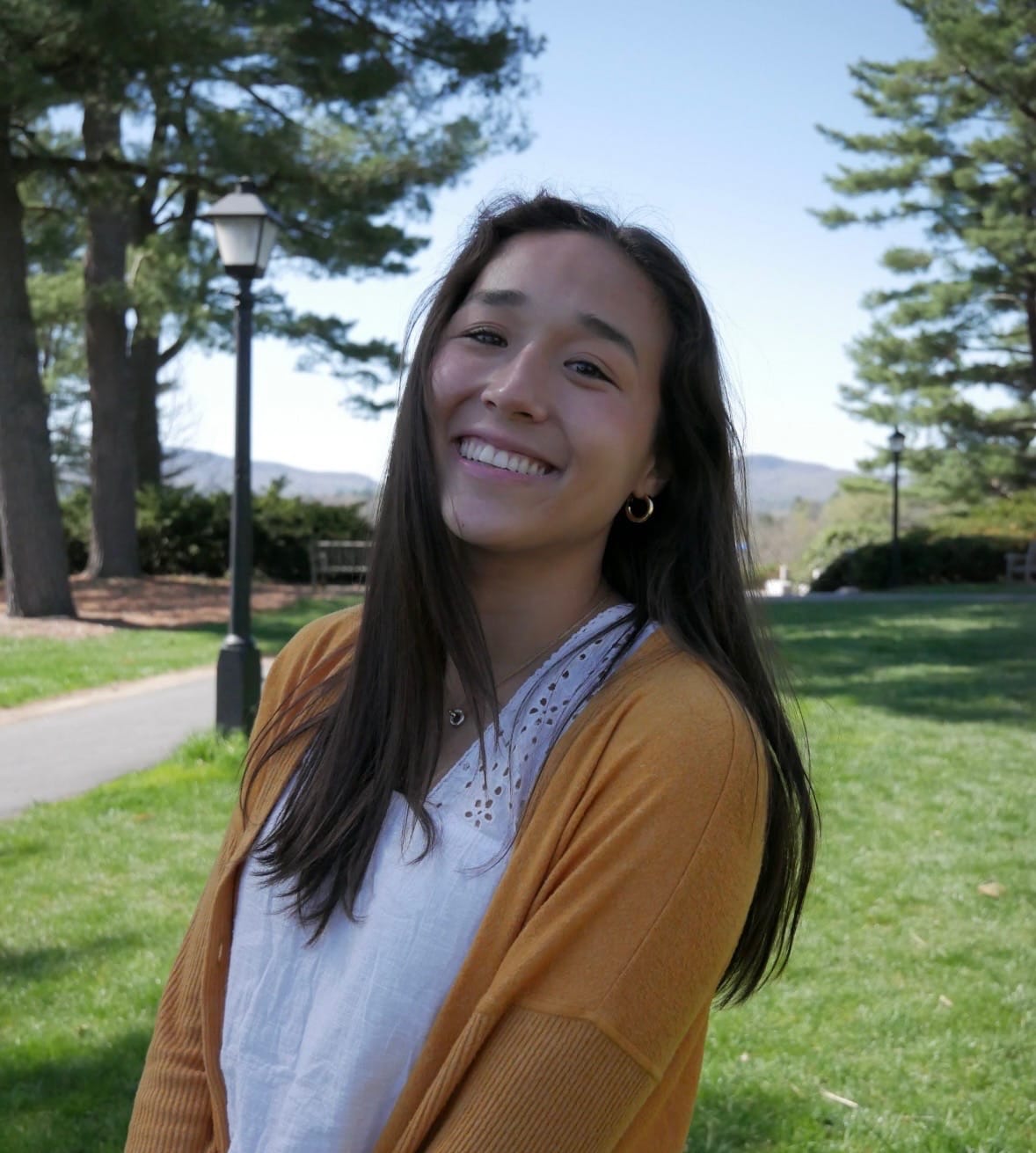
At the end of our interview, I called the duck necklace Joline Fong ’26 wore around her neck a “Lucky Duck.” Lucky because that was the word she incessantly used over the hour and a half that we spoke — lucky because she’s an All-American swimmer, because she’s thriving after three brain surgeries (with a fourth to come), and because she was admitted to Oxford University’s Medical Anthropology master’s program, to name a few of her so-called “luck-based” accolades. But beyond “Lucky Duck” being a name for the charm around her neck, and as a stand-in for how she describes herself, I take that word back in its entirety.
Relentlessly curious, with an endless appetite for people, stories, and learning — and incapable of doing anything halfway — Fong makes it incredibly difficult to believe that she is someone things simply “happen” to.
Learning for the Sake of Learning
Fong grew up in Brooklyn, N.Y., with two older sisters and a younger brother. Her childhood consisted of an eclectic mix of the Harry Potter book series, a serious stint in bird watching (hence the duck necklace), and lots of time at the pool. In fact, swimming was actually something she and all of her siblings took up due to a simple fear of her father’s: “He didn’t know how to swim, so he wanted all of us to so that we could save him if he drowned,” she told me, smiling. I don’t think her father could have predicted that he would be trading life-saving services for three college swimmers (nearly four, if you include the younger brother she’s currently trying to recruit to Amherst College).
Beyond the pool, Fong’s early education would later pave the way for what I can only describe as a compulsive love of learning. She attended St. Ann’s, an arts-focused school in Brooklyn with no grades — something she noted that people often romanticized as an easier version of school. But the way she describes it, it required the opposite. “I grew to love learning for the sake of learning,” she said.
Beyond that being a remarkably quotable quote, I noticed that instinct — to learn simply for the joy of it — in nearly everything she spoke about: the twinkle in her eye when she described her daily New York Times mini crossword ritual, the open-faced steak sandwich she was perfecting for her Molecular Gastronomy class’s Chem Fest competition, or the fact that she somehow managed to shop 17 classes during her sophomore spring semester simply because she couldn’t decide what interested her most.
Throughout our conversation, Fong kept returning to the same ideas in different forms: She likes stories. She likes complexity. She likes understanding how things fit together. President Michael Elliott later described her to me as someone who combines “deep curiosity with real emotional intelligence” — a person “truly interested in other people and what they think.” That attentiveness appears everywhere in the way she moved through Amherst. To her, anthropology, medicine, swimming, correctional healthcare, Valentine Dining Hall (Val) meals, and late-night conversations with teammates are not separate interests so much as different ways of intently caring for and connecting to the people around her.
Falling for Fall Fest
Fong’s path to Amherst was slightly unconventional. Though she had a spreadsheet filled to its brim with pros and cons of “100 different schools,” all it took was one Zoom call with a then-senior on Amherst’s swim team and a mention of Fall Fest — complete with pumpkin carving and horse-drawn carriages — for her to be completely sold.
Luckily for Fong, her gut instinct proved correct, because the second she set foot on campus, she fell in love. Actually — and this is not an exaggeration — I have never spoken to someone who loves Amherst more. She worships the ground Val stands on, speaks about Amherst Coffee with the loyalty of a brand ambassador, and, yes, she maintains that Fall Fest “absolutely lived up to the hype.”
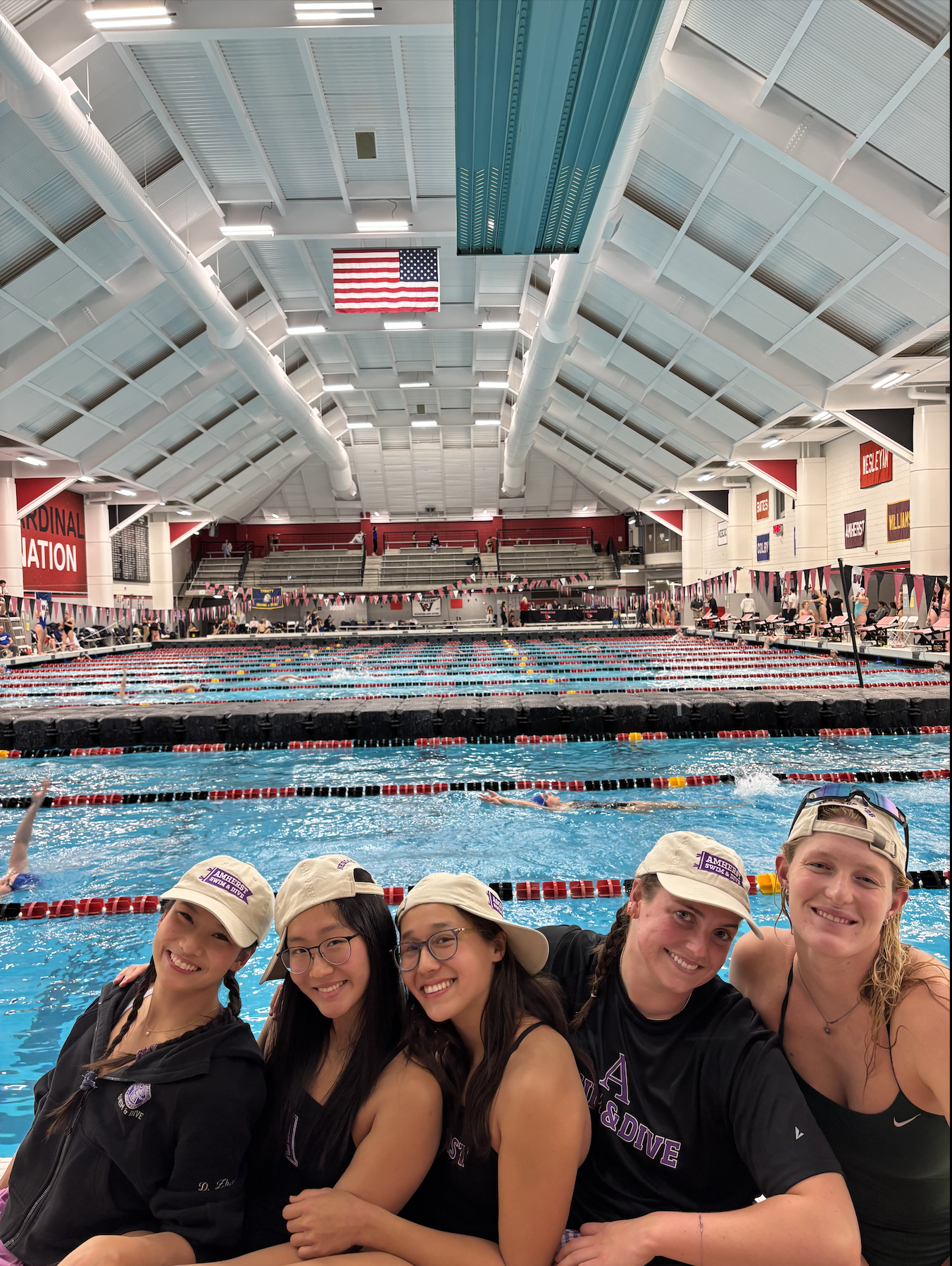
One of the biggest reasons for that love, she says, is, of course, the swim team, which she described over and over again as a “family.” She cites sledding down Memorial Hill, team trips to Puerto Rico, and even just walks to and from practice as some of the most meaningful memories of her college experience.
Objectively speaking, Fong’s Amherst career borders on absurd: she’s a captain of the Amherst swim team, anthropology thesis writer, Oxford master's degree program admit, research assistant, and future community health fellow. But what struck me most throughout our conversation was how instinctively she gravitates toward people and rituals rather than her accomplishments. Even as we discussed objectively extraordinary milestones, she remained down-to-earth in her appreciation for the ordinary moments in her life.
Threads of Amherst Life
What also became increasingly clear to me throughout our conversation was that Fong experiences Amherst almost entirely through what she calls “threads.” Stories leading to other stories, classes leading to friendships, or one conversation somehow reshaping the next three years of her life. She talked about Amherst less as a sequence of isolated experiences and more like an impossibly tangled web in which everything folds back into itself.
Sophomore fall, for example, she was “serendipitously” friends with two seniors taking a special topics course with President Elliott on public history and monuments. Somehow, despite being neither a history nor an American studies major, she ended up in the class, too. Every Monday morning, the four of them would meet in Elliott’s office for class while enjoying coffee. “It was so so cool,” she said, laughing.
That class — which eventually led her to research Amherst traditions and the Sabrina statue — also led to dinners at the president’s house. At one of those dinners, she ended up sitting next to Manwell Family Professor of Psychology Alan Hart. Then came another thread. After meeting Hart, she joined his research team, later took his course “Intergroup Dialogue on Race,” and eventually became a teaching assistant for the class.
Meanwhile, her sophomore-year course, “Medical Anthropology,” with Professor of Anthropology Christopher Dole (who later became her thesis advisor), completely reshaped her understanding of medicine. “I was like, wait,” she remembered thinking, “medicine and being a doctor isn’t just about labs and sciences.” Instead, she became increasingly drawn toward the human side of healthcare.
Even her friendships seemed to emerge through these same strange circular Amherst loops. Her freshman-year roommate, Ayres Warren ’26, now sits beside her once again in their final required anthropology course. “I love little full-circle things like that,” Fong said. “You get them all the time at Amherst.”
In many ways, Fong’s Amherst experience seems defined by this constant accumulation of threads — intellectual, personal, accidental — with just one of her million curiosities seamlessly folding into the next. And for a long time, that momentum seemed endless. Then, midway through her junior year, she learned she had a brain tumor.
Path to Recovery
While trying to get fitted for contact lenses, doctors discovered a brain tumor “the size of [her] fist.” At the time, in what she described as a frankly “absurd” coincidence, she was simultaneously taking a class called “Approaching Death” and learning about cancer pathways in biochemistry. “I was like, ‘I hope this isn’t some horrible sign,’” she told me, laughing.
Thankfully, the tumor was benign. Still, three days after finals ended last spring, Fong underwent her first brain surgery. Recovery was slow and difficult: She had to relearn how to walk, found herself winded simply getting out of bed, and lost sensation on the left side of her face. Even now, she still visits the eye doctor weekly while preparing for another surgery that will hopefully restore sensation to her face.
Listening to her talk about her operations, I started to realize that what Fong means by “luck” is perhaps less about ease and more about gratitude — an almost stubborn commitment to noticing what remains beautiful even when things become terrifying. For example, the day before surgery, she told me that she went on a run, drank coffee, and journaled. “I want to become a better person through the surgery,” she wrote to herself.
As she walked me through what anyone would consider a terrifying experience, she didn’t once center her fear. Instead, she looped everything she learned through this process into perspective and grounded “little moments,” such as the first time she got back into the pool and sent a video to her doctor, telling him she was “back.”
Later in our conversation, Fong told me that her senior assembly speech would center almost entirely on the importance of these “little moments.” “With the brain,” she explained, “it’s so overwhelming, and you cannot focus on these huge possibilities.” So instead, every single day, she deliberately chooses to return her attention to smaller joys — checking what’s for dinner, cashing in one of her (many) Amherst Coffee punch cards, or sitting on the quad with friends — tiny moments that are seemingly insignificant on their own, but that cumulatively matter the most to her.
Finding Humanity in Medicine
In many ways, her fascination with medicine seems inseparable from that same attentiveness. As an anthropology major, Fong’s academic interests consistently gravitated toward the deeply human side of healthcare — the ethical ambiguities and emotional tensions that exist beyond hospital charts and lab results.
Her senior thesis, focused on correctional healthcare, examines how providers navigate caregiving within prisons and jails — institutions fundamentally designed around punishment rather than healing. Over the course of the year, she interviewed doctors and nurses across the country, asking them how they reconcile care with violence.
The project emerged after she completed a summer internship at Bellevue Hospital in New York City, where she watched incarcerated patients from Rikers Island receive treatment while chained to hospital beds. “How do you care for someone who’s done something horrible?” she asked.
What moved her most, though, was not necessarily the research itself, but the responsibility of it. Again and again, interviewees entrusted her with deeply personal stories about caregiving, violence, and moral dilemmas. “I felt like I was gifted these stories,” she told me. “I had to write a thesis worthy of them.”
That curiosity — relentless and deeply human — is what will take her to rural Alabama after graduation, where she’ll spend the next year working for Project Horseshoe Farm, a community-based health fellowship, before eventually applying to medical school.
While you might remember that she was admitted to Oxford for a Master’s degree in Medical Anthropology, fully funded through an Amherst grant (as one does), Joline was also awarded an English Teaching Assistant Grant to Germany with the Fulbright Program. Of the three opportunities, she ultimately decided on the healthcare job, saying, “Going to rural Alabama is honestly probably more [of an] abroad experience.” Meanwhile, I sat there in awe listening to her describe having to make that choice at all, again wondering how someone who called herself “so lucky” could possibly believe that luck alone had gotten her there.
Exchanges of Gratitude
Prior to meeting Fong, I had, of course, done some diligent LinkedIn stalking and consulted a few of my own friends on the swim team about her. The overwhelming consensus was some variation of: this girl is so incredibly impressive. And yet, from the second we started talking, I found myself completely at ease with the person sitting across from me.
That reaction, as it turns out, is not unique to me. One teammate of hers, Sabrina Victor ’28, remembered arriving at Amherst for her recruit trip “extremely anxious about the whole experience,” only to be “immediately greeted by Joline’s big smile and welcoming hug,” Victor said. “That kind of thing is just very, very Joline.”
Throughout our conversation, Fong would occasionally pause, get a little sentimental, and tell me in true thread-like fashion, “thanks so much for doing this, by the way, it’s so nice bringing up all these memories.” And while I appreciated the gratitude, I would much rather extend my thanks to Joline because, in an interview that I thought would be 20 minutes and instead spanned an hour and a half, I learned just how disarming it can be to sit across someone so radically curious and caring.
So no, I don’t actually think Fong is lucky in the passive sense of the word, as though life simply keeps happening wonderfully to her. Rather, I think she has cultivated something much harder: a deliberate and rare attentiveness to joy, community, and gratitude, even in moments where it would be far easier to retreat into fear. That attentiveness appears everywhere in her life — in the way she talks about professors and teammates, in the seriousness with which she treats other people’s stories, in her adoration of Val meals and Fall Fest, and most importantly, in her appreciation of the little rituals that most overlook.
Comments ()