

Katya Havryshchuk: ‘Just Enjoy the Process’
Whether it’s through Intersections Dance Company, Amherst’s Ukrainian community, or the Physics & Astronomy department, Katya Havryshchuk has given back to the college in many ways.
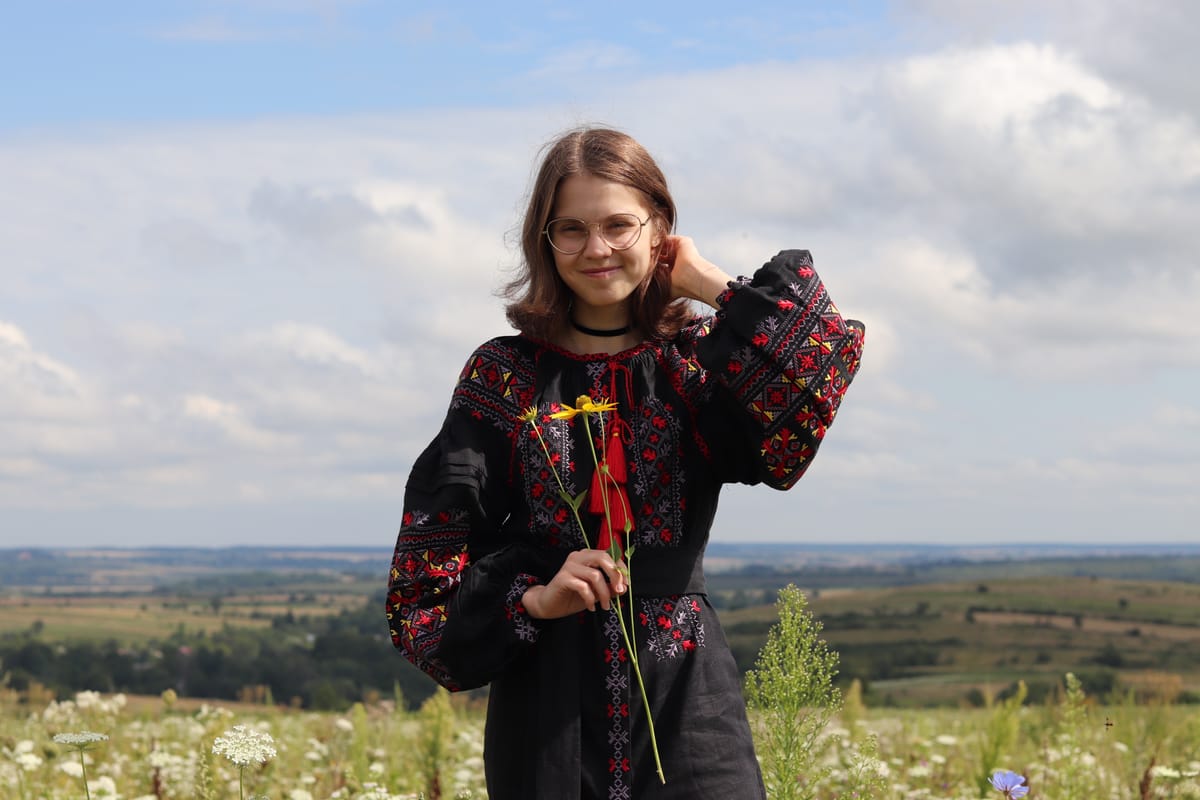
I didn’t expect my first time meeting with Katya Havryshchuk ’26 — a physics and math double major, a teaching assistant (TA) for eight classes across her two majors, and a student researcher at Fermi National Accelerator Laboratory (Fermilab) — was going to be spent talking about books. I was expecting my experience to feel more like cramming an entire semester’s worth of science the night before an exam: lots of technical jargon, but not so much understanding.
But Havryshchuk surprised me. I learned that she’s looking forward to an upcoming English translation of Ukrainian author Sofia Andrkhyovych’s 2020 novel, “Amadoka,” and also enjoys reading the works of Terry Pratchett in not only the original English but the Ukrainian translation as well. One of her favorite classes was Assistant Professor of English Nozomi Nakaganeku Saito’s 400-level class, “Literary Fieldworks,” where Havryshchuk was able to “explore the history of [her] family” through a research project.
Havryshchuk’s literary interests, of course, aren’t the only thing she’s known for on campus outside of the physics and math departments. You might’ve listened to her winning speech at the 2023 Speaking Competition, her exhibition on Ukrainian stories that same year, and her involvement in Intersections Dance Company.
Grace Under Pressure
Havryshchuk is from Kyiv, Ukraine, although she’s spent a lot of her childhood visiting her relatives in Crimea pre-annexation and Western Ukraine. She admitted that while she felt annoyed at having to travel such distances when she was younger, she’s now “very grateful” that her parents forced her to spend those summers with her relatives on their farm “without really anything else around.”
It was during her time at home that her diverse set of interests and hobbies first began. Havryshchuk recounted how she enjoys spending time with her grandmother, who taught her how to cook. She particularly likes baking honey cake, a piece of home she continues to recreate for her friends here (in fact, when I asked her friend, Venumi Gamage ’26, about Havryshchuk, one of the first things Gamage told me about was Havryshchuk’s honey cakes). Havryshchuk explained that the cake requires rolling each layer separately before layering them on top of each other: “When you [eventually] have 20 of them, it’s so much work. But you usually benefit from having people around you and doing it with you.”
As I listened to Havryshchuk describe her time leading up to Amherst College, I realized her ties to the different communities she interacted with were something that was inseparable from her life story. She had originally attended a public high school not too far from her home before later transferring to Novopecherska School, an elite private school that the current Ukrainian President Volodymyr Zelenskyy’s daughter also attended.
Havryshchuk explained that although her high school didn’t have access to that many resources, she and her friend once tried to create a model of the Large Hadron Collider (LHC), which is located near Geneva, Switzerland. Many may recall that the LHC discovered the Higgs boson (perhaps you may have heard of its sensationalist nickname: the “God particle”), which helped scientists understand how particles acquire mass. Havryshchuk’s model, which was made using polyfoam, was supposed to use gravity to accelerate the balls in a manner accurate to the particle collisions in the LHC.
Eventually, when she transferred to Novopecherska, she had the funding and resources to build a cloud chamber, which “tracks particles that are traveling through space” using alcohol vapor. It was also during this time of her life that she joined the Junior Academy of Sciences of Ukraine (JASU), an organization that helps select students to pursue research projects. At JASU, she took part in an initiative called “Agents of Change,” a year-long, four-stage program that culminates in a small project. Havryshchuk explained to me that her project, a summer festival for youth called “Lucky Fest,” taught her that she was capable of doing anything as long as she had enough motivation for it.
Despite these early excursions into science, Havryshchuk admitted that she still wasn’t sure whether she was interested in physics at the time: “I think that I was less interested in physics [and] more interested in questions that physics posed.”
Unsure about what she wanted to pursue after graduating, Havryshchuk took a gap year. She spent this time as a student at the Ukrainian Global Scholars (UGS) program, which helps students get placed into educational institutions outside of Ukraine. During this year, she also co-founded the National Astronomical Club at JASU, where she and others gave lectures on the different aspects of astronomy, physics, astrophysics; when Russia’s full-scale invasion of Ukraine began in 2022, the National Astronomical Club cooperated with several other youth organizations to organize a two-month long lecture series, where one of the lecturers happened to be Amherst’s Associate Professor of Astronomy Kate Follette. But Havryshchuk didn’t take an interest in Amherst until another UGS alumnus, who was a student at Smith College, later told her about the college.
Havryshchuk looked deeper into Amherst and liked what she was seeing: “I enjoyed the breadth of subjects, as well as the focus on critical thinking and the ability to incorporate different types of knowledge into whatever you’re doing — essentially being a well-rounded person who sees the world from very different perspectives … it just felt like the right place.” She soon realized that college’s small-town setting reminded her of the freedom she felt when she visited her relatives in the Ukrainian countryside: “There is a town and forests [as well], where you can go and become isolated … no one is there to judge you.”
Putting the “Discipline” in “Interdisciplinary”
Havryshchuk’s earliest memory of Amherst was her international peer orientation, which was also where she met Gamage and many other friends. But what truly stuck out to her were the course offerings.
Instead of using the open curriculum to take only physics and math classes, Havryshchuk took a physics, math, and Film and Media Studies (FAMS) course during her first semester. It was during this semester that she first met Associate Professor of English Amelia Worsley and Nancy and Douglas D. Abbey ’71 Professor of English in Film and Media Studies Amelie Hastie in “Amherst Poets” and “Film and Writing,” respectively. Even if she isn’t an English major, Havryshchuk has maintained close ties with both Worsley and Hastie — Worsley told me how Havryshchuk had gotten her baby a Ukrainian toy, even while Havryshchuk family’s was experiencing strain from the full-scale invasion.
Despite her close connections to the English department, Havryshchuk commented that it was difficult adjusting to the pacing of Amherst’s humanities curriculum. She recalled spending hours at the Writing Center trying to figure out what a proper essay structure looked like: “[Taking my first humanities courses] felt a little difficult for me, especially because I initially wasn’t sure how to write essays.” Luckily, all that effort paid off: Later in her freshman year, she received the English department’s 2023 Armstrong Prize for excellence in composition.
In her physics classes, meanwhile, she found the adjustment much easier. When she took “Maxwellian Synthesis” with Mark W. Perry ’65 STEM Presidential Teaching Professor of Physics William Loinaz, she was enthralled by the course material: “I love this class … I felt so fascinated by it, and the topics were so exciting.” Her engagement in her science and math classes led her to become a teaching assistant (TA) for several courses, for which she won first place for the 2023 Basset Physics Prize for excellence in introductory physics, as well as the math department’s 2024 Walker Teaching Award. Gamage, who took several math classes that Havryshchuk was a TA for, commented that Havryshchuk was one of the most humble people she’s ever known: “She’s taught me how valuable it is for someone to be so unfailingly patient.”
Havryshchuk continued engaging with the physics community at Amherst by serving as co-chair of the physics and astronomy department’s Climate and Community Committee (CCC). The CCC addresses the department’s work and social climate, oftentimes by focusing on issues such as student-faculty engagement. For Havryshchuk, being a part of the CCC echoed her previous commitments to JASU where there were very few female students in her physics classes: “There’s a perception that it’s very innovative to be a woman in science, and I definitely felt proud of that, but that perception also brings a lot of challenges.”
Unsurprisingly, Havryshchuk has also engaged with and earned recognition from communities beyond the physics and astronomy department. She won at the 2023 Speaking Competition for “Best Overall Persuasive Speech”: The theme for that year was “POWER,” and her speech was titled “My Step Towards Peace.” Worsley remarked that her presence continues beyond the podium. Even years later, she recalled what it was like to hear Havryshchuk speak in class: “What remains is not so much the exact thing she said, but that memory of her, her demeanor, her way of speaking, [all of which is] so strong.”
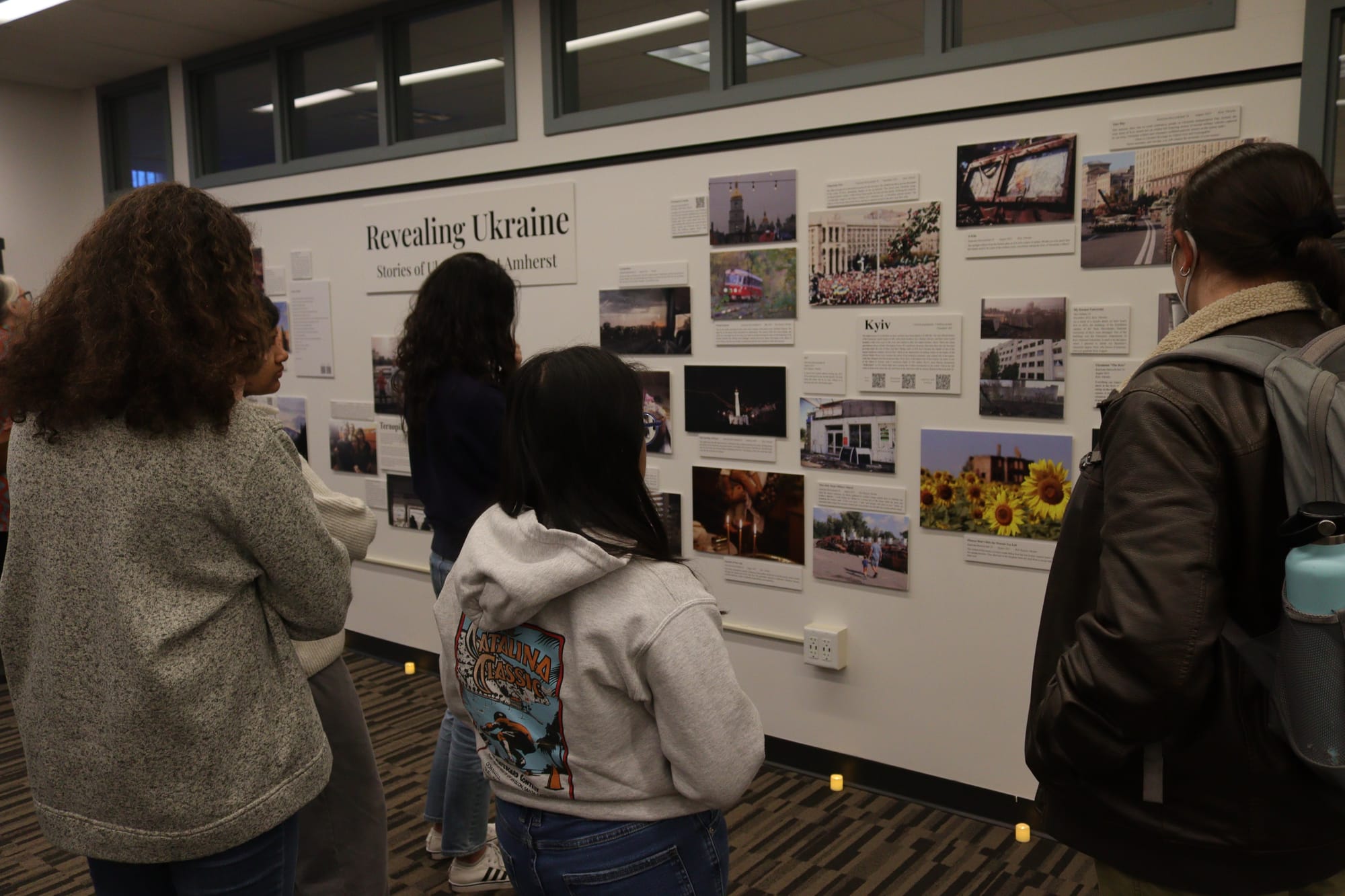
Besides the Speaking Competition, Havryshchuk also engaged with the public through her 2023 exhibition titled “Revealing Ukraine: Stories of Ukrainians at Amherst.” The exhibition included a series of photographs from the hometowns and places six Ukrainian students (Havryshchuk herself included) loved about their home country — both before and after the 2022 full-scale invasion. “Our goal,” Havryshchuk explained, “was to show that our country is more than a point of tension on the world map — it has a unique culture, a distinct voice, and a vibrant spirit that is often omitted from news headlines.”
Havryshchuk’s passion for public engagement has gone beyond the exhibition: She has also helped Assistant Professor of Theater and Dance Jenna Riegel with her fall 2024 dance repertory project; more recently, Havryshchuk choreographed a piece for the student dance team Intersections Dance Company, which used the recording of a Ukrainian subway as a soundtrack. It asks the viewer to consider all the different personalities you encounter when you’re on a subway — things like interview appointments, dates, tours. “Sometimes you don’t realize how many stories travel with you while you’re on a train,” Havryshchuk explained.
Optimizing ... Nuclear Reactions?
Havryshchuk’s interest in physics also led her to work in two labs during her freshman year: Paula R. and David J. Avenius 1941 Professor of Physics David Hall’s research group, which is researching the Bose-Einstein Condensate; and Assistant Professor of Astronomy Daniella C. Bardalez Gagliuffi’s research group, which is researching brown dwarves and exoplanets. While Havryshchuk learned a lot from these two experiences, she ultimately realized that she didn’t like experimental lab work as much as computational work. And these labs, as interesting as they were, didn’t match what Havryshchuk was looking for: nuclear physics.
Because opportunities for undergraduates in nuclear physics are difficult to come by (let alone for international students), she decided to aim for the closest approximation, which was particle physics and accelerator physics. This interest led her to Illinois’s Fermilab during the summer of her sophomore year, where she researched exotic particles. If the name “Fermilab” sounds familiar to you, it’s because this was the lab that discovered the top quark, bottom quark, and tau neutrino. These three particles, among others, experimentally confirmed the Standard Model of particle physics.
For her thesis, Havryshchuk is investigating alternative ways to model targets. Targets are stationary objects that scientists direct a beam of particles toward — the resulting collision causes a nuclear reaction, which releases exotic particles such as pions, muons, photons, and neutrinos. One issue facing this experimentation model is optimizing the target to withstand the destructive power of particle beams. The target’s material directly affects the number of particles emitted under beam exposure, while the design affects the target’s stability — the wrong combination of these could result in the target melting, fracturing, or even exploding during an experiment. At Fermilab, this process requires the expertise of both a physicist and an engineer, not to mention the expensive and recondite simulation tools (usually needing a supercomputer) that slow down the optimization process.
Havryshchuk’s thesis aims to streamline this process by combining the softwares Fluktuierende Kaskade (FLUKA) and Ansys Student into one workflow for target testing. FLUKA is meant for particle interactions, whereas Ansys Student is meant for engineering. The innovation of Havryshchuk’s work is that this new workflow would not only be more streamlined than the current process, but more accessible — both softwares are free for science and engineering students alike. To quote from her thesis: “If any willing scientist or engineer in the Target Systems Division, regardless of qualifications or access to computing resources, could carry out preliminary target testing, how would it affect the deployment of a functional Mu2e target?”
Radiating with Knowledge
Havryshchuk’s eventual goal is to give back to her home country through her scientific knowledge. After talking to some industry professionals, however, she quickly realized that her Amherst education wasn’t enough to address the problems Ukraine is currently facing — she needed to do more, which is why she will be fulfilling her lifelong interest in nuclear physics by pursuing a Ph.D. in Nuclear Engineering & Engineering Physics at the University of Wisconsin–Madison. Havryshchuk hopes that the experience and knowledge she will gain from her Ph.D. program will allow her to contribute to Ukraine’s energy system.
Since high school, Havryshchuk’s wanted to understand how new generation nuclear plants can be implemented in electric grids since high school. She further explained that “approximately 40% of [Ukraine’s] nuclear grid is based on nuclear power,” a number which is expected to climb even higher due to the ongoing invasion: “Because of all of the missile attacks on other power plants around my hometown … they can no longer provide the necessary energy.”
From all the interviews I had with her friends and professors, the one thing that stuck out to me was how much they all appreciated Havryshchuk’s resilience: She has kept giving back to her college community in a variety of ways, be it baby toys or her patience as an eduactor, even as her home country faces massive political strain. But perhaps “giving” isn’t the right word; Havryshchuk explained that engaging with her communities was what sustained her throughout her time at Amherst and encouraged future students to explore different communities and interests. “Just enjoy the process,” she said. “Taking classes that have nothing to do with my major has been an important part of my experience [at Amherst] — emotionally, psychologically, as well as for establishing relationships with people,” she said.
It isn’t everyday that you meet someone, to quote Havryshchuk’s friend, Sandesh Ghimire ’26, who “shows up in [so] many different parts of campus life.” But across all the communities that Havryshchuk has interacted with, she always ends up improving them. As Hastie told me, “I very much hope that the world can become a better place for her. It is certainly a better place because of her.”
Comments ()