

“Life of the Mind” Showcases Faculty Research
On Thursday, the annual event “Life of the Mind” took place in Converse Hall, with a reception aimed at celebrating the scholarship and creative work of Amherst faculty and staff. Exhibitions ranged from themes ranging from life and physical sciences to art and philosophy.
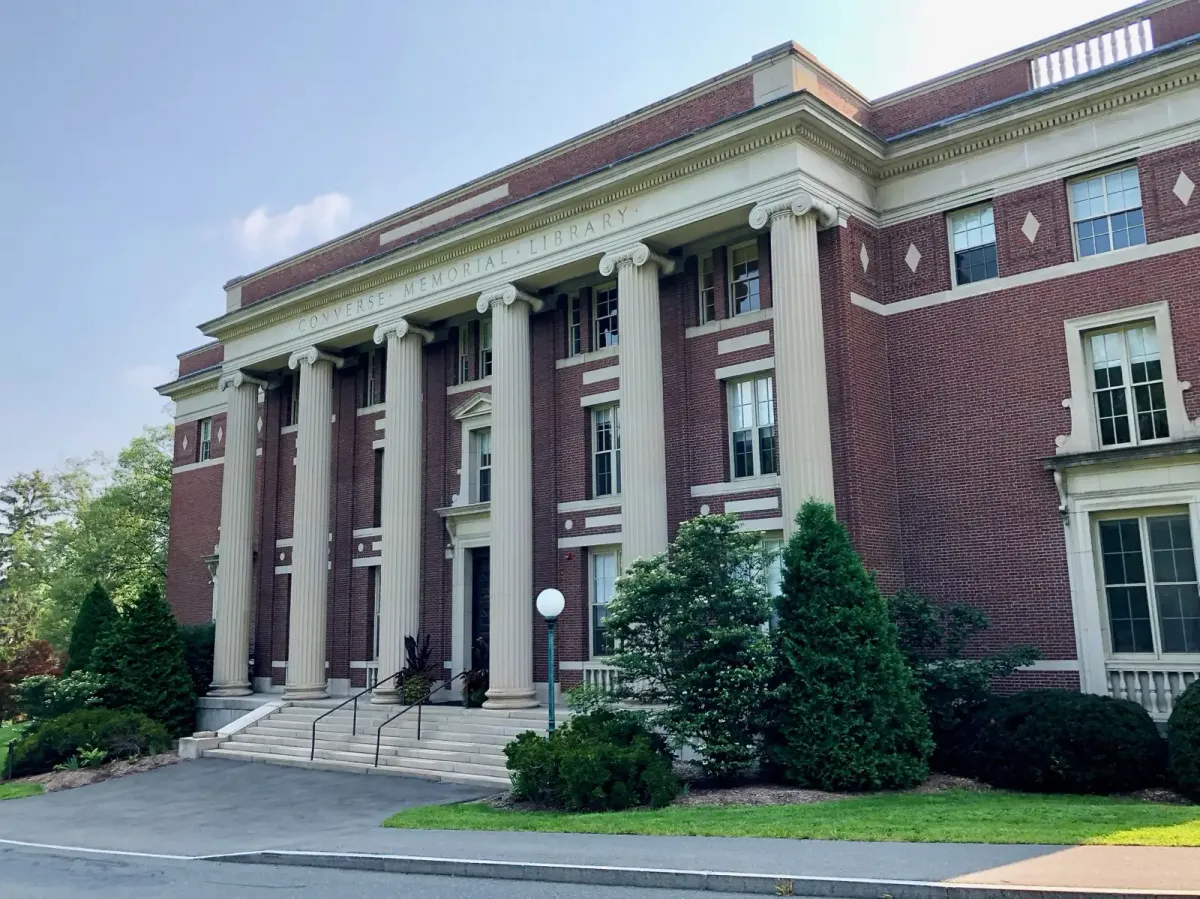
On Thursday, the college celebrated recent projects and work by faculty and staff during its annual event, “Life of the Mind.”
Students and faculty observed small displays showcasing work from various departments in Converse Hall from 5 p.m. to 6:30 p.m. Departments from all over the college were represented, ranging from life and physical sciences to art and philosophy.
Karl Loewenstein Fellow and Visiting Professor of Political Science Armando Chaguaceda Noriega displayed his research on authoritarianism in Cuba. To Noriega, sharing his work at the event is part of a larger goal, outside of his academic career. “For me, it’s a source of curiosity and civic [duty] because … I feel that we are in the world to change something, to [make the] world the best place,” he said.
According to Noriega, although it is challenging to analyze nationwide political oppression, his project is tied to his own identity. “Someone needs to study the bad and the ugly things,” he said. “It’s a mixture of personal history, a sense of compromise with my own history and the history of my homeland, and a way to contribute to … democratic societies and [my] country.”
Assistant Professor of Chemistry Ren Wiscons used a folded paper model to explain her work. “The molecule is most strained in its flat state, and so it wants to be puckered … this is useful [as] we use this for binary data storage [to record] as ones and zeros. Puckered up is a one, puckered down is a zero,” she said.
Using the molecule’s electric field, the computer is able to record it as either a one or a zero, allowing information to be stored in the process. Wiscons’s research aims to make data storage more energy efficient. “The byte size is so much smaller, and the electric field that’s required to switch between ones and zeros is also a lot smaller,” she said. This change allows higher space density than other storage systems, ultimately requiring less energy.
Among the displays, the Amherst Press had a booth showcasing several of its recently published works, which are composed of peer-reviewed scholarly books, all of which are open-access. “It’s part of a knowledge-sharing mission,” Marketing and Communications Manager Miriam Kolar said. “Open access titles tend to have at least ten times that amount of downloads [compared to non-open access].”
Kolar added that being able to access research online without the barrier of a paywall reduced costs even more for those trying to reach it internationally. Not only do they not have to pay the price for the work itself, which may be more dependent on individual exchange rates, but they also do not have to pay international fees, such as additional shipping. “We have a very global readership … pretty much in every country of the world, people read and use their books and download them,” Kolar said.
Ava Wong ’29, an intern for the Amherst Press, noted the importance of open access for improving research accessibility. “We are trying to really bring our books to communities everywhere,” she said. The press hopes to continue its mission by working on producing translations of literature for languages that are rarely translated, such as Haitian Creole, Mayan, and Aztec.
Noriega also highlighted the importance of working across disciplines. “In the traditional development of academic work … we are [always] trying to specialize,” he said. He added that being able to observe the work of scholars around him encourages him to think outside of his expected field of study and allows him to develop ideas that may not have been possible otherwise. He emphasizes the value of the event outside of its professional merit. “[This event] is not only academic, but it’s also intellectual. It’s [about] how to share ideas about the world,” he said.
Comments ()