

Natalie Stott: A Legacy in Net
Defined by her humility, consistency, and historic success in net, Natalie Stott leaves Amherst as one of the greatest goaltenders in Division III history.

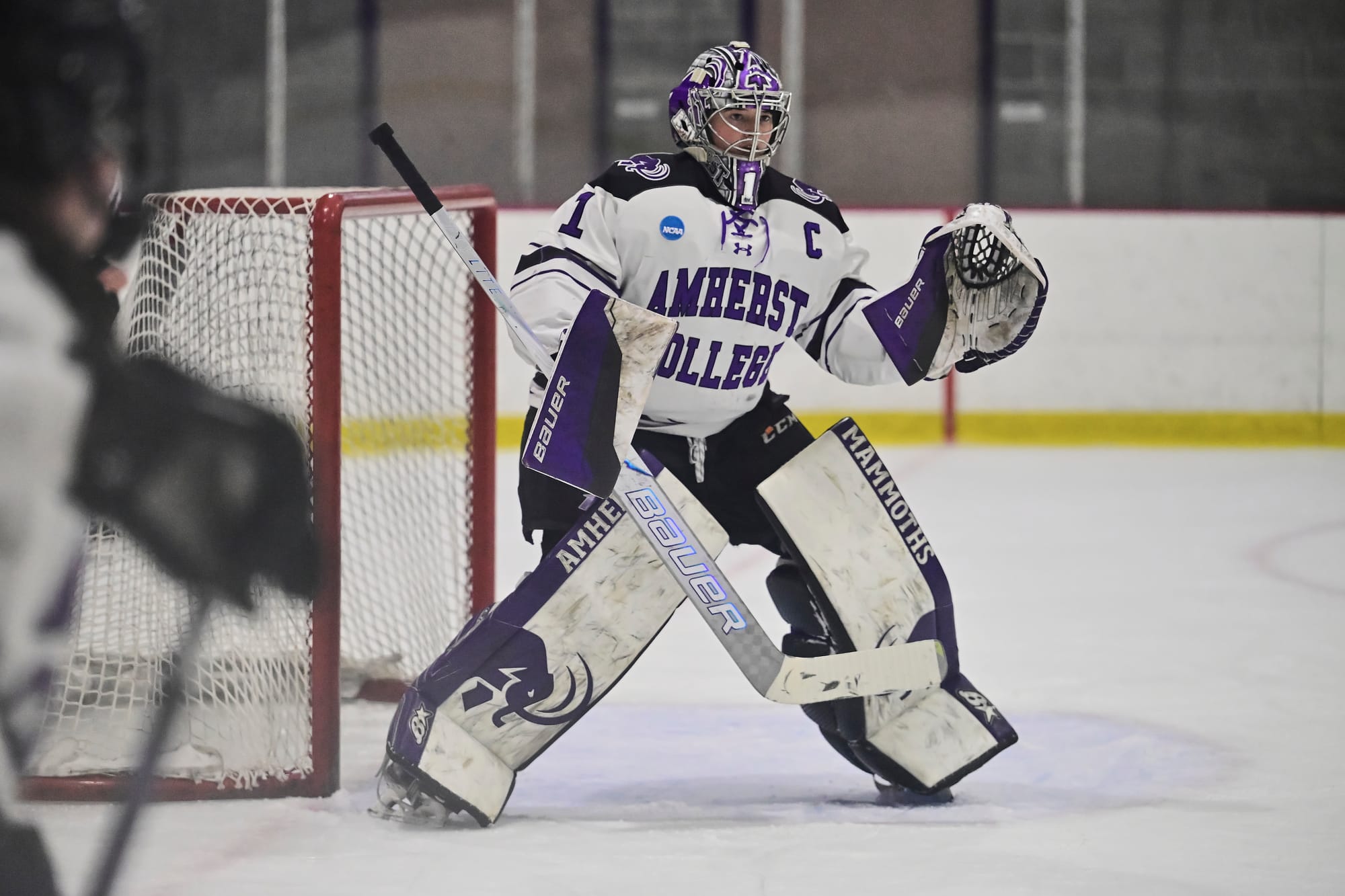
There is a strong argument to be made that Natalie Stott ’26 is the greatest Division III goaltender of all time. Her records and consistency over the last four seasons make it hard to dispute. But what most distinguishes her is not just what she has accomplished in net, but the way she consistently carries herself — with humility and a steady, genuine support for those around her.
Growing Up
Stott grew up in Franklin, Mass., only an hour and a half from Amherst. Her father had played hockey growing up, and before long, Stott was following him onto the ice herself. “I honestly started playing hockey as soon as I could walk,” reflected Stott. Although she initially played both forward and goalie as a child, she gradually gravitated towards the net. By the time she was 12, Stott had committed fully to the position of netminder.
Stott later attended Williston Northampton School, where she played hockey for four years. It was also where she met one of the people who would become central to her Amherst experience: Maeve Reynolds ’26.
“When I first met Natalie in high school, she was super quiet [during] the first two weeks of school,” Reynolds remarked. “Which is super out of character for her.” The two quickly became close friends, playing both field hockey and ice hockey together and living in the same dorm at Williston.
Their friendship only deepened when they both committed to playing hockey at Amherst within a week of each other. “I was super excited when I [learned] she was also coming to Amherst,” Reynolds said. “Coming here together was super helpful for both our transitions.” During the pandemic, the pair even toured Amherst together after their high school coach drove them around campus because official tours were unavailable.
Stott and Reynolds lived in Stearns Residence Hall during their first year, were roommates sophomore and junior year, and lived directly across the hall together as seniors. “I’ve lived in the same building as [Natalie] for the past eight years,” Reynolds added. “And I cannot imagine going to college without her. She’s a big personality in the best way and such a supportive friend.”
A Fast Start at Amherst
Like many other first-year students, Stott was nervous about starting college life. But the hockey team immediately gave her a sense of belonging. “Right as I stepped on campus as a freshman, I already felt like I had a family,” she reflected.
Stott immediately stepped into the position of starting goalie for the team. In her collegiate debut against Hamilton, Stott stopped all 22 shots faced in a 4-0 shutout victory — an early glimpse of the success that would define the Mammoths’ season.
“We ended up blowing any expectations out of the water,” reflected Stott. “We had a great hockey season.” The team posted a 21-3-0 overall record during the regular season — including an 18-game win streak. The team’s success culminated in Amherst hosting the Division III NCAA National Championship. Stott remembers hosting the Frozen Four at Orr Rink as one of her fondest Amherst memories. “We’ve never had that many people in the rink before; you basically couldn’t get in. It was standing room only,” she remembers. “Having that experience and feeling supported by the community while playing with my best friends [was] one of the defining moments of my Amherst experience.”
In the semifinal game — once again against the Continentals — Stott faced a penalty shot against an All-American forward in front of a packed crowd of over 1,000 spectators. It was an All-American against an All-American. Reynolds remembers Stott’s calmness and confidence in the moment: “[Natalie] was just like, ‘fine, give it to me. I’ll stop it.’”
She did.
Women’s Ice Hockey Head Coach Jeff Matthews sees moments like that as emblematic of Stott’s mentality. “She’s always had that ‘I get to’ mindset,” he explained. “She handles pressure well and shows up every day with great focus and energy. She’s able to overcome any adversity that she’s facing in her life with her impressive mindset.”
The team ultimately progressed to the national championship game, where they fell 2-1 in a devastating triple overtime loss. Despite the outcome, Stott recorded a historic 59 saves over the 101 minutes of play. In Stott’s mind, the success of the season “really laid the foundation for the years to come.”
A Record-Breaking Career
And they did. Over Stott’s four years, the team has won three NESCAC championships, made three Frozen Four appearances, and two trips to the national championship game.
Individually, Stott built one of the most decorated careers in Division III history. She set the Division III record for career wins with 86 out of 112 appearances, along with the Division III record for shutouts with 45. Meaning more than half her victories came without allowing a goal. She also holds the highest career save percentage in NCAA history across all levels of men’s and women’s hockey. Her accolades include NESCAC Rookie of the Year, four All-NESCAC selections, and four All-American selections — a feat only reached by two other players in Division III history.
Yet even as she reflects on these accomplishments, Stott is quick to acknowledge those around her. While she acknowledged that the recognition was meaningful after nearly two decades of dedication to hockey, she emphasized that many of her achievements were made possible by the strength of the team in front of her. “I think it’s also been a big testament to how good my teammates are and how much they support me on the ice,” she said.
Even as her own accomplishments piled up, Stott is always the first to celebrate her teammates. “She’s the first person to text in the group chat if somebody gets an academic award or player of the week,” described Reynolds. “She’s somebody who knows every single stat. And so when I was getting close to [scoring] 100 points, she was the person keeping track of it and made a poster for me. She’s more excited about other people’s accomplishments than her own.”
In the Classroom
Stott’s discipline between the pipes extends off the ice and into the classroom.
After taking both introductory courses in psychology and economics in her first year, Stott found herself drawn to both disciplines and eventually declared a double major. “Economics really pushed me out of my comfort zone, and I liked that,” Stott said. “I thought psychology was really interesting, and learning about why people do the things they do.”
This curiosity led Stott to some of her favorite classes at Amherst, one of which is a special topics psychology course with Professor of Psychology Matthew Schulkind on athletics and autobiographical memory. “[It’s] been really interesting, because we got to make our own class and focus on what we wanted to learn about.”
Schulkind noted that Stott and her classmates bring something essential to the course: firsthand insight into elite athletic performance. “One of the reasons to select this topic is because they have insights that I don’t have about what it’s like to perform at a very high level in an athletic context,” he explained.
The seminar investigates how athletes process success and failure, and how those memories shape future performance. Schulkind described the central idea as understanding how people make sense of both achievement and setback — and how that meaning shapes what comes next.
After Amherst: Full Circle
After graduation, Stott will return to Williston as a faculty fellow, teaching math classes and coaching hockey and softball.
For Reynolds, the decision feels fitting. “We always said that she’s gonna go back to Williston,” she said. “And it’s so awesome to see that actually happening.”
Matthews believes Stott will thrive in education and coaching for the same reasons she thrived at Amherst. “She empowers you and makes you feel confident,” he explained. “You can genuinely feel how much she cares [and] how empathetic she is.”
Schulkind agreed, adding that Stott once told him she hoped to lead a school like Williston someday. “She would be great at that and the school … would be better for having her in that position.”
For now, Stott is simply excited to still have a connection to hockey, the game that has been such an influential part of her life. “I’m not ready to give that part of my life up yet,” she admitted.
Schulkind reflected on Stott’s potential beyond Amherst. “I think I would say to Natalie — which I’ve said to her many times — you are actually exceptional. The only ceiling on what you achieve in your life is the one you place on yourself. So set that ceiling as high as you want, because that’s where you’re going to go,” he said.
Even with a resume filled with historic records, championships, and national recognition, those who know Stott tend to return to something simpler: not what she has achieved, but how she carries herself while doing it.
Stott’s legacy is not only that she stopped nearly everything that came her way, but the way she carried herself through it all — with humility and a character that consistently lifted the people around her. As her coach puts it, “she’s a better person and teammate than she is a goalie.”


Comments ()