

Nora Lowe: At the ‘Corps’ of Scientific Journalism
Nora Lowe’s storytelling instinct, paired with admirable rigor, has given Amherst — and the wider world — a writer to watch, read, and learn from. She is indefatigable!
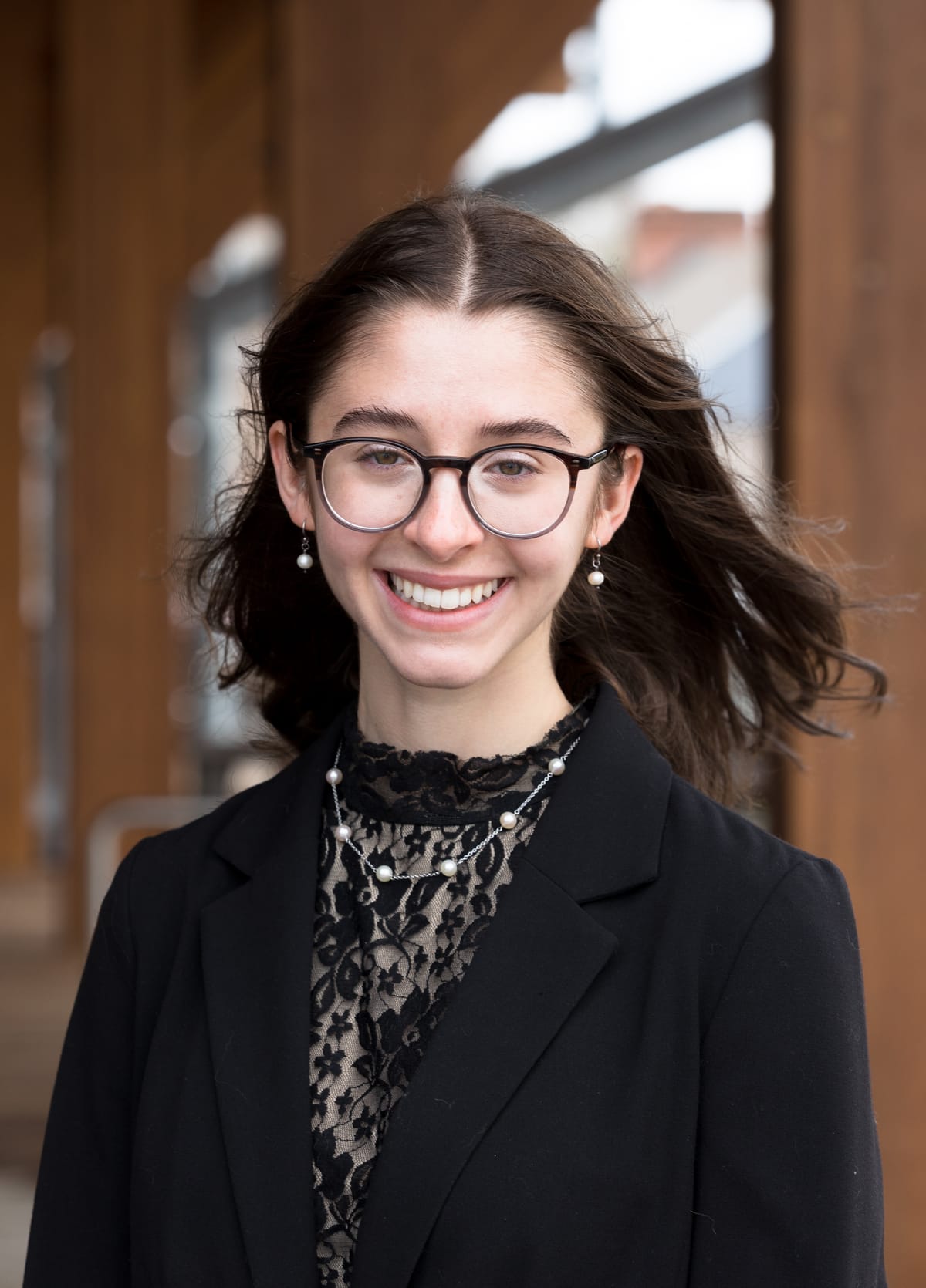
I sat down with Nora Lowe ’26 in early April. What was intended to be an hour-long meeting was extended to a second, scheduled a few days later, for a total of two and a half hours of talking. By the end, my notes were full of facts I could not have anticipated. That she is a great gifter and an even greater friend. That last fall, before tens of thousands on the Charles River, her crew on the Amherst College Rowing Association (ACRA) broke the record it had set the year prior. That she is obsessed with the environment. That there was a peanut scheme in postwar Tanzania. That she loves storytelling.
“My name is on Mars,” she said, “which is something I forget about, because in class when you’re like, share a fun fact about yourself, I’m like, ‘I don’t know, I like dogs.’”
Spend an hour (or two) in her company and a pattern — no, a machine — shows itself. Specifically, Rube Goldberg machines. Simply put, a Rube Goldberg machine performs simple tasks through a convoluted, often humorous, chain-reaction contraption. In levers and pulleys, each component’s action triggers the next, eventually achieving a goal.
“I was really early on, thinking about how processes are interrelated and how small actions can all accumulate and accomplish a goal.”
Lowe was building these machines in her childhood. She still is today.
Two Scales at Once
In seventh grade, Lowe checked the bluebird boxes once or twice a week. They lined a stretch of woods near her family’s house in Westchester County, N.Y. — a dozen wooden cubes mounted on poles — and she took notes on each one: how many eggs, how many hatchlings, how many fledglings. The eastern bluebird’s population was struggling, and her data, one box at a time, uploaded to a central scientific system, became one tiny pixel in a statewide picture.
It was her bat mitzvah project. It was also, she would tell me eight years later, when she learned how to tell a story on “two scales at once.”
“There was both this really up-close, human element of ‘oh my gosh, I just watched a bluebird fledge its nest,’” Lowe said. “And also, zooming out, this picture of, well, this is one of these many bluebirds, and this is why their population is the size it is.”
In high school, she enrolled in a three-year science research program and chose to study tardigrades (also called water bears) — microscopic, eight-legged invertebrates that can survive radiation, dehydration, and decades of suspended animation. She learned Python and ran a bioinformatics project to determine which proteins drove resilience. (“Could not code a line in Python now if my life depended on it,” she added.) She also entered NASA’s student-naming pitch contest for an upcoming Mars rover with the submission, “Ambition Tardigrada.” She argued that the rover should be like its namesake: small, durable, and capable of enduring conditions designed to kill it. The judges were persuaded enough to make her a semifinalist: her name was etched onto a silicon chip and launched into space with the rover — which is how it ended up on Mars!
It was two teachers from her research program that “lit the fire” under her, she said. By championing the tardigrade work, they let her in on the secret that the gap between scientific knowledge and public attention was a career-worthy practice. People did this for a living. For money, even.
“If you have a topic that’s not receiving as much attention,” she said, “it doesn’t mean it’s not important. Maybe you haven’t told the right stories about it yet.”
To Survive, Achieve, and Endure
Lowe arrived at Amherst planning to write about science. At the annual club fair, The Student’s editors admitted that the paper didn’t have a science section and pointed Lowe down the table to the Amherst STEM Network. She started as a writer her freshman year, became a news editor as a sophomore, and was editor-in-chief by junior year, leading the club to publish its first physical magazine. Her bylines from those years read like a tour of the strange and overlooked: squirrel psychology, sea slug neuroscience, salamander road crossings. She liked writing about animals because they weren’t her, and she liked editing because she got to watch younger writers improve. The satisfaction of her work, she said in different ways across both our interviews, was watching other people come into their own. The case for science writing she’d worked on by then was a symbiosis. A scientist, a student, could spend years in a lab, find something extraordinary, and slip back into the lab. Without somebody outside it to translate the findings, nobody else would know, nobody else would fund the next round of work.
She declared two majors: English and environmental studies. She also added the Five College Coastal and Marine Sciences Certificate onto her workload as well. Her favorite classes braided the two. Professor of Geology David Jones’s Oceanography course turned out to be a class about patterns — “really tiny, but lots and lots and lots of tiny points,” accumulating into systems. William R. Kenan, Jr. Professor of History and Environmental Studies Ted Melillo’s global environmental history of the 20th century shaped her thesis. Melillo told the kind of stories she wanted to tell: Among them, the British peanut scheme of postwar Tanzania, in which planners flew over the country, decided it looked good for peanut farming, and were spectacularly wrong. “Fly-by research is not the way to go,” Lowe said. “You better be on the ground talking to people.”
The English major comes up often, she said, in an era of humanities retreat. Her answer changes. Early on, it was for the language itself — for the Toni Morrison line she’d picked up somewhere, possibly in a Johnson Chapel bathroom stall, that to read is for one’s mind to dance with another’s. Now she reads to understand the world.
Shake It Off, Ladies
A week later, I sat down with two of Lowe’s closest friends, Lanie Rawlinson ’26 and Shani Getz ’26 — both from Hillel and crew, both in her life since freshman year — and asked them for one story that captured her. They named the Wellbeing Makerspace.
“Nora probably spends a minimum of five hours in there a week,” one of them said. “She makes everything in there.”
She makes cards, mostly: for birthdays, thesis defenses, a sister returning from abroad, ACRA’s spring break talent show, anything. The cards usually arrive with a small gift to match. The sardine pens were one of these. So were the matching wisdom-teeth-shaped rings she gave a friend after they got their wisdom teeth out the same day. (“I wear it always,” she said.) She remembers small things people mention in passing — a hedgehog buried in someone’s email address, an artist mentioned offhandedly in September — and returns them, months later, as objects. She has her own fixations, too. For years now, Lanie said, Nora has been planning a trip to a “fish elevator” — a, let’s say, Rube Goldberg-style machine somewhere along a river, near a dam, that lifts migrating fish over the obstacle and lets them keep going. She has not yet been, but she is committed to going.
“She doesn’t do anything halfway,” her friends said. “She doesn’t do friendship halfway, either.”
Lowe joined ACRA during her freshman year, discovered she couldn’t row, and switched to being a coxswain — the loud person who calls out commands. She approached the role the way she had approached the bluebird boxes. From day one, she carried a notebook into the launch (the small motorboat coaches use during practice), writing down offhand technical comments — “when the water flips off the end of the oar in this way, that means somebody’s feathering out.” Over four years, it grew into a long, official-looking document of accumulated detail, to be passed down to whoever takes her seat after her.
Lanie and Shani will never forget two of Nora’s calls. “Drop the hammer,” she screamed at the rowers in the final sprint. “Shake it off, ladies,” she declared when somebody caught a crab (crew language for when an oar gets trapped underwater). They had taken to applying both, depending on the day, to Nora herself.
At the Head of the Charles (the world’s largest three-day rowing event) her senior fall, Lowe and her boat broke the record they had set the year prior. “It [the race] taught me how to take things one step at a time,” she said. “Let’s all just get our hands on the boat. Let’s all just lift it over our heads. Let’s all just put it in the river.”
Mission to Inform
Lowe launched her career early. The summer before college, she filed 12 local news stories for Examiner Media, a Westchester-based newspaper. That January, she was a Gregory S. Call intern, supporting Professor of Sociology and Environmental Studies Hannah Holleman’s research, in sociology and environmental studies. The summer after, NASA called. Baby steps, right?
At the Goddard Space Flight Center in Maryland, she was assigned to the Nancy Grace Roman Space Telescope team. She wrote profiles of the engineers building it, reported on a handheld spectrometer called “STELLA” (Science and Technology Education for Land/Life Assessment) designed to measure plant health, and produced social copies for @NASAGoddard and @NASARoman. One of her posts set a record for the Roman Telescope’s Facebook account: more than 18,000 likes, 9.4 million impressions, the most engagement the mission had ever drawn. NASA’s blog wrote a piece about the intern who had moved their numbers — “Mission to Inform: How a NASA Intern Brought Space Science to Life.” Her work landed on the NASA.gov homepage and Phys.org. Nora’s writing had, four years earlier, earned her a name on a silicon chip headed to Mars. Now her writing was on NASA’s homepage. She’s everywhere!
The next nine months brought her to Brookhaven National Laboratory, the Department of Energy facility (DOE) on Long Island, as a science-writing intern. She wrote two press releases and six feature stories — among them a profile of a DOE Distinguished Scientist Fellow studying neutrinos, a story on prescribed burns and tick-borne disease, and a portrait of two lab archivists. Her neutrino piece — headlined “The More You Neutrino…” — was picked up by the DOE-wide newsletter. To get it, she had asked a particle physicist whether a subatomic particle was, in fact, comparable to a ghost. (Yes, the physicist told her, in some respects.) Another story was reprinted in National Woodlands Magazine.
In her junior spring, Nora enrolled in Williams-Mystic, a semester-long coastal and ocean studies program at the Mystic Seaport Museum in Connecticut. Her older sister, a geology major at Williams College, had sent her there. Of the offered courses was one called “Literature of the Sea” — students read “Moby-Dick” on the deck of the Charles W. Morgan, an 1841 whaling ship turned museum exhibition — and a ten-day field seminar aboard a 112-foot schooner. She got gravely seasick. She also learned to blacksmith, which is the kind of thing a person mentions in passing only if she has done a lot of other things. As a marine-ecology research assistant on the program, she dissected cormorant pellets and extracted fish otoliths — the inner-ear bones, which grow in rings — to track how seabird diets had shifted over the previous twenty years. What the semester really gave her was less photogenic but more useful: the logistics of fieldwork. How to find people to talk to. How to talk to them. How to get from one coast to the next without a car, and what to pack for each.
Later that semester in March, she sat down across from Anthony Fauci. Yes, that one.
Asking dumb questions in good faith was the method. “You have to be completely unafraid to sound like a complete idiot,” she said. “Your job is to be the interlocutor between the reader and the expert. If you or the reader don’t know what something is, you have to ask.”
At the Corps of It
Nora’s thesis is titled “At the Corps of It: A Retrospective and Prospective Look at Public Service for Environmental Health and Civic Engagement,” with “core” spelled C-O-R-P-S — a pun she would not let her advisor, Professor of Economics and Environmental Studies Katherine Sims, talk her out of. According to Sims, Nora’s thesis compares two federally funded environmental service programs: FDR’s 1930s Civilian Conservation Corps (CCC) and Joe Biden’s American Climate Corps, which the second Trump administration dismantled by executive order weeks before Lowe’s senior spring semester began. The thesis traces the ebbs and flows of progressive environmental policy across a century then outlines a blueprint for what a future federal service corps might look like. Sims recounted that “Nora’s work combines interviews with more than 80 (!) people with archival work and living relative accounts.” This might just be the most complex Rube Goldberg machine ever: 211 pages to make a case that, reduced to one line, is “go talk to people.”
Senior Lecturer in Biology & Environmental Studies Rachel Levin, who taught Lowe in “The Resilient (?) Earth: An Introduction to Environmental Studies” during her freshman year, told me the thesis was “so Nora”: the willingness to undertake such a challenge and “do it with everything you’ve got.” Sims, who watched the project come together across the year, called it an “interdisciplinary inquiry and methodology in the best tradition of environmental studies,” and described Lowe as “one of the most highly motivated, self-directed, and ambitious” students she had advised at Amherst. Lowe came to every weekly meeting, Sims said, “with a carefully prepared list of questions about her thesis and an ambition to chase down every last source, interview subject, fact, or piece of feedback that she could.” The 80 interviews she’d done included Climate Corps administrators, Maine Conservation Corps participants, Vermont Conservation Corps members, and Boston PowerCorps workers.
The 80 interviews, of course, wouldn’t have been possible without what she learned from interviewing workers during her time in Williams-Mystic. In Maine, for instance, she learned about how lobstermen have to keep modifying their gear at a high cost in order to prevent right whales from getting tangled in them, even if many of them are financially struggling. Moreover, in Louisiana, she learned about oil-rig workers watching the seas rise on the rigs they depended on for income. The work feeding their families was also raising the water that would eventually flood their towns.
“Two truths can coexist,” she said. It was the bluebird boxes again: a story told on two scales at once, the close-up human and the larger ecosystem.
Nora also emphasized learning how to interview people without taking from them. She talked, repeatedly, about the difference between extractive and reciprocal interviewing — about noticing somebody collecting firewood, helping them collect it, then, and only then, thinking of asking the question. “Building empathy with people,” she said, “and trying to meet them where they’re at.”
The thesis’s form, as you can imagine, is hybrid — traditional academic analysis braided with narrative nonfiction, with a section of the thesis dedicated to defending the form itself. The argument hinges on a theory she draws from Rhett Ayers Butler of the environmental magazine Mongabay: “narrative transportation,” which contends that the gap between what people know about climate change and what they do, if it is bridged at all, is bridged by story.
To Infinity and Beyond
Last fall, Lowe was offered a science-publishing internship at Quanta Books, a book arm of Quanta Magazine — one of the country’s most respected outlets for science journalism. She had also applied for an editorial fellowship at The Atlantic, in the science section where Ed Yong was once a staff writer. Many may recall that Nora and Kyle Hur ’25 interviewed Yong during LitFest. When Quanta demanded an answer before The Atlantic had finished its second round of interviews, she asked The Atlantic to move her second interview up by a day. By 5 p.m. on the deadline day, she heard nothing.
Lowe recalled how she had sat in on Jamaica Kincaid’s recent LitFest talk. Kincaid, recounting how she had landed at The New Yorker early-on in her career, told the audience: “Don’t be afraid to be lucky.” The Atlantic called at seven. Lowe will be one of their editorial fellows this fall.
She came to Amherst, she said, “incredibly tightly wound, a little bit burnt out, and super cynical about the world” — three perfect attributes, she added, to walk into college with. She is leaving a little less tightly wound, re-energized, and “cautiously optimistic.” Cynicism, she has come to suspect, is also a kind of close reading: it picks up the absurdity that other people glaze over. Used right, it is funny. It is also useful at the bluebird box, the coxswain seat, and the oil rig — anywhere the small detail tells the larger story.
The silicon chip took her name to Mars. Everything since has been the longer machine: the one that will carry the rest of her past the red planet, past the rover, as far as the stories she tells reach.
She leaves for D.C. in July.
Comments ()