

Old News: A Deep Dive into 50CO Deliberation
As 50CO swiftly approaches, Managing Features Editor Talia Ehrenberg ’28 investigates student and faculty discourse from 1974 surrounding the official decision to admit women into the college.
Fifty falls ago, Amherst was abuzz with students, faculty, alums, and trustees all separately voting on whether the college should become coeducational. Looking through articles published in The Student surrounding the decision, this edition of Old News captures the uncertainty, passion, and apathy surrounding the Nov. 2, 1974 decision to admit women to the college through articles published in the weeks before and after.
Barney Softness ’76 traced the history of the struggle for coeducation at Amherst in the special edition announcing the decision on Nov. 2. While speeches at the college’s 50th birthday in 1871 called for Amherst to open its doors to women, the beginning of the recent initiative stemmed from a resolution emerging out of students’ two-day anti-war Moratorium in 1969, per Softness’s account. Starting in 1969, numerous committees, reports, studies, and proposals took shape to advocate for coeducation until 1973, when the Board of Trustees came to a “non-decision.” In anticipating the admission of women into the college, Amherst doubled the number of women on faculty to 14 in 1974.
Prior to the Trustees’ 1974 vote on the issue, both the Faculty and Student Assembly held their own votes to affirm their supportive stance. On Thursday, Oct. 10, it was announced on the front page of The Student that the faculty would vote “on the merits of coeducation for Amherst.” This was the “final thrust,” Lee Newman ’75 wrote. With numerous questions emerging regarding the change in student body size and the student-faculty ratio, former Dean of Faculty Professor Prosser Gifford said that faculty going on the record for methods of implementing coeducation would be ideal for clearing up “‘confusing complexities’” bound to arise from 120 different faculty members.
On Monday, Oct. 14, The Student published an editorial on the subject. The article sought to underscore primary concerns in the 380-page “Casebook on Coeducation,” a comprehensive document with cases for and against coeducation, along with different student population sizes. The categories of concerns largely included: size, student-faculty ratios, finances, and Five College cooperation. Going category-by-category, the editorial board affirmed its support.
The editorial concluded: “Nineteen Days. This Much Longer.”
This Casebook was the source of more conflict, as reported later in the issue. The document included a plan for renovating athletic facilities to meet the needs of new students. In the same Oct. 14 issue, the Athletics Department, however, said that plan simply would not work, and thus devised a new plan, proposing a new building for a women’s locker room, new basketball courts, wrestling and dancing rooms, and a new basketball stadium. Notably, the plan in the Casebook was estimated to cost around $1 million, whereas the Athletics Department plan would be $2.2 million (which would be roughly $13 million in 2026). Chairman of Physical Education Benjamin McCabe admitted in the article that the new plan’s lavish price tag may make coeducation less attractive to the Board of Trustees — at this point the vote loomed 19 days away. His rationale was that even if the Casebook plan would work for a few years, it would soon become insufficient with a growing student body. “There is no reason not to exercise our foresight now, rather than be plagued by our hindsight later,” he told the student.
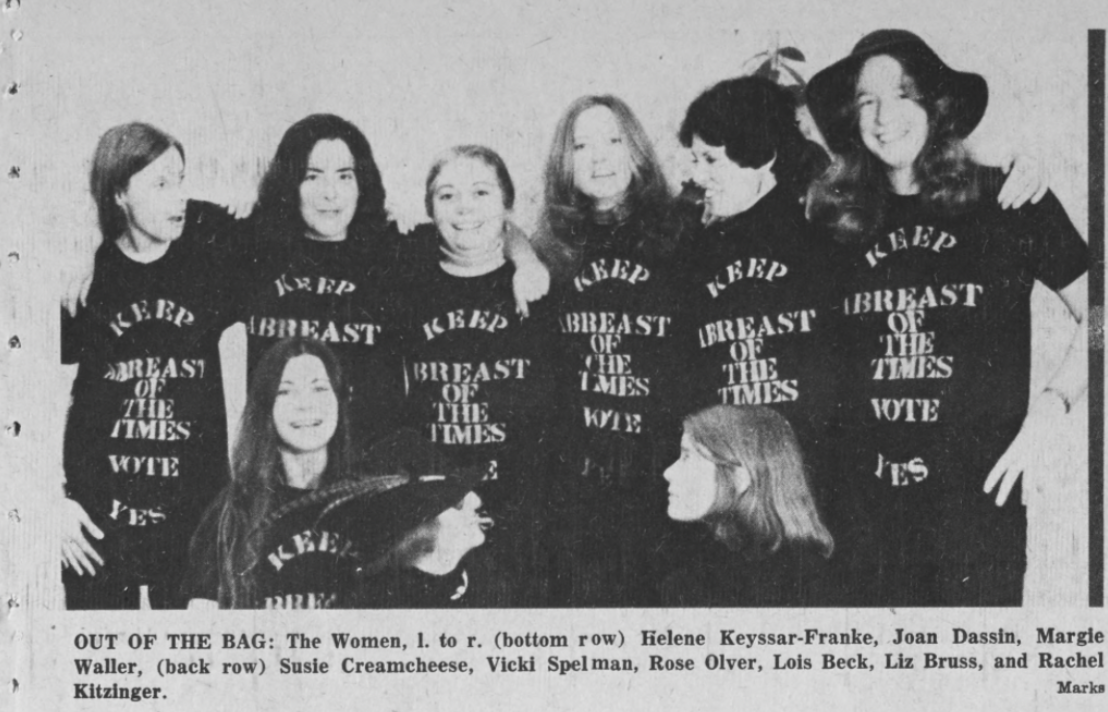
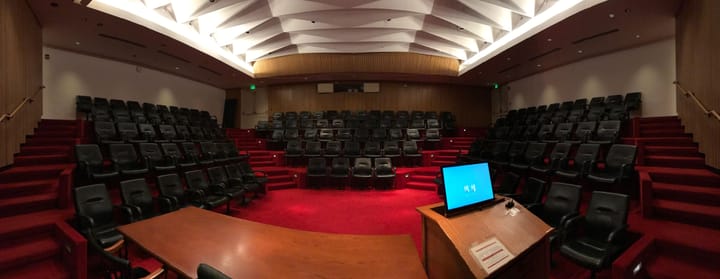
The Faculty vote took place on Oct. 15. “Unlike most staid, formal, uptight faculty meetings, Tuesday night had a twist,” Newman wrote. Nearly all the women faculty sat in the same section of the Cole Assembly Room. “Men professors wondered: ‘wha?,’” Newman wrote. “When it came time for the motion on coeducation to be introduced, the women rose. They unbuttoned. They exposed … T-shirts. ‘KEEP ABREAST OF THE TIMES’ it read across their chests. ‘VOTE YES’ read the below-the-belt message.” (Please note the ellipses are included in the original article.)
Newman quoted former President John Ward, who said “‘There was a lot going on in that gesture.’”
With a decision of 95 to 29, the faculty voted in favor of coeducation. Newman described the meeting as a “calm, direct, slender, three-hour meeting,” focused primarily on the politics of getting the vote of the Trustees and avoiding alumni backlash.
In a back-and-forth on the significance of alumni opinions, former Professor of German Donald White asked, “‘why do we continue to agonize about the Amherst Alumni?’” Professor of History and American Studies Theodore Greene ’43 answered that the Trustees were concerned about alumni opinion. George H. Corey Professor of Chemistry Richard Fink (in a heading that the then-newspaper editors entitled “Dick Fink Dunks Alums”) retorted, “the alumni view is just why our coeducation decision has taken so incredibly long.’”
While the faculty debated in the Cole Assembly Room, the Student Assembly held its own vote. With a vote of 16 in favor to 2 opposed, the student representatives also voted to support coeducation. David Krieger ’76 interviewed one of the dissenting voices, David Applefield ’78, a freshman at the time. “‘The majority of the people in my class that I’ve talked to were either against it or unsure. The motion read ‘overwhelming support,’ and I didn’t feel that existed within our freshman class,’” Applefield said.
On Saturday, Oct. 18 and Sunday, Oct. 19, the Trustees met in New York to discuss coeducation. Women faculty gifted President Ward one of the ‘Keep Abreast of the Times’ shirts to wear at the meeting, but he declined, per Newman’s reporting. No Trustee would utter a word about the mood at this meeting. Trustee George Peterson ’63 told Billy Schwartz ’76: “‘I’m sorry, we’ve agreed not to comment.’”
On Oct. 21, exactly 50 years ago today, the alumni voted to oppose coeducation at the college by a “reasonably close margin.” (Notably, 18 alumni attended the meeting, and multiple of the attendees declined to comment on what this margin was.) While this vote did not directly determine any college-wide decision, the Board of Trustees, who did have the power to make a consequential ruling, placed significant weight on alumni opinion.
Despite “cautious optimism” among students, who speculated that the Trustees would support a coeducational campus, Ward publicly articulated his anxieties around the decision, of which the build-up alone had defined his presidency. “‘I find myself not sleeping nights, waking up and saying ‘my God, there’s really going to be some kind of decision made,’” Ward said at a college assembly. A student asked him about the chances of the Trustees voting in favor of coeducation, and he replied: “I‘m not sure. I’m no longer a good judge … I psychologically defend myself against disappointment.”
Only three days before the vote, on Thursday, Oct. 31, The Student wrote that Board of Trustees President George Shinn ’45 would announce the decision on coeducation Saturday, Nov. 2. The audio would be broadcast over WAMH. Initially Shinn planned to declare the outcome from the steps of Johnson Chapel, but upon concern of rowdy crowd reaction — in response to either decision — Ward and Shinn decided against it. (In the article directly below this announcement, the headline reads: Grade Inflation Leaves College. The first sentence reads, “grade inflation has ended at Amherst.” An ironic pairing given that in 2026, Amherst now has both women and grade inflation.)
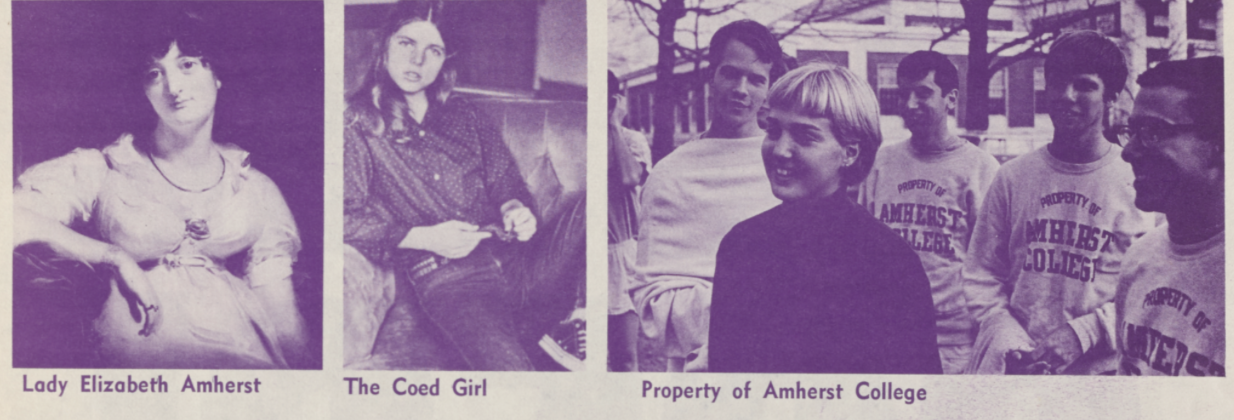
While ample attention had been paid in the months prior to how men felt about coeducation, in the same Oct. 31 issue, Joyce Haines, a student at Mount Holyoke College and the first woman to serve on the Board of The Student, spoke to 14 “coeds” — women who were enrolled in other institutions like Smith College and Wellesley College but spent some time taking classes at Amherst and some even living on campus — about their perspectives on the vote. While these students expressed positive feelings toward being a woman at Amherst, they relayed concerns over gender dynamics in both academic and social settings. Students reflected on how male students were taken more seriously in class, and professors “‘expect[ed] more of [men].’” Allyson Beeber, a student at Wellesley, reflected on the limited presence of women role models at the college and how male professors seemingly “‘had much more camaraderie with male students.’” Socially, students found the campus culture to be competitive and driven by insecurity. “Amherst students seem afraid of the power of their emotions,’” Dorothy Schatzkin, a student from the University of Connecticut, told Haines. She also was glad to no longer be “a prospective prey, anymore.” In thinking about the future classes of women at Amherst, Gwen Lyman from Wellesley said she hoped that “‘the lingering misconceptions about sex roles would disappear.'"
At noon on Nov. 2, the decision arrived. The Student published a special edition, with the half-page, purple headline: “WE’RE COED.”
“The Lord and George Shinn move in mysterious ways. It took Amherst College only 153 years to join the human race. Hallelujah!” the editorial board wrote.
The affect of campus the morning of the decision is captured in a different light by Theodore Iacobuzio ’76 in the Nov. 4 issue of the paper. Instead of discussing the decision, Iacobuzio wrote that “everybody seemed to be sleeping Halloween off or going to the library to study.” When a prospective student was asked what he thought of Amherst going coed, he said: “I don’t know. You think it will look any different?” None of the students Iacobuzio saw that morning seemed “particularly conscious of what was going to happen. “They were all headed somewhere else,” he wrote. An hour before the decision, no one was standing outside by the planted cheering-section signs. “It seemed like just another Saturday morning,” Iacobuzio wrote.
“When the news of the announcement hit Valentine [Dining Hall (Val)], there was no cheer, not much of anything,” Iacobuzio stated.
Around 11:45 a.m., a crowd of about 35 formed outside the President’s office. At one point, Ward put a thumbs-up outside the window. Iacobuzio reported: “‘I think we’ve just been told,’ someone said. ‘Shut up,’ someone else said.”
Iacobuzio wrote that, after the decision was announced, “no one seemed particularly excited by the news.”
“There were jokes about urinals and whips and boots by those of us who had been outside by the window,” Iacobuzio stated.
By dinner, more conversations regarding the implications of a coed Amherst could be heard throughout Val.
For coeds — female students already on campus — the question of “what now?” was less abstract. On Nov. 11, The Student reported that Dean Edward Wall and David Drinkwater lent their support to the coeds to stay at Amherst and graduate in the class of 1976.
By Nov. 14, the developments in the coeducation saga were not front-page news for the first time in over a month.
Through chronicling The Student’s reporting of Amherst’s decision to become coeducational, we see that the admission of women was never viewed as inevitable, even 20 minutes before the announcement.

Comments ()