

Professor of History Delivers Annual Lazerowitz Lecture
Last Thursday, Assistant Professor of History and Asian Languages and Civilizations George Qiao delivered the 2026 Lazerowitz Lecture. Drawing on his upcoming book on the Shanxi merchants, Qiao argued that the Qing frontier expansion transformed China’s economy and social life.
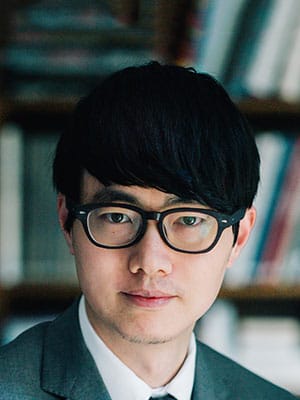
On Thursday, the college hosted the 2026 Lazerowitz Lecture, an annual event established in 1985, showcasing research from a junior faculty member. This year featured work by Assistant Professor of History and Asian Language Civilizations George Qiao.
Qiao is a historian of late imperial China whose research explores how trade, empire, and everyday social life shaped one another, especially through the world of Shanxi merchants and Qing frontier expansion. Educated at Fudan University and Stanford University, he also brings a wide-ranging passion for Chinese history, capitalism, and photography to his teaching, helping students see the human stories behind large historical change.
At the center of Qiao’s lecture was a broader question: “What if we took the Qing frontier seriously, not just as a distant borderland, but as a space whose expansion and trade reshaped the society at the empire’s core?”
Drawing on research from his upcoming book, Qiao argued that frontier expansion did more than enlarge the empire geographically. Through the movement of merchants, goods, labor, and credit, it helped transform China’s economy, institutions, and social life.
Qiao organized the talk around three main claims. First, he argued the relationship between frontier expansion and imperial rule. “Conquest brought the frontier under Qing rule, and commerce made that work,” he said, explaining that merchants often proved more effective than officials at moving supplies, labor, and credit across long distances.
Second, Qiao argued that the challenges of frontier trade pushed merchants to develop new business and financial institutions. He described caravan systems, multi-branch firms, and merchant banking practices as innovations shaped by the practical demands of doing business across vast distances. “The frontier did not simply receive institutions from the interior,” he said. “It generated them.”
Third, Qiao emphasized that the wealth produced by this commercial system came with major human costs. While frontier trade helped bring prosperity to Shanxi, it also depended on harsh labor, long family separations, and the often-overlooked work of women managing households in men’s absence.
The lecture was followed by a Q&A session. Audience members asked questions focusing on the role of merchants, who the frontier wealth was really for, and how the frontier management is organized.
The lecture specifically focused on the Qing frontier, but audience members connected Qiao’s research to the U.S. frontier. “Learning in the United States, we have all kinds of lovely and warm feelings about the frontier. I do wonder, though, about the narrative of this frontier endeavor in the work that you’re doing, and is your narrative of whatever has happened in the past,” one audience member said.
Qiao noted that the concept of frontiers carries significant historical baggage, but expansion still has to be taken seriously as a force in history. “Expansion, no matter whether it’s positive or negative,that fact itself is, I think, indisputable,” he said.
Comments ()