

Rave Reviews: Community Reflects on Shutdown
In her investigation of the recent Rave shutdown, Managing Features Editor Lauren Siegel ’27 spoke to community members about the chaotic scene at the Rave and their broader frustrations with Amherst’s social scene.
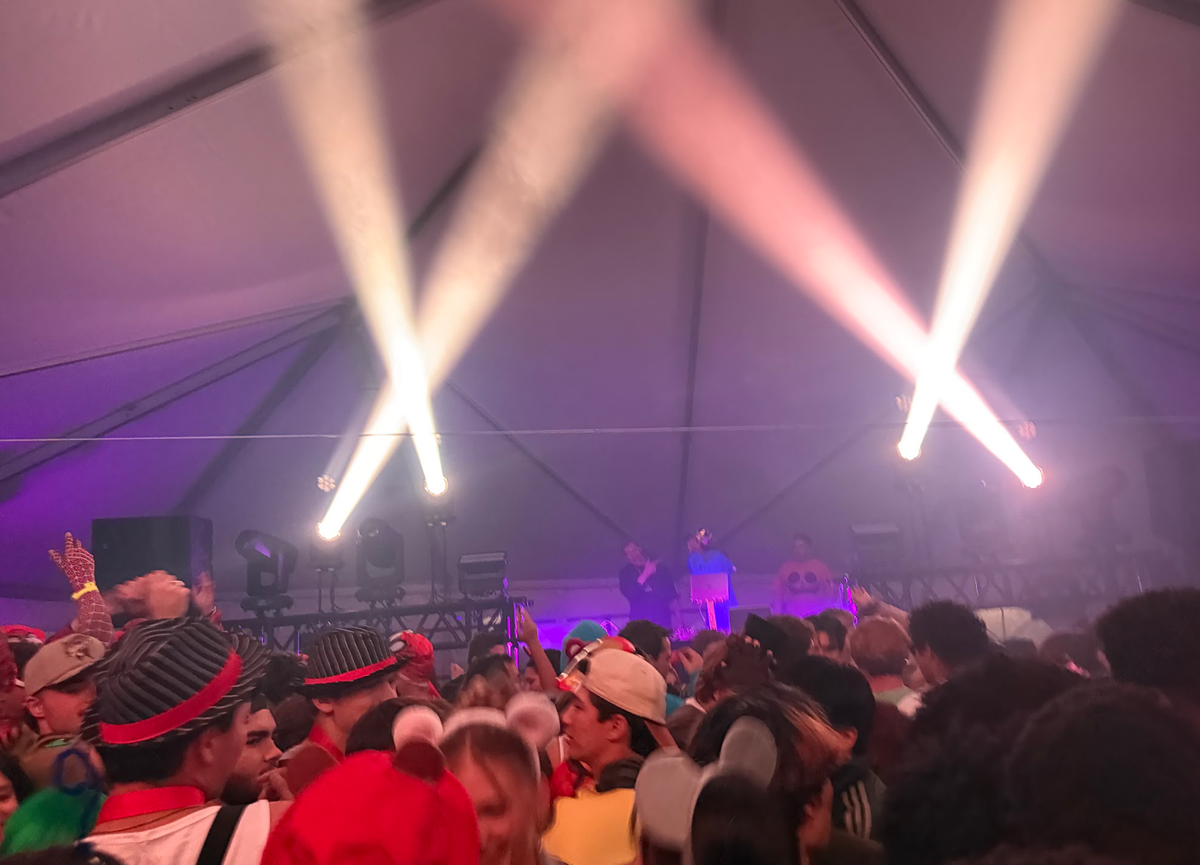
On Oct. 31, the college shut down its Fall Rave early due to safety concerns, resulting in widespread confusion and disappointment among students. The rave, which is sponsored by the Association of Amherst Students (AAS), Student Affairs, and The Office of Student Engagement & Leadership (SEL), has occurred once a semester since fall 2023 and has become a staple of the college’s social scene.
“I heard that it was the best event that Amherst [College] would host all year,” Lorelei Roof ’30 said. “So I think leading up to it, there was a lot of anticipation that this will be so much fun. Like, everyone’s gonna be there, [so] you kind of have to be there as well.”
With the event interrupted and with no clear “make-up” plans, students have been left questioning what went wrong at the rave, what will happen moving forward, and what the situation may signal about the state of social life at Amherst.
What Happened?
Before the rave even officially began, administrators noticed many individuals attempting to enter the event who were not Amherst students.
“There was a huge [number] of people there trying to falsify Amherst IDs,” Dakota Costa ’27 said, a member of the AAS Rave Committee who arrived early to the event. “[Administrators] told me that they were going to start checking IDs immediately, but the complication with that is we have mobile credentialing now, so not everybody has their physical ID like we used to.”
According to Associate Vice President for Student Affairs and Senior Associate Dean of Students Megan Lennon, she “implemented ID checks for all attendees, which had not occurred previously, to limit the event to Amherst students and avoid the risk of reaching capacity and our students being unable to attend.”
Lennon stated that the new ID requirement was shared with community members leading up to the rave through AAS meeting minutes, as well as on flyers and campus-wide emails advertising the rave.
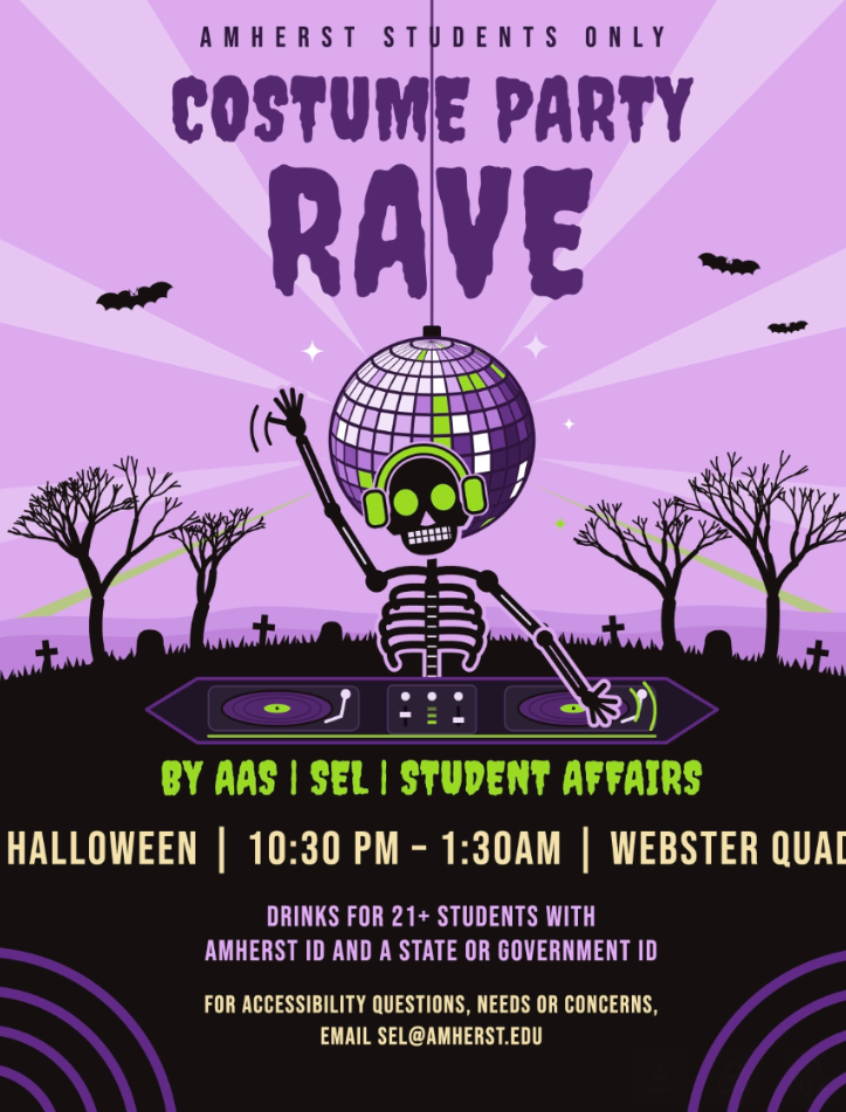
Flyers advertising the rave also stated “Amherst Students Only” and “Drinks for 21+ Students with Amherst ID,” leaving many students confused when they were met with ID checks at the entrance of the tent. Similarly, the campus-wide email sent to students on Oct. 20 only mentioned IDs in the statement: “Students will need both their Amherst College ID and a government-issued ID to access the bar.”
After administrators made the decision to check each person’s ID before allowing entrance to the rave, a crowd quickly formed outside of the tent of people waiting to get in.
“I arrived to the rave at around 10:45 [p.m.], and there was a line that was, I would say, 15 feet wide pushing all the way back from the middle of the quad towards Morrow [Hall],” Daphne Witherell ’27 said. “There was a lot of yelling from the front, I’m assuming from security, just trying to push the line back, but nobody could really hear it.” The Student reached out to the Community Safety Team, who assisted with security at the rave alongside security personnel hired from Green Mountain Concert Service, but the team declined to comment, saying that they do not have much information to provide at the moment.
For students who made it through the line and into the rave, many noted that the tent never came close to reaching full capacity.
“I was mainly distracted about the fact that my friends were still outside, and I was like, ‘what’s taking them so long?’” AAS senator Sascha Reveron ’30 said. “And I went out to look at the front, and it seemed like nothing would change. People were trickling in by two, three, and then not trickling in at all.”
According to Costa, administrators paused the music inside the rave once or twice to communicate more easily with students, but these efforts were ultimately unsuccessful. “I think the problem was they didn’t have a way to communicate over the massive [number] of people that were waiting outside, so they just stopped checking IDs, and then more people just kept coming [into the crowd].”
When Roof arrived outside the rave, she found “a huge crowd of people, and everyone was pushing their way through, trying to get to the front, but there was no communication at all.”
According to Witherell, the conditions inside the crowd felt hazardous. “It was a pretty thick crowd, to the point where, if you were in the middle of it, it was so tightly packed that it would probably take several minutes to get out. I definitely noticed a lot of people panicking,” she said.
Ben Kasen ’28, an AAS senator, even attempted to help security and calm students down. “I think at one point I was standing on a trash can, asking everyone to just take a couple steps back so that they could keep letting people in,” Kasen said. “It was getting pretty rowdy, and it was understandable. The students were promised a rave, and it was a big night; everyone was a little bit inebriated by that point … and I think people wanted to get in. They were cold outside.”
Witherell noted that when she got to the front of the line, security was tasking students to push the line back to get the whole line turned around. “But the problem was the crowd was so big that the back of the line was pushing the front up towards the security, and then they were getting frustrated with the people in the front,” she said.
Roof also noticed rising frustrations from security officers near her. “[One security guard] obviously seemed like she was not very happy. I think it was probably because of us. But I didn’t even do anything wrong.”
When Witherell left the line, she noticed that security officers were trying to prevent people from entering through the side of the tent. “Occasionally people would try to slip through the slides, and the guards were grabbing at them,” Witherell said.
Eventually, administrators decided to shut down the rave around 11:30 p.m. Lennon stated that senior staff and safety personnel made this decision because of “potential safety and security issues posed by a growing crowd of hundreds,” with the ultimate goal of “ensur[ing] the safety and wellbeing of everyone involved.” As reported in The Student, Lennon also noted that there were ultimately 12 alcohol-related incidents on the night of the rave, with six ending in medical transports and 10 incidents not being Amherst College students.
Many students experienced confusion when they heard the rave was shut down. “It was kind of being yelled around that the rave was getting shut down, and my first thought was, ‘they’re just saying this to get the crowd to calm down, and they’ll reopen it. So I kept yelling, ‘no one’s getting in unless we all calm down,’” Kasen said.
Administrators soon began instructing students to “exit the tent” and “clear out” of the area. “It was almost more chaotic clearing out,” Reveron said. “The DJ was on the mic, and he was like, ‘okay, due to security reasons, we’re gonna have to shut it down,’ and everybody was like ‘booooo.’ I think the DJ was like, ‘I don’t think it’s very smart either. I think it’s dumb that they’re shutting this down’ … He started talking about how far he traveled, and I lowkey empathized with that.”
After the rave was officially over, many students were left unsure of what to do. “I was kind of in a bad mood, and then I was like, ‘well, now what do we do?’ Because it’s like, ‘why is the biggest event not going to happen?’” Roof said.
Many students did not immediately realize the rave was permanently shut down. “After the rave ended, I went back into Mo[rris] Pratt [Hall] … and waited out for an update on the rave because I think that a lot of us were under the impression that the rave might resume after the chaos got under control,” Witherell noted.
Many students ended up going to Jenkins Hall, a common Student-Hosted Event Policy venue, after the rave. “It was funny because once we got there, I was looking out the window and I would just see mass groups of people coming [from the rave],” Roof said. “And I was like, ‘wow, it’s a mass migration.’”
“Everybody went to [Jenkins] afterward,” Reveron echoed. “I felt like [that] was a bit more dangerous than [the rave].”
Next Steps?
After the rave was shut down, many students questioned whether this would be the last rave hosted by the college, ending the biannual tradition.
Lennon affirmed that there will be another rave in spring 2027. “We remain committed to [the] Rave as an important Amherst tradition,” Lennon said. “[We] look forward to continuing conversations with students and working in partnership with the Rave Committee and campus partners to reflect on this year’s event, address concerns, and make adjustments as we plan for future raves.”
Students echoed the importance of the rave as an Amherst tradition. “Pretty much everybody goes [to the rave] … So I think in that way it’s very much a gluing event, which makes it all the more disappointing that the school ultimately had to cancel it,” Witherell said.
While many students called for a “redo” rave before the end of this fall semester, Costa explained that it will not be feasible. “We thought maybe [we could host a rave] the weekend after Thanksgiving because that’s Crossett [Christmas Party], but that’s when dance organizations have all of their showcases, so [Dancing and Step at Amherst College], Intersections, [African & Caribbean Students’ Union], so all the SEL staff will be there,” Costa said.
In terms of what the rave will look like in the future, Lennon mentioned that Student Affairs is considering “more streamlined security and entrance into events” as potential solutions.
According to Costa, members of AAS pitched a “wristband situation” to administrators, where students could pick up wristbands the days before the rave and show them upon entry. However, she affirmed that “nothing is a guarantee right now.”
Costa also mentioned that, despite concerns about non-Amherst college students’ presence at this rave, she doesn’t think the rave should just be for Amherst students moving forward. “I think it should be mostly Amherst students, but I think there are people who have best friends and partners [from other schools], and it makes it more fun,” Costa said. “Making sure that the Amherst students can get in safely and have a good time is what’s important, but I also think some people do want a plus one. So we’re also thinking about other solutions where we can have a small number of other college students that don’t overtake the rave.”
Reverson echoed this idea, urging Amherst students not to “villainize” the Five College presence at Amherst parties. “Yes, [the University of Massachusetts Amherst] showed up and showed out … but you can account for that. I think we forget that [as the] Five Colleges, we’re supposed to have a culture. I think that we’re supposed to engage with the Five Colleges without fear of them, and sometimes certain students from certain colleges get a stereotype about them. I don’t think it’s fair,” Reveron said.
Costa explained that AAS is talking about trying to host more events next semester. “In the winter, it’s always kind of sad and depressing and gets dark early, so [we want to] have something to look forward to, maybe something in February or March. [Then] we’ll have, hopefully, another prom, we’ll hopefully have our alternative to the spring concert, whatever that may be … we are really hoping to come back with a bang next semester,” Costa said. However, she explained that it is difficult to find an indoor location that fits more students than The Eighmy Powerhouse but does not feel “isolating” like LeFrak Gymnasium, where The Amherst Prom was held last spring.
“If we don’t have enough students to fill [the gym], then it’s going to feel like a school dance,” Costa affirmed. “So we’re trying to find a middle ground, and maybe that’s Val[entine Dining Hall], or maybe that is using Coolidge Cage but making it smaller.”
Looking forward, Costa hopes students can stay positive about the possibility of new events and also “be kinder to everybody about when these things happen.”
“It’s not one person’s fault [that the rave was shut down]. It’s a multitude of factors, and to blame the people who have made this possible is just wrong,” Costa said.
Social Life at Amherst
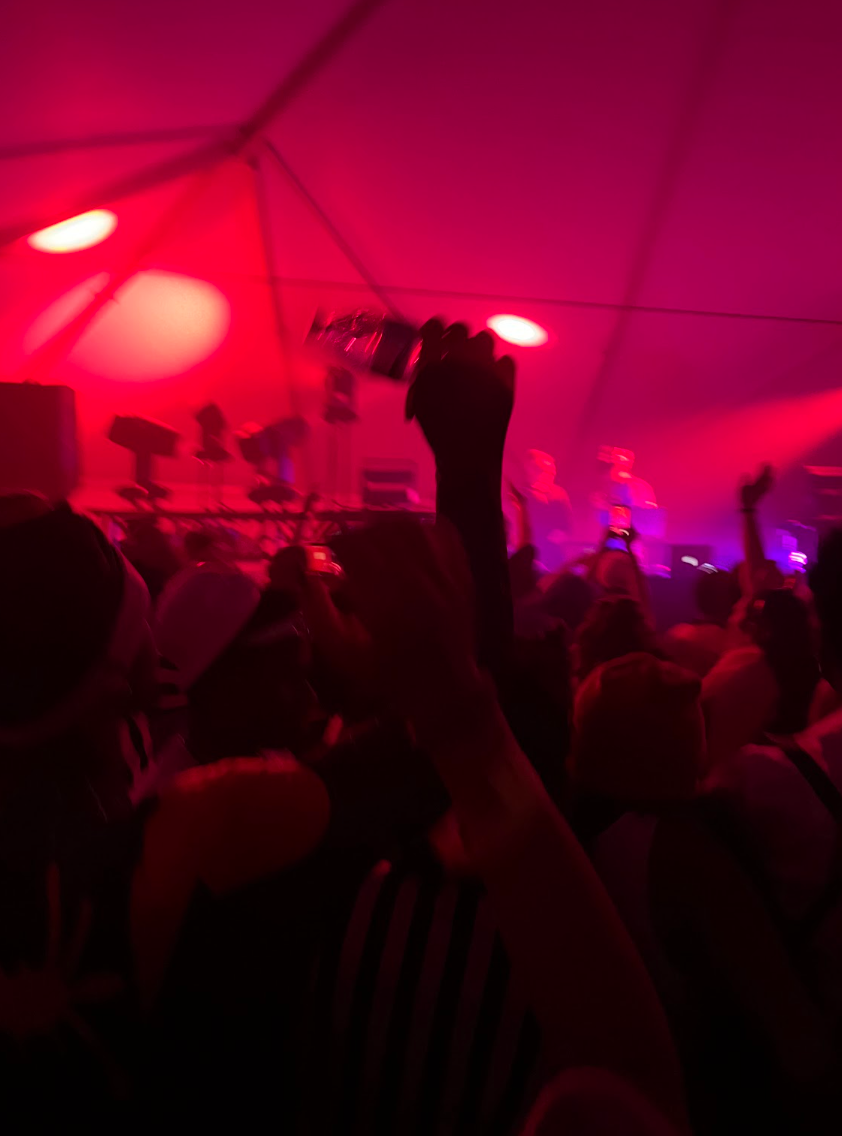
Many students expressed that their frustration with the rave’s shutdown was motivated by their frustration with Amherst’s broader social scene.
“I think the student body is so angry, not just at the fact that their event got canceled, but I think some people are like, ‘Is this where we’re headed?’” Reveron said.
As a first-year, Roof expressed that she is already becoming a little fatigued with Amherst’s party scene. “I’ll go out Saturday nights, and it’s usually the same thing every single weekend,” she said.
Helen Akilu ’30 echoed this idea, stating that while she really enjoys parties hosted by the Black Student Union (BSU) or Humphries House (The Zü), “when everyone just defaults to Jenks, it’s really depressing.”
According to Reverson, Amherst parties tend to “skew more into networking events, because we’re standing around, some people are drinking, and we’re just talking.” Reverson noted that those kinds of parties typically don’t get shut down, “but the parties where you’re dancing, you’re having a good time, those are the ones that do get shut down.”
Kasen noted that he believes the school has recently started saying “no” to students more often when it comes to party culture, mainly out of risk aversion.
“It’s understandable given the current political scene and how we’re trying to stay out of the news,” Kasen said. “But it is kind of sad. I think a lot of people go to college kind of expecting it to be like this place where there’s a lot of exploration and a lot of community building through [social] events, and that’s how the college experience is really formatted.”
As a senior, Costa affirmed that she really feels the social scene has changed since her first year.
When considering why there has been a change, Kasen noted, “I think [students] act out of turn a little bit more. I think that might be a reaction to this [administrative] oversensitivity and how people are kind of pushing back more.”
More communication and mutual trust between the student body and administration may be a solution to the issue: “It might just be my perspective,” remarked Kasen, “but I think that it’s something that the student body needs to address if we’re going to get back to a spot where the admin trusts us, but also there’s trust amongst students where pushing of boundaries can safely happen, and people are willing to participate in that.”
As one of her AAS projects, Reverson hopes to address Amherst’s social concerns by working with Jono Milicevic ’30 to create a Registered Student Organization (RSO) whose sole purpose is to organize parties.
“Amherst College students work so hard … it would be nice to have a party culture that reflected that,” Reverson said. “We don’t need fraternities or sororities, but we need consistent party spaces where we know we’re going to be able to dance, let loose, things of that nature.”
Reveron affirmed that facilitating a thriving social scene is a “long-term investment” for the college.
“If we have alumni graduating from the school who don’t just remember four years of studying, and they remember ‘yes, we worked hard, but on the weekends, we got it going,’ what you get is like a happier alumni base that gives the school more money,” Reveron said. “I think more students would engage more in campus activities if they [had] more zeal for their school, but that comes from creating a [social] environment for them to be proud of.”
Comments ()