

Rebekah Hong: Between Sound and Silence
Re-interpreting silence as an interdisciplinary mode of expression, Rebekah Hong has immersed herself in Amherst’s community of Khmer Rouge survivors, and will soon travel the world to expand her research.
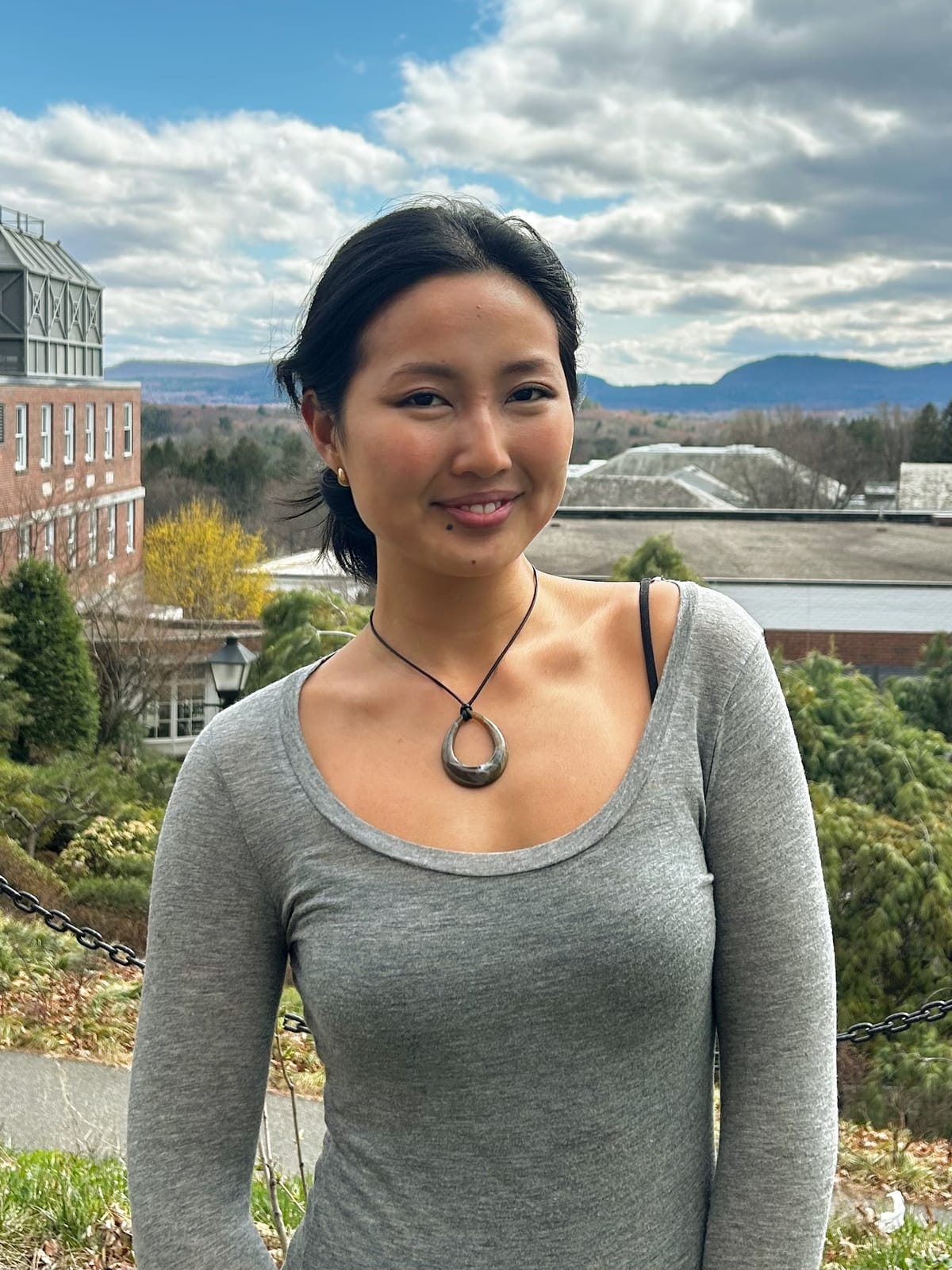
Is silence an absence of sound?
To Rebekah Hong ’26, silence is more so a counterpart of sound — a withholding of information, an expression without verbal language. A classical pianist, a researcher aiming to shed light on the repression of Amherst’s Khmer Rouge survivors through attuned listening, and a recipient of the Thomas J. Watson Fellowship to travel the world investigating different cultural interpretations of silence, Hong’s relationship with sound is intricate and profound.
Growing with Music
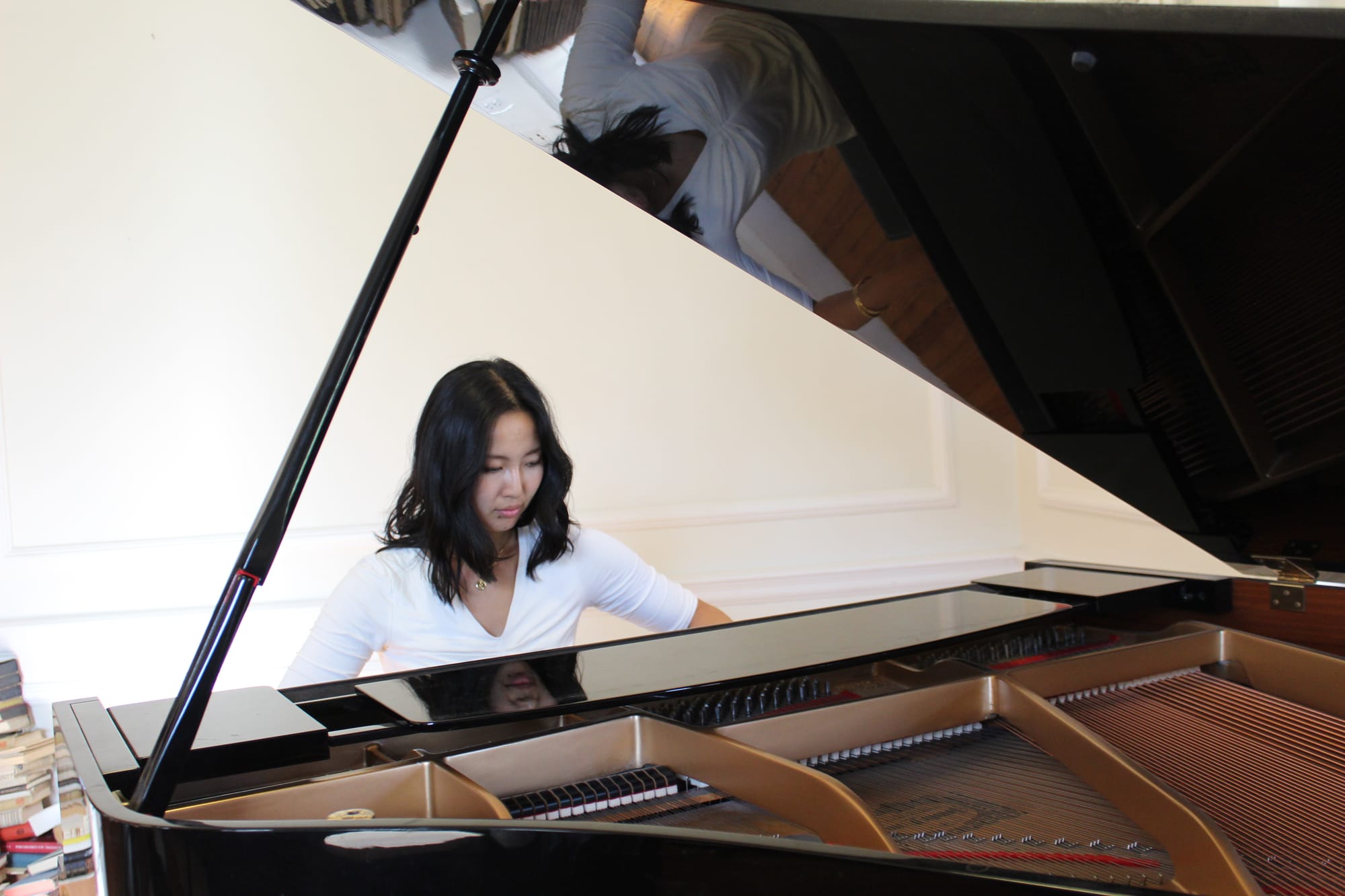
Hong started playing classical piano when she was five. Music, she said, has always been a big part of her life. During her early years in Cleveland, Ohio, Hong was part of the Cleveland Institute of Music’s preparatory program, which felt like “an atmosphere of so much competition” to her. After moving to Amherst for ninth grade, Hong kept up her practicing schedule — three hours of practice every day — and continued to compete during the Covid pandemic by submitting videos online.
Shortly after, Hong’s relationship with Amherst College began. In her senior year at Amherst Regional High School, Hong took “Multivariable Calculus” at the college and was surrounded by classmates that would soon become her own. Here, Hong said she quickly discovered a collaborative nature on campus, where friends often introduced her to more friends, and professors “were willing to give so much to students.”
Though many of her high school classmates wanted to leave the small town for college, Hong was drawn to Amherst’s open curriculum. Having developed an interest in medicine and public health in high school, Hong hoped to take rigorous STEM courses that could build quantitative and critical skills while pursuing a major in music. Amherst became the place where her college experience would “span both music and other disciplines” as she hoped for.
At Amherst, Hong performed regularly with the music department, composed two quartet pieces (one of which was performed at the Emily Dickinson ballroom last year), and continued to update an improvisation journal she created when she was 12, which holds a total of over 1000 recordings now. For her final recital at Amherst, Hong performed the iconic first movement of Sergei Rachmaninoff’s Piano Concerto No. 2 with the Amherst Symphony Orchestra. Yet, Hong told me that Amherst’s music major led her to perceive music differently, focusing less on perfecting a piece but the people and stories behind it.
Through Karen and Brian Conway ’80, P’18 Presidential Teaching Professor of Music Jeffers Engelhardt’s course “Soundscapes of the Connecticut River Valley,” Hong was able to embark on her first ethnography project: producing a documentary on Lou Sorrentino, a local musician who reclaimed his life from substance addiction through songwriting and performing. Hong had known Sorrentino while volunteering for Amherst Community Connections, a nonprofit serving the houseless and low-income communities, but conducting an ethnography on him felt different.
“I was getting to know a stranger, and [had] to deal with the ethical boundary [that] I’m [his] friend, but I’m also holding a camera and writing notes about [him],” Hong said. “It’s a pretty unnatural way to be as a human being at first, but that’s also when I realized I had a really big passion for ethnography and I wanted to continue it.”
Hong’s documentary depicted ways that music helped Sorrentino find expressions for his own feelings and help others in need after his own recovery. Music, in her description of her documentary, is a “thread of humanity woven through stories of pain, resilience, and transformation” that brings musicians and audiences together.
This project also brought Hong to investigate what she calls a “gray space” between sound and silence. Hong explained that musicians are able to feel their lyrics on a deeply personal level while keeping the subject rather ambiguous. “There’s some privacy and protection in that the listener might never fully know what you’re expressing, but you get to fully embody [that],” she said.
Silence as the “Unsaid”
Once a classical pianist myself, rests were my gray spaces. They created brief, yet almost majestic moments between silence and sound as the last notes faded away. They were means through which I controlled the piece’s breaths and cadences to convey emotions with no verbal equivalent. When Hong shared her interpretation of silence as a variable, personalized aspect of music, I felt a surprising familiarity.
“When you look at that rest, for example, in Shostakovich, the silence feels so suspenseful. In Chopin, for example, the rests feel like breaths to keep weeping,” she said. “Silence is never just absence, and when you think about it like that, there’s a million different meanings that silence could have.”
My understanding of silence had never really gone beyond music, but Hong’s decision to find meaning in silence led her to investigate a “silent” zone of the Amherst community for her thesis. Many survivors of the Khmer Rouge, the genocide in Cambodia in the 1970s that led to over 2 million deaths, had relocated to Amherst, where generous sponsorships and donations from local churches allowed them to carve a space of their own in the Pioneer Valley. This Cambodian community, to outsiders, marks a history of silencing and repression: Even Hong, who had lived in Amherst since high school, had not been aware of this history until college. Yet, as Hong immersed herself in the community through seven months of field work, she discovered the many ways that her life serendipitously intersected with theirs.
“The first refugee who came here formed a rock band in the same room that I would play jazz in, [and] my house is two blocks away from the farm in which they were farming for crops to donate money back to Cambodia,” Hong said. “It became a realization that the silence between me as a resident and this community was actually a symptom of ways of expression and communication … that I as a listener was not attuned to.”
Hong wanted to find a way of listening that could shed light on the rich history of the Cambodian community — a way that doesn’t privilege spoken words or information but instead focuses on what remains unsaid. Her passion took her to a local Cambodian cafe in Lowell; Buddhist temples in Pelham and Leverett; family dinners; the organizers of the “Cambodians in Amherst: A History of the Khmer Community” exhibition, which was temporarily hosted in Frost Library; and eventually a descendant of Khmer Rouge survivors, Yanna.
Within the Cambodian community, Hong felt a familiar collaborative nature that she experienced when she first came to Amherst. “Once you find one person who’s really willing to talk to you, that’s when your ethnography really goes forward, because then they’re going to introduce you to other people, who are going to introduce you to other people,” she said. “One person who’s willing to open up about their life to you is just a gracious act in itself, but also really makes things a lot quicker and easier.”
Hong’s work culminated in her 160-page thesis for the music department, titled “Modes of Silence in Amherst’s Cambodian Community: Attuned Listening as Ethnographic Methods.” In her thesis, Hong develops three modes of silence she listens for: practice silence, which is a refuge in meditation; imposed silence, which is a repression of verbal speech; and supportive silence, which is a companionship that does not rely on utterance or verbal affirmation. Though her field work took her to many places and people, Hong’s thesis focuses on the daily life and experiences of two individuals — Yanna and Sokhen.
“I realized that much of what listening entails is spending a sustained amount of time with fewer people, [and] how much there is to learn in that engagement and knowing from one person’s everyday life,” she said.
Through her thesis, Hong reaffirmed her view of silence as a powerful expression, and realized a need for a more holistic approach to listening. “[Silence] is shaped by not only what you say, but also your body language, your relationships [with] other people,” she said. “And … you’re listening with not just your ears, but with your eyes, your memory, your critical thinking, all at once, which then decenters the ear, words, speech, and [becomes] a very interdisciplinary skill.”
Engelhardt, who became Hong’s thesis advisor, said Hong did “such an admirable job” delving deep into two individuals’ lives. He encouraged Hong to share chapters of her thesis with Yanna and Sokhen, and told me that Yanna felt like she was reading her own diary through Hong’s words.
“What an affirmation that you’ve done good ethnographic work — that somebody can say ‘that felt like me even though I didn’t produce it,’” Engelhardt said. He told me that he learns something new each time he looks at Hong’s thesis, and is particularly impressed by her humility.
“She added this half paragraph that, just so elegantly, talks about how silence lets us both have knowledge of people’s worlds, but also hold the fact that complete knowledge is not attainable and perhaps not appropriate,” Engelhardt said. “Rebekah’s deep thinking about silence preserves and recognizes the fact that there is so much that’s still unknowable, and it’s okay to not know it.”
A Versatile Path to Science and Health
Having forged her own path in Amherst’s music major, Hong continued to pursue her passion in the sciences, not strictly in an interdisciplinary sense but as side-by-side interests. Also a biochemistry & biophysics (BCBP) major, Hong has maintained a schedule of two STEM courses and two humanities or music courses throughout her four years at Amherst.
Her most memorable course, however, was not a BCBP requirement but an upper level neurophysiology course taught by Professor of Biology Josef Trapani. As her thesis began to emerge this past fall, Hong hoped to find an intersection between how STEM and the humanities perceive listening. Trapani’s research on the physiology of zebrafish listening inspired her to embrace the challenges of this course.
“It ended up being my favorite class because I felt really challenged at the beginning. I had never taken a neuro[science] class before, so the learning curve was steep,” she said. “But Professor Trapani made it so easy to really believe in myself through that.”
Trapani remembers Hong as an inspiring and engaging student who always came to lectures and office hours full of curiosity. “The first exam can be a real shock to a lot of students … but she did a really good job. And then she doubled down on it,” he said. “It was just fantastic that here’s this BCBP major … in a very complex neurophysiology course that’s far outside the realm of the learning she’s doing, and yet succeeding in it at a very high level.”
When Hong first told me that she was also on the pre-med track, I thought we would be embarking on parallel journeys after our time at Amherst — taking a gap year, tackling the infamous MCAT, attending medical school, and becoming physicians. In fact, Hong had envisioned the same future for herself when she first started college — “going to med[ical] school right after [college], taking the MCAT [her] sophomore year” — but volunteering at Cooley Dickinson Hospital’s emergency room changed her perspective.
While assisting with rounds in consultation and waiting rooms, offering blankets and water to patients, Hong realized the quick turnaround of the emergency room was not her ideal environment. “With ethnography, for example, I was getting to know a stranger … and I want to get to know them for an extended period of time, but with patients, you’ll probably never see them again,” she said.
“They say that you don’t really understand the doctor’s job until you volunteer and get to see what it’s like,” Hong said. “I don’t know if what I’ve observed is necessarily what I could see myself doing.” The slowness she greatly valued from her ethnographic project was nowhere to be found in the emergency room, but Hong remains committed. Instead, knowing that she is still interested in health and medicine related questions, Hong looked at ways she could pursue a career in global health.
Hong’s Watson Fellowship will take her to four countries over the next year: Cambodia, Iceland, Japan, and Germany. She wants to apply the three modes of silence she coined in her thesis on a global scale by traveling to countries where silence has a strong influence on daily life and interpersonal relationships. The close-knit communities in Iceland would allow her to examine how “practice silence” and “supportive silence” play a role in everyday life. For the other three countries, Hong said she wanted to compare how different cultures come to terms with historical trauma and repression.
“For example, silence in Buddhist meditation is part of your internal transformation, of transforming suffering into something that you can live with and look beyond,” Hong said, referring to common practices in Cambodian culture. “[But] in Germany, this feeling of collective national guilt is always there, especially on Holocaust Remembrance Day or the national day of mourning, [when] people are always promoting verbal exchange of what had happened.”
What would Hong do after touring the world then? She’s not exactly sure herself. She told me she might work in some type of global health organization for a few years before going to graduate school for a masters or Ph.D. in public health, or a masters in business. Either way, Hong is going down a path that opens many doors.
“I’m becoming much more open to many other possibilities of where this type of thinking and research now could lead me, because [when] you’re trying to uplift someone, you’re always thinking about how to listen,” she said. “So I think the scope of where I find myself in the future has expanded much more recently.”
The Warmth She Carries
I left my conversations with Hong and her professors deeply admiring her dedication, intellectual curiosity, and breadth of knowledge. There was one last piece about Hong that I was trying to know more about: What is it like to spend time with someone like her?
Her friend and suitemate Muskaan Bhansali ’26 filled in that blank. “She does everything under the moon, from her academic work to extracurriculars, but when you’re one of the [important] people in her life, she definitely makes a lot of effort to check in and always be around,” Bhansali said. She also shared how Hong always opened up her house for her friends to stay over spring break, creating a home away from home for her friends.
“I think later in life, even if we’re not in the same place, she’s always going to be a person I reach out to,” Bhansali said.
Now, my image of Hong is complete: highly accomplished yet genuinely personable, incredibly driven yet immensely caring.
Comments ()