

Taking the Plunge into “Sátántangó”
In this film review of “Sátántangó,” Contributing Writer Lucy Li ’28 reflects on the immersive experience of Béla Tarr’s slow-cinema epic and its adaptation of László Krasznahorkai’s novel, exploring how duration and bleak humor reshape the act of watching a film.
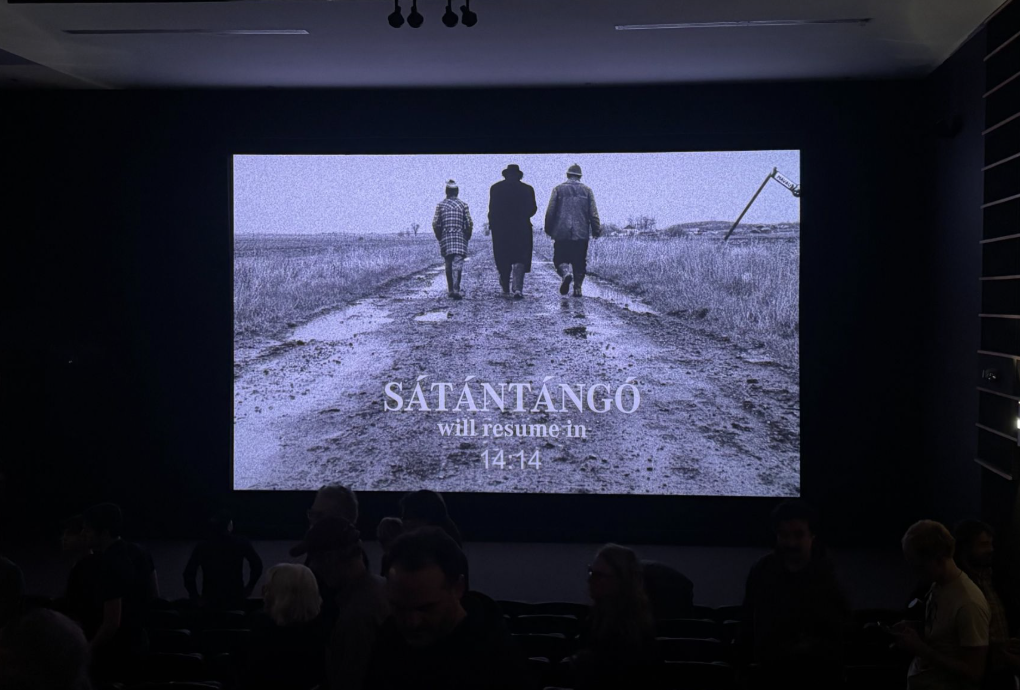
It is Sunday, and the sun is out in a sky that is the clearest it’s been for weeks. I meet up with some friends at Frost Library, and we enjoy the breeze as we make our way to Amherst Cinema. We get our tickets and pick up a reserved slip to tape on our seats. The theater is already filling up with signs and jackets, but we secure a nice section toward the back that fits the four of us.
It’s almost 12:30 p.m., which means that we will soon be starting the 439 minutes of “Sátántango.” Almost seven and a half hours (with two intermissions) in the dark, watching the bleak black-and-white world of Béla Tarr’s 1994 Hungarian epic of slow cinema.
In the broadest sense, “Sátántangó,” directed and co-written by Tarr, follows the residents of a small town in decadence after the fall of communism. The film is based on Hungarian author and 2025 Nobel Prize in Literature laureate László Krasznahorkai’s 1985 debut novel of the same name, for which he co-wrote the screenplay and remained present in post-production, resulting in an adaptation so faithful that no events are omitted from the source material.
The opening shot lingers on cows wandering outside a dilapidated building before transitioning into a tracking shot through the town, every structure as worn and weathered as the last. This long take lasts around eight minutes before cutting to black. Then we hear the narrator delivering the novel’s opening lines almost verbatim: “One morning near the end of October … Futaki woke to hear bells.”
The film unfolds across 12 episodic chapters, each sharing the title with its counterpart in the novel. Tarr described the structure as mirroring the tango itself, with the narrative taking steps forward and backward in time. The town’s institutions have long since collapsed, and some residents yearn to leave for a better life. A few villagers secretly conspire to flee with the community’s shared earnings, until a mysterious figure named Irimias (played by Mihály Víg), long believed dead, returns. We are gradually introduced to the residents as each chapter unfolds. Their stories do not continue immediately in the following chapter, but we as an audience must keep track of them as the narrative returns to their storylines.
For all its bleakness, “Sátántangó” is not without humor. The audience inside the theater laughed often at the absurdity of the characters’ predicaments and the frustrating persistence of their delusions. These villagers were trapped in stasis and sustained by false promises, something we found both tragic and ridiculous.
Víg, who also composed the film’s score, uses haunting, melancholic accordion pieces to help set the tone. But it is really Tarr’s camera that fully immerses you. The entire film consists of around 150 shots, each a long take. For comparison, “Shrek” (2001), with a runtime of less than 90 minutes, has 1,288 shots. Admittedly, there were moments when I wondered: Do we need to see the room gradually get brighter through the window? Is it necessary to keep watching them dance? Must we sit through every moment of the doctor’s degeneracy?
Perhaps Tarr would say that is the kind of question we’re supposed to be asking. Media scholar Asbjørn Grønstad writes that duration makes “presence”, or immersion, possible; the temps mort (dead time) of slow cinema is not futile. Feeling uncomfortable or restless with the stasis on screen is not a shortcoming as a viewer, but a window into what characters in this cinematic world feel. In “Sátántangó,” movement is never interrupted by cuts. As characters walk through and towards new locations, we, the audience, follow them the entire way — through the rain, through the mud. Each shot lingers until your eyes wander the frame, picking up details, reading faces, and interpreting the silence between exchanges. By the time the credits roll, it feels like you’ve not only observed these objects and people but were actually alongside them.
Watching “Sátántangó” was an unforgettable experience. You’re submerged in this bleak world, only allowed to breathe during the intermissions. When it’s all over, the seven and a half hours stay with you as the achromatic palette and slow music replay in your mind.
To the curious viewer, a tip I have would be to research the film and read the book (along with bringing it to the theater as a reference and conversation piece) to enhance this experience. The night before, I spent hours getting through the first 40 pages of Krasznahorkai’s novel, which translated into the first hour of the film. I would try to predict the next narrative motion, which added an extra layer of anticipation. Instead of going in blind, try to get the gist of what you’re about to watch.
Though my attention span has undergone some damage from the instant gratification of scrolling through reels, I wasn’t bored for a moment in the theater. I attribute this largely to how I hyped myself up for a week and a half beforehand; so, before you watch this film, you should get excited rather than anxious about the challenge it may pose.
We left the theater at 9 p.m, and it was completely dark outside. The film took up our entire Sunday, but it surely wasn’t wasted. As some lingering advice from it all: If you go into “Sátántangó” prepared, those seven and a half hours submerged may pass faster than you’d expect.

Comments ()