

The Immortal Godzilla and an Unfinished War
Is Japan’s war over yet? Staff Writer Daniel Shen ‘30 analyzes the new Godzilla sequel and the Nov. 5 lecture “Is Your War Over Now? Nationalism and Japan’s Long Postwar in Godzilla Minus One,” given by William M. Tsutsui, to ask what Godzilla still means for Japan’s postwar history.
Matsumoto, Japan: People run from alerts of an electricity-spewing, winged kaiju. The theater’s high-pitched, strident sound shook my insides, followed by another, and another. The vibrations accompanied scenes of crumbling buildings and death. “Godzilla Minus Zero” (2026), just like its predecessor, “Godzilla Minus One” (2023), is not lighthearted mass entertainment.
Spoilers for those who plan to watch the movie.
This article briefly summarizes the film and the lecture “Is Your War Over Now? Nationalism and Japan’s Long Postwar in Godzilla Minus One,” given on Nov. 5 by William M. Tsutsui, President and CEO of Ottawa University. It then applies Tsutsui’s political and historical framework to “Minus Zero,” released on Nov. 6, and asks how the film answers the criticism of “Minus One” and what Godzilla still means for Japan’s postwar history.
“Minus Zero” is set two years after the Godzilla attack in “Minus One.” The story follows Koichi Shikishima, a former World War II kamikaze pilot; his wife, Noriko; and Akiko, the orphan they are raising. Kenji Noda, who devised the plan Koichi carried out to defeat Godzilla, now directs the Large-Scale Disaster Response Bureau. Professor Kanji Murakami, a newly introduced character, survived the Hiroshima bombing, the Godzilla attack, and the recent Ghidorah attack. He is consumed by guilt over the family he lost to “Little Boy” and by a twisted desire for vengeance on the United States.
The new threat is Ghidorah, which mutates into King Ghidorah after a failed attempt to electrocute it with a thunderstorm. Godzilla, believed dead, reawakens. The team then plans to lure Godzilla into a fight with King Ghidorah and finish off whichever monster survives the duel.
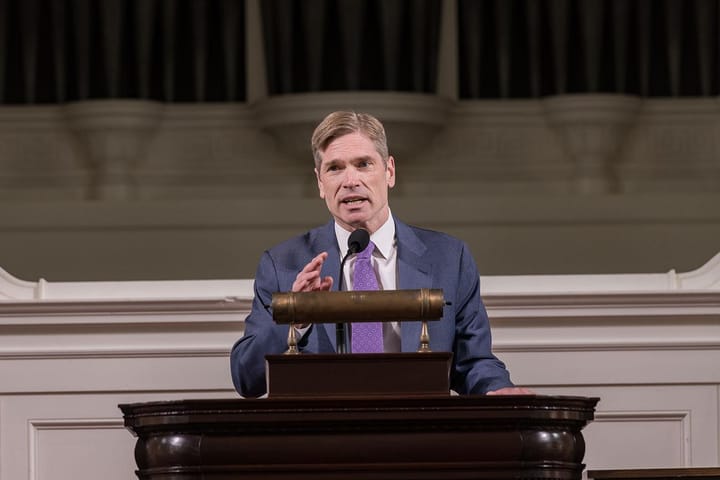
In the dim lights of Fayerweather Hall Room 113, with Godzilla visuals projected behind him, Tsutsui explained that the original 1954 film was dismissed at the time as lighthearted mass entertainment, a product of modern boredom and desensitization to trauma. Yet it is now known as a “Cold War classic, pathbreaking anti-nuclear statement movie.” Tsutsui argues that Japan remains stuck in the postwar era, and Godzilla symbolizes its unsettled history and trauma.
Three years ago, he said, Director Yamazaki Takashi’s “Minus One” sparked international attention and a polarized reception. Supporters, including then-Prime Minister Fumio Kishida, praised its focus on ordinary people, its heartwarming storytelling, and its visual effects. Critics perceived a right-wing agenda in its nationalism and militarism. They said it contained romantic historical revisionism and longed for a traditional Japanese unity and family life that contemporary Japan lacks. It was also faulted for sidelining the U.S. occupation and for focusing on Japan’s victimhood rather than the violence Japan committed, a tension embodied by the protagonist’s past as a kamikaze pilot.
Yamazaki responded neutrally, stating that his film focuses on humanism, survival, and the devastation of war. He said he wanted to explore contemporary anxieties about a world heading toward war, along with Japan’s Covid experience of governmental failure and survival through community action, which explains the film’s focus on ordinary people.
“Minus Zero” answers the historical revisionist critique by establishing postwar U.S. occupation on screen: The Supreme Commander for the Allied Powers (also known as General Headquarters, or GHQ), a U.S. naval base, and Major Harlan Gilbert, who has a transactional interest in using Japan as a proxy against kaiju. Gilbert reveals that the U.S. planned to drop a third atomic bomb on Japan to kill Godzilla if the mission in “Minus One” failed. What I found interesting was Murakami’s fantasy of vengeance: He imagines controlling Godzilla and unleashing its atomic blast on New York City, with the Statue of Liberty crumbling beneath its claw. I interpreted this as direct anti-U.S. sentiment, or a reflection of such sentiment in contemporary Japanese society.
Yamazaki’s mistrust of government and his faith in ordinary people pervade the film. The most memorable scene for me was a montage of the weather team tracking King Ghidorah day and night, citizens phoning in sightings, and the government offering almost no response.
In a film with so much realism, I found it hard to believe that there were almost no evacuations despite King Ghidorah’s streak of city destruction, no military resistance until the very end, and no consultation with high-level Japanese officials about luring the monsters to Tokyo. The absence of government, to me, felt like both plot convenience and a protest against the inefficacy of the current Japanese government.
“Minus Zero” also sends a mixed message about sacrifice. In “Minus One,” Koichi, the kamikaze pilot, ejects from the plane that crashes into Godzilla instead of dying with it. Noriko appears to die saving him but survives. In the sequel, she is revealed as the sole survivor of Godzilla’s atomic blast, mutated by its DNA. Murakami builds a sonar device that connects her to Godzilla, allowing them to lure it toward King Ghidorah. Koichi reacts furiously, telling Noriko she will be made “a tool of war” and punching Noda in the face.
Koichi’s anger seemed hypocritical. Not only has he been a “tool of war” many times, but he also went on an earlier mission to bring down King Ghidorah despite Noriko’s hesitation and Akiko’s protest. Here, Noriko willingly accepts the team’s proposal to lure Godzilla. His intense reaction suggests a double standard.
Later, both commit to the plan, and Koichi tells her that if they die, Akiko will see they did it for her. That seems to glorify sacrifice, contradicting his earlier anger. In the end, the Shikishimas say goodbye to Akiko, intending to protect her by leaving, as Noriko would be sought after with the Godzilla DNA. After a long farewell and a lot of crying, they end up taking her with them. The family isn’t sacrificed either.
Godzilla is revived twice in this movie: First after its apparent death in “Minus One,” caused by Koichi’s crashed plane, and again after King Ghidorah seems to bury it in their final duel. Noriko, with Godzilla’s cells in her body, a glowing eye, and a scaled shoulder, communicates with Godzilla and awakens it to fire the atomic blast that appears to vaporize King Ghidorah. Its double resurrection and refusal to die fit Tsutsui’s point that Godzilla symbolizes the long postwar period Japan still lives in.
Yet “Minus Zero” also offers something that “Minus One” didn’t. Murakami, who is consumed by vengeance until the very end, chooses to sacrifice his life’s work to ensure that the Americans — or anyone else — never get their hands on the sonar technology that can control Godzilla, hinting at a break from endless cycles of trauma, nuclear escalation, and vengeance. When he is arrested by the Americans, he says, “So many more eyes to be opened,” suggesting that the rest of the world needs to awaken from this cycle. Yet he remains in the custody of Americans, and the Godzilla DNA in Noriko’s body remains strong, which offers opportunities for more films in the franchise and a continuation of such a cycle.
So is Japan’s war over yet? “Minus Zero” offers a more nuanced answer than “Minus One.” Murakami’s sacrifice is an attempt to break the cycle of vengeance and the long era of postwar trauma, yet resentment toward the U.S., a populist lens on people, and the uncertain framing of sacrifice are all characteristics of the still-ongoing war, as Tsutsui argued.
Godzilla’s double resurrection says the same. Every time it emerges from the water and the rubble, the unresolved sentiments it stands for are reinvoked. The title seems to count toward an ending, “Minus One,” “Minus Zero,” but zero never arrives. When the credits rolled, the shrieking that had shaken me in the theater seemed like a sound Japan has not yet finished hearing.


Comments ()