

The Liberal Arts Experience in Japan
Contributing writers Matthew Huang ‘29 and Kamahaʻo Halemanu ‘29 reflect on their time studying abroad in Japan this summer. For Huang, it led to the formation of an unexpected friendship, and for Halemanu, it led to a connection with his Okinawan family.
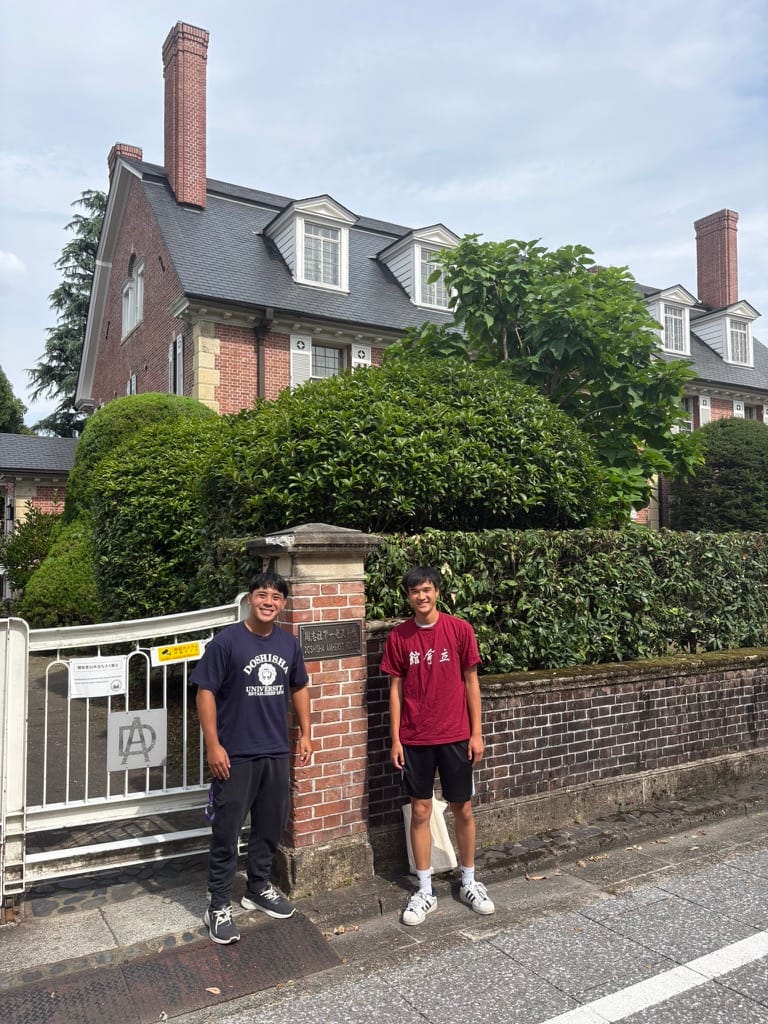
As two language-learning students here at Amherst College, we decided to reflect on our journey of learning Japanese. This past summer, we had the once-in-a-lifetime opportunity to study abroad in Kyoto, Japan’s historical capital and cultural heart. Through the generosity of the Amherst College Department of Asian Languages and Civilizations, we took intensive Japanese-language classes and participated in cultural activities alongside students from around the world.
What was our program, and what was our connection to Japan before studying this summer?
Kamahaʻo Halemanu ’29:
My program took place at Amherst’s beloved sister institution, Doshisha University. Having traveled to Japan multiple times throughout my life, I found this trip to be the most special. Yes, on a superficial level, there was the food and the sightseeing, but what always makes me feel so close to Japan was its people. Learning from Japanese university students has strengthened my language skills and comprehension. It is a beautiful feeling to speak with native speakers and enter a sort of “flow state.” Like Matthew, I intended to strengthen my language skills, but I also saw this study abroad as a reconnection with my roots.
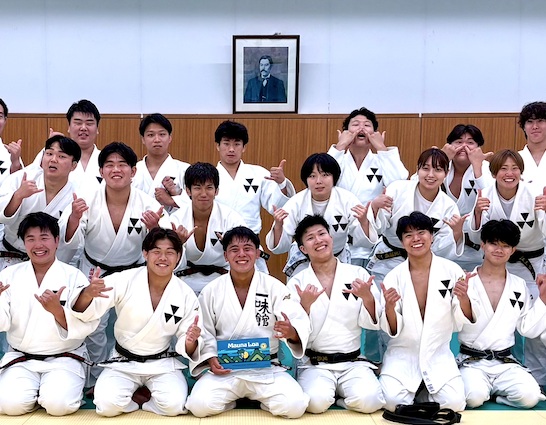
Back home in Hawaiʻi, much of the community, including myself, is of Japanese descent. My family’s lineage is traced back to both the Fukui and Okinawa prefectures. Japanese vocabulary is embedded in the “local” dialect of Hawaiʻi through a creole from the plantation era called Hawaiian Pidgin. My grandmother, Tamiko, was my first Japanese teacher. She taught me jikoshoukai (自己紹介), or how to introduce myself, when I was five. Around the same time, my judo (柔道) instructor, Kurakazu Sensei, helped me get comfortable with Japanese pronunciation and the basic counting system (i.e., ichi, ni, san, etc.). At Doshisha, funnily enough, I was once again able to learn Japanese through judo and by practicing alongside the Doshisha University team. I viewed this as an opportunity, first, to continue my lifelong commitment to judo, but also, second, to strengthen the connection between Amherst and Doshisha.
Matthew Huang ’29:
My program at Ritsumeikan University in Kyoto ran for five weeks, with a three-hour intensive Japanese language class every day and cultural activities two to three times per week. Coming into the program, I had two main goals: First, to improve my Japanese, and as a close second, to eat all the food and see all the sights I possibly could. Although my family knows me as a couch potato, I was constantly looking for ways to maximize my time in Japan by meeting new people and gallivanting around the Kansai Region.
Growing up in the Bay Area in a monolingual, English-speaking household surrounded by a vibrant community in one of the most diverse regions in America led to my linguistic curiosity. I took Japanese classes throughout high school and continued into college. Let me tell you: Nothing is quite as humbling as studying Japanese for five years only to realize that textbook Japanese does not help you understand spoken Japanese. Instead, the full-immersion language classes I took, the conversations I had as well as the friends I made, were the most helpful to me. I am extremely grateful to my many senseis, who taught me Japanese in an academic setting, as well as my friends, Kotaro, Ryotaro, and Runa, for the crash courses in different dialects and for teaching me Gen-Z slang.
What was our experience in the classroom?
Our Japanese programs were remarkably similar to the classes that we attend at Amherst: small, close-knit, and discussion-based. The fear of being called on in a small class really kept us on our toes. Sure, there were awkward times, many awkward times, but we persevered. Amherst has taught us to find our voice and made us realize that it is okay to say you do not understand. It is okay to ask questions. That is the beauty of the foundation that Amherst has given us: We can thrive in discomfort, and for that, we are thankful.
What was our most memorable moment?
Matthew:
During my first few days in Kyoto, I sometimes got lost on my walk to school. On one of those days, I happened to be stuck at an endlessly long stoplight with another student. Although I’m quite shy, I decided to spontaneously start a conversation with him. His name was Kotaro, and I found out that he was also heading to Ritsumeikan. His usual train got delayed, forcing him to walk from a different station. We talked the rest of the way to Ritsumeikan, and he told me that I’m welcome to visit him in his hometown of Kobe anytime.
The stars must have aligned for us to meet; if his train had been even one more minute early, and if that stoplight hadn’t stopped us, I would never have started talking with him. I had been meaning to visit Kobe during my study abroad, and meeting Kotaro gave me the perfect excuse, so I immediately started planning a day trip with him. Kotaro’s friend, Ryotaro, and my friend, Rei, whom I met in the program, joined us on our trip.
Kobe has a unique atmosphere not found anywhere else in Japan; it is wedged between the mountains and the sea on a narrow strip of land, where completely different worlds crash into each other and converge into something beautiful. Historically, Kobe was a major international trading port for Japan, and as a result, many Western-style houses are nestled at the foot of the mountains overlooking the sea, giving the town a transnational ambiance. What made Kobe the most memorable, though, wasn’t the architecture or the beef; it was the camaraderie I found with my good friends Kotaro, Ryotaro, and Rei. We were able to find common ground between our different cultures, perspectives, and lifestyles through language and respect.
If I had stayed within my comfort zone during that morning in Kyoto, I would have kept my eyes on the ground and let the stoplight pass in silence. But by taking a chance and starting a conversation with a stranger, I opened the door to several lasting friendships: The most profound things happen when a mountain meets a sea.
Kamahaʻo:
Summer in Japan is quite hot and humid, especially in Kyoto. There is a three-day weekend in July called “Umi no Hi,” otherwise known as Ocean Day. Since I had no classes, I was able to fulfill my lifelong dream of visiting my family in Okinawa. My great-grandfather, Matsuchiyo Momohara, in the early 1900s, journeyed from Yomitan, Okinawa, to work on the sugar plantations in Hawaiʻi. Although he was described as a kind, funny, and gentle Okinawan man, I never had the opportunity to meet him, as he passed away before I was born. Perhaps, symbolically, traveling to Okinawa was the only way I would ever be able to get close to him. Okinawa was my opportunity to see where he grew up, the beaches he swam in, and also to discover where my roots come from.
For the first time, I got to meet my family in Okinawa. Together, we ate Okinawan cuisine and talked about our families. Although no one could speak English, we found common ground in my Japanese studies at Amherst. What brought me to tears when I visited my relatives’ house was seeing the many pictures they had not only of my great-grandfather, Matsuchiyo, but also of my family when they had visited Hawaiʻi over twenty years ago. I am thankful to the gracious sponsors of my summer study and to the teachings of my senseis, both here at Amherst and at Doshisha. Thank you to my study partners, volunteers, and friends at Doshisha for your priceless support and encouragement.
皆さん、いつもありがとうございます。
Comments ()