

The McDonagh Men in ‘Wild Horse Nine’
Staff Writer Harry Finnegan ’28 unpacks Irish filmmaker Martin McDonagh’s 2026 dark comedy “Wild Horse Nine,” breaking down McDonagh's recurring archetype of prickly, world-weary male leads while praising the performances of the cast and analyzing their Academy Award prospects.
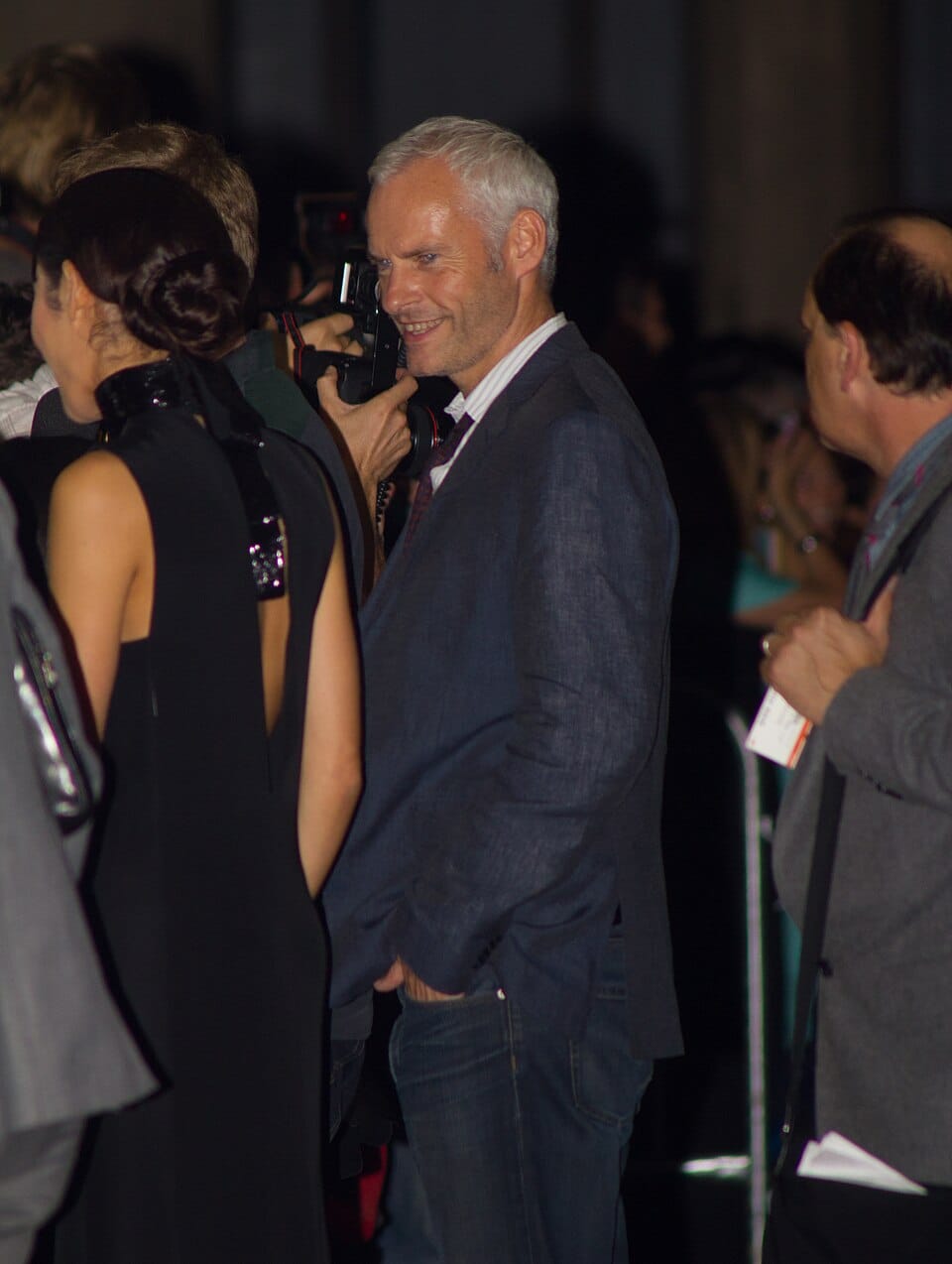
Martin McDonagh makes movies about men. Well, perhaps this generalization isn’t entirely accurate: His “Three Billboards Outside Ebbing, Missouri” (2017) starred Frances McDormand in the lead role. But even this seeming exception featured a few very prominent men, including regular McDonagh collaborator Sam Rockwell. And so the point still stands, and Martin McDonagh certainly preoccupies himself with the affairs of men over anything else. To get even more specific, these are dark, troubled, caustically funny, lonely, and self-destructive men — great to watch, but terrible to be around.
For some filmmakers, this might be a reductive and insulting generalization. They would insist that their movies are about spectacle or about society (“Transformers” or “Joker”), even as they are far more successful at being about the minds of the male main characters or the typically inevitable man in the director’s chair. For McDonagh, though, this generalization is not an insult, but the explicit point. His films are about men because they want to be about men specifically, and they want to be about how men react to, destroy, and are destroyed by the world around them.
“Wild Horse Nine” is a movie about men. To be exact, it is about two men. And these men, Lee (Rockwell) and Chris (John Malkovich), are two instances of one of the worst types of men: CIA agents taking a break from helping to overthrow the democratically elected government of Chile in 1973 by traveling to Easter Island. They are paranoid, violent, crude, and occasionally cruel. They sound unique, but really they are quintessential McDonagh Men.
Watching McDonagh Men sounds like a terrible and exhausting experience, and it is, especially at first. But the director slowly works his magic on you in three different ways, so by the end you are fully won over to his side — “Wild Horse” is a piece of quiet wonder.
His first stroke is humor, both broad and dark. Rockwell in particular is excellent at this, and a well-timed reaction shot to his face alone can lighten an otherwise bleak scene. However, as a whole, this might be where “Wild Horse” fumbles the most, as not every joke in the more obviously humorous first half lands. Still, enough of Rockwell’s physicality and Malkovich’s wild line deliveries connect to power you through to the more emotional second half.
As you could probably guess, it is this uncommon emotion that accounts for McDonagh’s second trick. Thus far, all of his movies have been rather misleadingly advertised as uproarious dark comedies by highlighting the funniest jokes — I certainly was tricked by the trailers. When confronted with the real thing, it becomes obvious that all his films are actually tragedies about complex people living through terrible lives. A foreboding atmosphere hangs over all of them, and his newest film has no less of a central theme than confronting mortality head-on. You know going in that Lee and Chris’s story won’t end well, and McDonagh being up front about it means that you become sympathetic to them, despite their worst qualities.
A large part of that sympathy, especially for “Wild Horse,” is derived from the last ace up McDonagh’s sleeve: his actors. This largely carries over from his career on the stage, where the words he wrote had to be acted without the benefit of cinematographic tricks. As a filmmaker, he has become a sort of “actor’s director,” with nearly all of his actors receiving widespread acclaim. McDormand and Rockwell even both won Oscars for “Three Billboards.”
Rockwell, along with the entire rest of the cast of “Wild Horse,” is excellent; don’t get me wrong. But the real star of the show is Malkovich. His character, an aging veteran, is afflicted with age, cancer, an unspecified cognitive disorder implied to be dementia mixed with trauma, and the regrets of a career spent doing terrible things; you see all of these things just in Malkovich’s eyes. His performance is real, lived-in, and truly transformative. Without him, the central character wouldn’t work. With him, the movie has a constant emotional anchor dealing with the complex nature of being a true McDonagh Man. It hurts Chris, and Malkovich embodies that hurt so well that it hurts us in turn.
I’d be remiss to not briefly remark upon Oscar potential, given McDonagh’s record of directing nominations and wins. Simply put, Malkovich’s performance is my favorite performance that I’ve seen so far this year, and I have seen fellow Best Actor contenders Matt Damon (“The Odyssey”) and Tom Cruise (“Digger”). I would not be at all surprised if he ends up winning, and Rockwell will almost certainly be nominated as well, especially for the scenes where Lee goes toe-to-toe emotionally with Chris.
I mainly mention this because so many movies this year have been about men. The Best Actor lineup in which Malkovich is competing is one of the most crowded fields in a long time, and it’s simply because almost every big movie this year was about an even bigger man. Only one, though, is about McDonagh Men.
It can be hard, then, to see the value in yet another movie about men in a year like this one. In addition, more so than even in other McDonagh movies, the women of “Wild Horse” are thoroughly sidelined; only one, a student activist played by Chilean actress Mariana di Girolamo, has an active role in the plot, and she is still subservient to the men around her. But if it isn’t possible to see “Wild Horse” as valuable for its uniqueness, perhaps we can also value it as an exemplar of a masculine year.
Let’s take those two oft-mentioned men above: Damon as Odysseus and Cruise as Digger Rockwell. From Odysseus, Chris takes his regret, and Lee takes his desire to keep his family safe at a home far away. From Digger, Chris and Lee both take from the stereotype of the boorish and crude American, destroying the world one step at a time on the outskirts of an empire. We can go further with this, and we can go deeper into each individual strand of masculinity that McDonagh puts into his characters, but I think from just these examples the conceit is obvious.
Now, we are left to return to the McDonagh Man, and his use. At no point is any McDonagh Man “good,” in the absolute sense, but at many points they are sympathetic and deeply human. They are funny, and they are sad at the same time. They are kept busy with their lives, but they are afraid of dying. They work together, they break up, they leave each other, and they come back. They give each other what the other needs, as best as they can give it. In short, they’re people, albeit men. And by making the McDonagh Man so specific, “Wild Horse Nine” comes strikingly close to pure, genuine, universal emotion.

Comments ()