

The Room Where It Happened: AAS Speech Night
On Wednesday, April 8 in the Cole Assembly Room, the Association of Amherst Students held its annual speech night ahead of voting, which would take place the following Friday through Saturday. Managing Features Editor Belaine Mamo ’27 attended to hear what this semester’s candidates had to say.
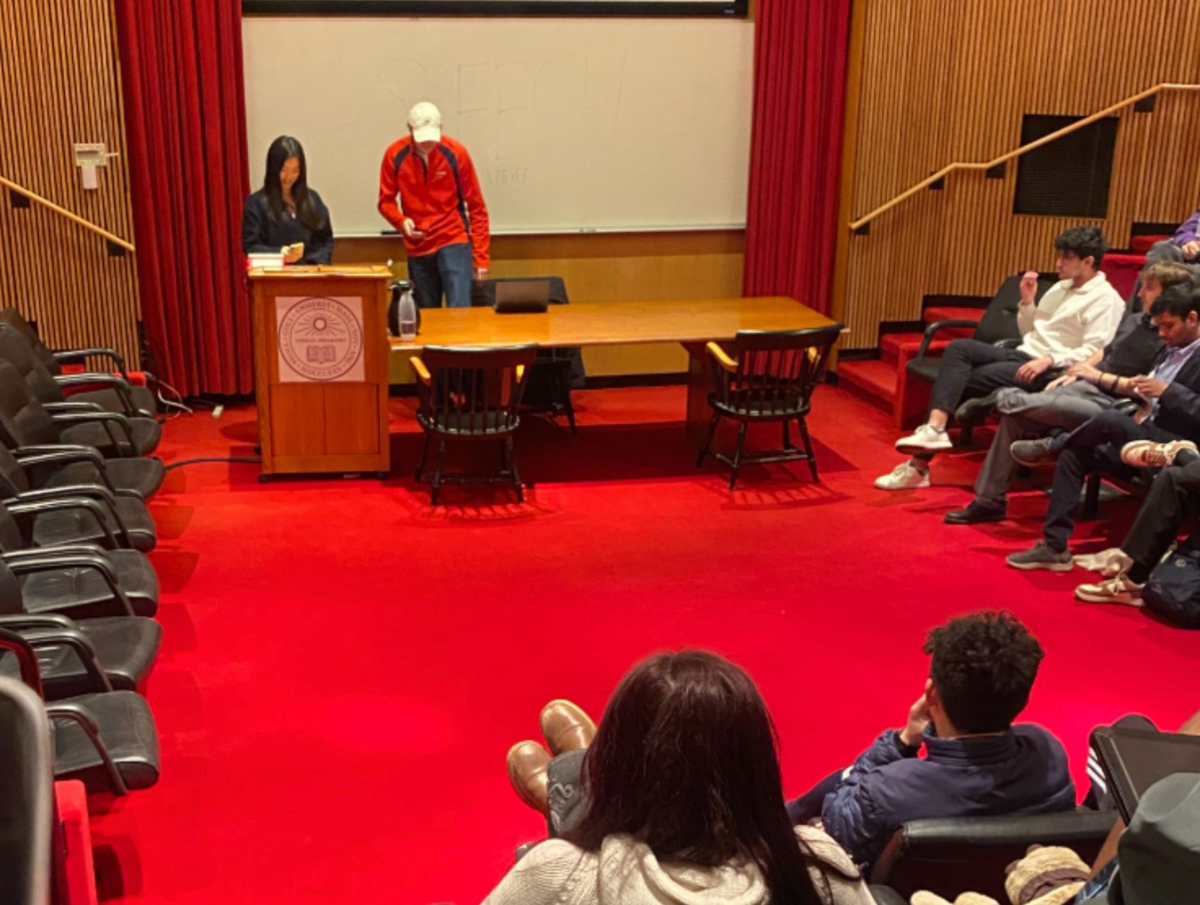
This semester’s speech night started with opening remarks from the Elections Committee — a five person senate-nominated group that coordinates elections and referenda — and former Vice President Hedley Lawrence-Apfelbaum ’26. Each candidate had two minutes to speak and 30 seconds to respond to questions afterwards.
Beginning the round of speeches was Judiciary Council (JC) Chair, with its sole candidate Chloe Lee ’28. Lee spoke about publishing decisions and minutes on the website, remodeling of constitution and bylaws, and responsibilities as JC Chair to be more responsive to registered student organizations (RSOs), senate projects, etc. No questions were posed for the sole candidate.
Next up was the secretary position where Beckett Lawrence-Apfelbaum ’29 took the initiative to speak first, opening with a quote from his rowing coach: “when the soup is good, all is good.” Lawrence-Apfelbaum spoke about how the role of secretary shouldn’t be the center of attention, but rather requiring a quiet efficiency. He sees the job as facilitating students to view whether the senate is functioning for them and be able to improve it.
For Micah Scott ’29, the other secretary candidate, the role is foremost a communicative one. His priorities were efficiency — hoping to address the excessive correspondence with students through emails — and transparency by keeping archives and records up to date, allowing students access to information that helps them evaluate the senate. He emphasized the importance of accountability as the senate is an institution made possible by the power given by the student body. “If you don't understand what’s going on, you can’t hold us accountable when we make mistakes … This is an injustice,” Scott said.
Numerous questions were posed to the two freshmen, one of the first being why they decided to run in the first place. Lawrence-Apfelbaum focused on the desire to represent students and their will along with being able to learn more about how the school works. Scott described his desire to be a representative of the students and act as a middleman for communication both ways, especially having previously not been sure of how to approach the senate.
Other questions involved concerns about losing RSO spaces like prayer rooms being moved from Morrow Hall basement to the new student center. Both expressed interest in being a firm voice to the administration in support of student groups, with Lawrence-Apfelbaum citing his personal issues with the recent Rabbi firing suddenly over winter break.
A common thread in the secretarial candidates’ speeches and the questions posed to them was the flooding of student emails by the Association of Amherst Students (AAS). Scott explained that some students have expressed annoyance, and that his aim is not to cut communication but to improve it. Scott suggested relying on other modes of communication, such as a newsletter or social media, leaving emails for highest priority communications. Lawrence-Apfelbaum suggested sorting weekly emails all into one email with sections for each topic like project updates and attendance sheets to allow for better oversight.
On the question of whether AAS is “broken,” as some students and candidate speeches have expressed Scott replied he would agree in that the senate has “made a lot of mistakes” and “haven’t embodied what we’re supposed to”, while Lawrence-Apfelbaum followed that it’s easy to say that phrase and not make any change, but he chose not to make a judgement either way.
The next position was treasurer with the sole runner Mikka Wolff ’27 who is abroad this semester and had Rizwan Ayub ’27 serve as his proxy. His speech centered on his experience serving on the Budgetary Committee “I cry when I see a dollar misused. Yet, we have seen hundreds of thousands disappear into flunked centrally planned events and redundant offices that rarely meaningfully impact students.” Wolff, by way of Ayub, spoke about the importance of sound budgetary decisions based on a comprehensive understanding of student life and the events and programs that matter most from their perspective, not an administrative one.
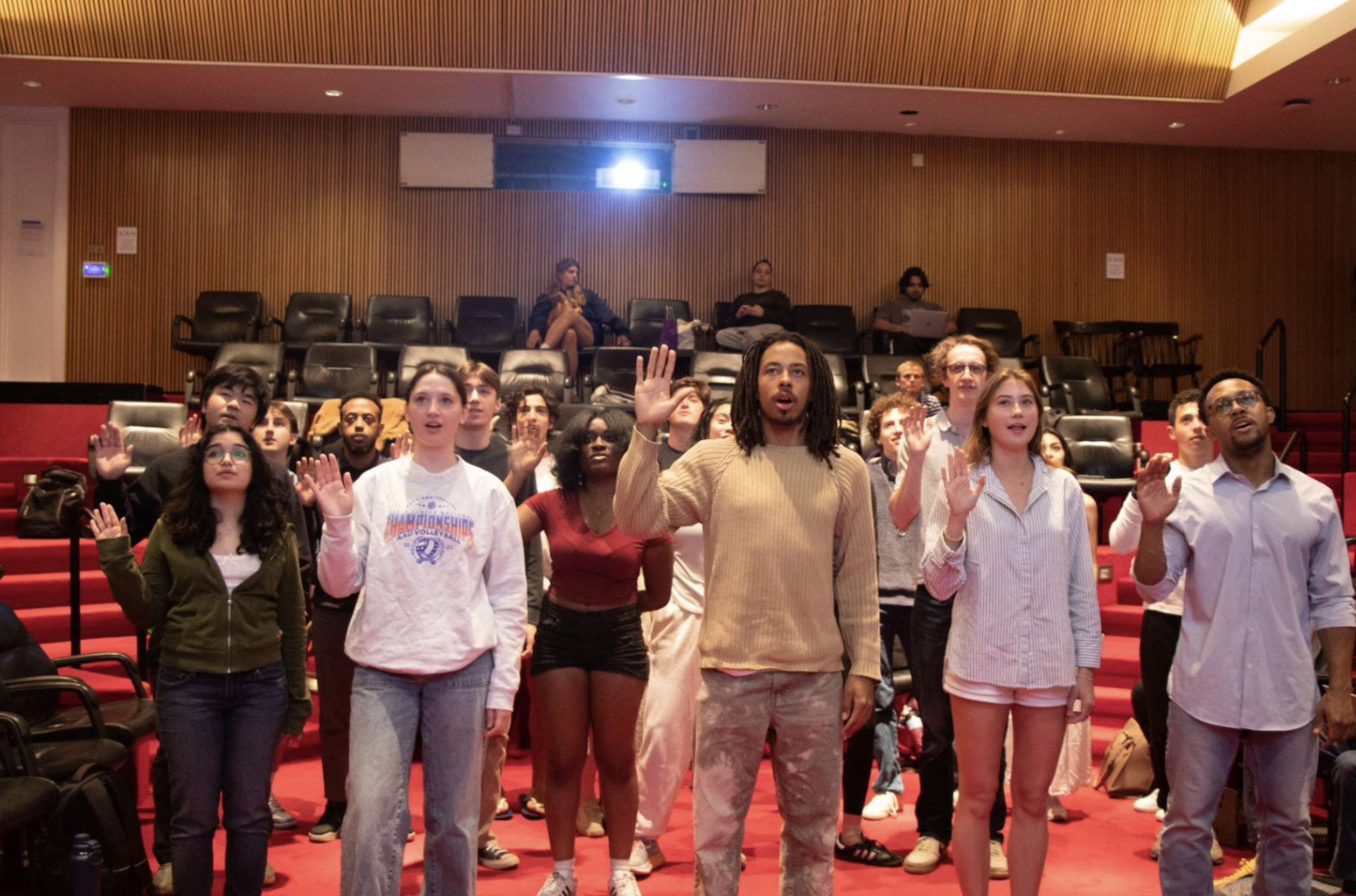
Following was the sole vice presidential candidate Joey Supik ’27. His main focus was transparency. “I want people to be here seeing our meetings, more town halls, and info sessions,” he said. He explained that the senate either does whatever they want or focuses on accountability, rather than empowering senators to do what they believe they should for the community. Supik himself expressed the desire to be present in the community and take suggestions from the room.
The first of the questions addressed to Supik centered on how to tackle the lack of senator engagement in meetings. Acknowledging that taking away electronic devices is impractical, Supik encouraged a seating system. Additionally, he expressed the need to encourage people not to be disengaged by feeling empowered to do what they believe is right.
Another student asked Supik to expand on the growing worries about senate failures to practically implement campus improvements.. Supik suggested reimplementing a senate binder which details items like administrative people to reach out to and how to begin a project, because it can be hard for senators who join in their first year to know what they’re doing. He hopes to be more present in the community citing that people often know classmates in the senate, but don’t know what actually happens. He also emphasized his desire to table in the new student center to be available to students.
Last came the presidential speeches from the two candidates Ayub and Charles Tufenkji ’28 (who ran on a dual-ticket with Supik).
Ayub began with his speech on the slogan “Riz can handle the biz,” highlighting his accomplishments as senator like the talent show and perfect attendance, as well as advocating for by standing up to the administration in support of people with accommodations during the new Herd Housing process. Ayub ran on the idea that he can simultaneously tell admin “no” when necessary and work with them when necessary to improve student life. His other main goal was to bridge gaps between the town of Amherst and Amherst College.
Tufenkji began his speech addressing the two experiences he finds students have with AAS: being a member and upset with the lack of power, or being outside of AAS and not knowing how it works and not feeling comfortable to come and talk about concerns. He began to express the importance of having students really know the senate, as well as the president’s role as a guiding force within the senate, before his speech was cut for time.
Naturally, the questions for presidents were extensive.
One student asked how they plan to navigate a situation where the student body wants one thing, and the administration wants another. Tufenkji said the role is to be the president of the student body and this responsibility comes first, citing the example of his discontent with the grade inflation debates of last semester.
Ayub explained that it would be the same as his job as senator: He would always put students first.
After a student asked for their strengths and weaknesses, Ayub highlighted having a lot of institutional knowledge to guide AAS. His weakness was not always knowing when to stop talking. Tufenkji sees his biggest strength as his personality to bring people together and enjoy knowing things. His weakness he identified was lack of experience.
Another student asked how they plan to bring about meaningful change, not just rely on repeated slogans. Tufenkji admitted that, even after he or Ayub hold the presidential position, not everything will be completed in a year. “The president’s job is to plant seeds,” he said. “People should vote for the candidate whose vision they trust more.”
Ayub explained his mission in two parts: getting AAS into the community through town halls for different groups such as housing and faculty committees, and to become a guide and mentor within the senate to give them feedback and keep them on track.
Another student asked about their grade inflation stances. Ayub explained he believes grade inflation shouldn’t be used to “rigorously curve exams, or punish students when they’re doing their best” emphasizing the importance of being understanding. Tufenkji drew on his desire to go to law school, and explained that he doesn’t see it as a problem if all institutions had the same policy, but since that isn’t the case, it can really put students at a disadvantage.
On the topic of how to connect with students and the concerns of those who might be more disconnected from AAS happenings, Tufenkji said these are either people who might care, but simply don’t know where to look. The responsibility of the president and senate is to be a resource and make themselves available, to which students can decide to use or not. He hopes to try to make it fun and more accessible for those who have interest, but don’t know how to approach them.
Ayub found that a big part of making AAS accessible to people is simply talking to them and developing a bigger presence in the community through tabling or inviting people in to welcome them. “I’m always on the first floor, Frost Cafe,” he said. “I’m always available, personally.”
The closing question asked of the two presidential candidates to say something nice about each other. Ayub responded with a sweet coincidence: “[Charles] was my Be A Mammoth kid. I love Charles, even though he’s running against me.” Tufenkji echoed the sentiment. “The only reason I’m running against him is because I have a slightly different vision than him,” he said.
The results, released on Sunday, April 12th by email, are as follows:
Judiciary Council Chair – Chloe Lee ’28 (94.60% of the 389 votes)
Secretary – Micah Scott ’29 (50.26% of the 378 votes)
Treasurer – Mikka Wolff ’27 (94.31% of the 404 votes)
Vice president – Joey Supik ’27 (91.55% of the 414 votes)
President – Charles Tufenkji ’28 (54.02% of the 448 votes).
Comments ()