

Thoughts on Theses: Muskaan Bhansali ’26
In this edition of Thoughts on Theses, Staff Writer Savita Jani ’28 speaks with Muskaan Bhansaali ’26 about her political science thesis on Narendra Modi and her concept of “strategic gatekeeping” in India’s parliamentary systems.
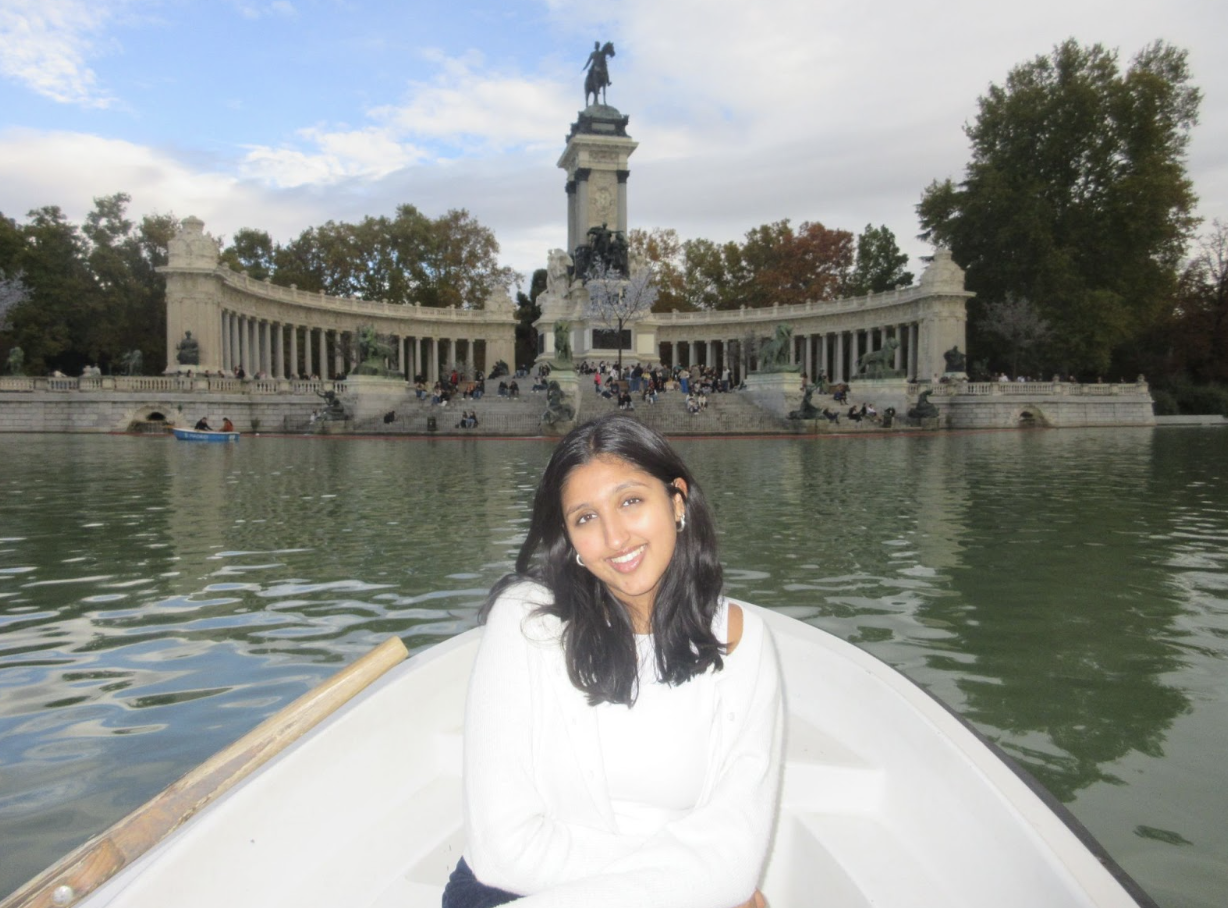
Q: What was your thesis about?
A: So, I wrote my thesis in the [Department of] Political Science, and I specifically wanted to focus on India and Prime Minister [Narendra] Modi. What I was looking at is political theory focusing on parliamentary systems. Usually, parliamentary systems are better at blocking authoritarian[ism] or outside[r] figures, just because of the way the nomination process works. But India is a unique example where you have a figure like Modi, who’s really an outsider in terms of national leadership experience and seniority, because that’s a big thing that the Bharatiya Janata Party (BJP) has (Modi is a part of the BJP). I was arguing that, unlike past candidates, the BJP chose to actively elevate a newcomer outsider candidate— coined “strategic gatekeeping” in the thesis — because they’ve been struggling electorally to keep power, especially [given] India’s political system is really through coalition. So it’s hard for one party to really maintain power, but the Indian National Congress (INC, another political party) had done that for a while. So I’m arguing that 1) Modi was chosen as a candidate purposefully because of his outsiderness, and that 2) [by] using this kind of outsider identity, he was able to repurpose a lot of democratic institutions but still under the facade of democracy.
So [I] specifically talk about areas like media. For example, [in] India there’s [still] free press. But at the same time, Modi will do certain things: He won’t talk to journalists unless he’s pre-approved the questions. There’s been a lot of sedition laws for free speech during his time. There’ve also been a lot of authors and journalists, who’ve had their homes raided and been arrested. I also [study] the same thing with the judiciary [system]. For example, courts and all of that stuff are still in place. Yet, there [are] so many things that he and his government have done, like court delays that suppressed opposition [and] allowed his policies to go through. Specifically, a big part of Modi is also his Hindu nationalist rhetoric. For example … the Citizenship Amendment Act looks like it’s a law that’s bringing refugees into the country, except it’s all refugees minus Muslim citizens. It looks great on paper, but then you see the underlying circumstances of it. I argue he’s a newcomer candidate who was purposefully elected. I call it “strategic gatekeeping.” And then the other aspect is that he has repurposed democratic institutions to erode democracy, while having this facade that he’s doing great things for the country.
Q: Wow, it’s an amazing project! I will say that the reason I reached out to you is that my family’s also South Asian, and we went to India over break, and there were Modi posters everywhere.
A: [One hundred percent], and that’s definitely a big reason I also wanted to do this project, because there’s definitely a lot of tension in my household in terms of politics. My family’s all originally from Gujarat, where Prime Minister Modi’s from. When I speak with my grandparents, there’s definitely a lot of tension [around] opinions of how he is. Because I think the hard thing about Modi is [that] he’s also done so many great things for the country in terms of infrastructure [by] building new systems and things like that. So it’s hard.
Q: Besides personal motivations, was there anything else that helped you land on this topic area?
A: I think for me, I was definitely inspired by a lot of professors here. [In] my freshman year, I took a class called “Democracy Erosion in India” with [Visiting Assistant Professor of Political Science Giles] Verniers, who was a visiting professor at the time. It was actually a three-person class, and that definitely sparked my interest in [this topic]. Honestly, a lot of the material I pulled for my thesis came from his syllabus … and [from his] writings. I think also just hearing about how much pushback [Verniers] got in India over the stuff that he published is also a big reason why I want to focus on this topic. I think India is also such a vast country … but no one really ever talks politics about it.
The other reason was that in my time at Amherst, I've taken a lot of classes about democratic backsliding. That’s a big reason [why] I asked [Dwight W. Morrow 1895 Professor of Political Science Javier] Corrales to be my advisor, because he’s so knowledgeable in that area. And I think it’s an issue that’s so prevalent in India ... There’s definitely a huge wave towards democr[atic] erosion in a lot of countries that I think needs to be focused on. One thing I talk a lot about in my thesis is that India is a very unique case, so the theory I [develop] might not be applicable to other countries, but I think it’s really important to find these patterns. That’s the only way that you can … eventually come up with solutions.
Q: Moving on to the process, could you tell me what the most interesting parts of writing your thesis were?
A: I think probably the challenging part was just coming up with the main idea, and I was really happy to have Professor Corrales because he really challenged me to be unique with my idea. I think there’s so much literature and writing out there about India’s democracy and democratic erosion. I was really nice for him to ground me in political theory, because I think it’s super easy to get excited about all the other stuff.
I think just narrowing down what you actually want to argue, making sure it’s a unique idea, was challenging, but also a very fulfilling part of it. Also, this sounds cheesy, but I think printing the whole thing out and seeing all your work is definitely a great feeling. It was the first time in so long that I took a red pen and edited the whole thing by hand, and it was … a nice feeling.
Q: How many pages did it end up being?
A: The total, I think, with my bibliography, was 91 pages.
Q: Wow, that’s a lot! What was the research process like for that?
A: [It] was definitely way messier than I wanted it to be. I think there’s just so much information. My first step was definitely figuring out a research list that I want to go off of. And also, dividing up my research was really important because I think that’s the most overwhelming thing. It’s like, “where do you even begin?” So for example, I knew I was going to look at democratic institutions. I knew I was going to look at the political theory behind gatekeeping parliamentary systems. So doing it that way was definitely helpful — breaking it up into subjects.
Q: What sort of sources do you look for in a poli[tical] sci[ence] project?
A: I think Professor Corrales really taught me the importance of quantitative research, like really looking at real data, like poll data. I use Varieties of Democracy (V-Dem) a lot [and] Freedom House that has stats on democracy erosion, on free press, things like that. Having hard, real numbers, even looking at electoral stats, was a big thing. Seeing how parties like the BJP and the INC have been doing in terms of seats, voting percentage, and all of that.
And then definitely, there’s so [many] great secondary sources from scholars who’ve already analyzed the situation … building off of them was a big thing.
I think the last area would definitely be political theories [as] secondary sources … because a lot of my thesis, to make it unique, was maybe challenging some aspects of some theorists, or building off of them. In terms of primary sources, [I used] constitutional amendments, legal cases, [and] things like that [as] evidence … about the different democratic institutions that were affected by Prime Minister Modi.
Q: Huge congrats on turning it in. What happens now?
A: Basically, [on] Monday, I submitted my thesis to my advisor and my first and second readers, and then they take the week to read it, discuss it together, and then I have my defense on Tuesday the 14th… [for] 30 minutes, they’ll ask questions about my thesis.
Q: After writing this whole thesis, do you feel like it’s changed the way you see other current events going on?
A: I don’t know if it changes that much, because I think I was very aware of the state of the political world. Diving deeper into India, I think I didn't realize how many parallels there were [to the United States]. As much as Modi is still a newcomer in the Indian political scene … It’s not like he’s [Donald] Trump, who’s completely coming from nothing, right? But I think this idea of a charismatic leader who’s so different than past leadership was definitely a parallel that I noticed immediately. I was researching this one idea of the celebrity figure; Modi acts like that a lot in the same ways that Trump does. And I think it’s interesting to think about why leaders like that are really appealing … [to] a lot of people.
Q: Could you talk a little bit about the biggest thing you've learned from your thesis process?
A: Definitely time management. I’m sure this one’s said a lot. I think it’s definitely different than any other kind of assignment I’ve ever done, because it's really up to you. You have two deadlines; you need a draft of your full thesis by Jan. 6 for pol[itical] sci[ence], and then you have your final thesis due on April 6. So, besides that, it was all up to me.
Learning to set internal deadlines and things like that, and not letting it fall behind with other school work, was definitely a really great experience. I think those are great skills to learn.
I think also … more broadly, [it was also about] taking advantage of the resources that Amherst has, even just in terms of research citations. If I [could] do it again, [I] wish I talked to the library staff more [and] the Learning and Teaching Commons, [reaching] out to groups like that to get more guidance.
Q: On that topic, do you have any advice for students considering writing a thesis, particularly in poli[tical] sci[ence]?
A: Definitely think about who you want your advisor to be. I’m very happy with Professor Corrales. Each professor has so much knowledge [across] different areas, so really taking advantage of that, and also going beyond just your advisor. Professor Verniers isn’t even actively teaching here right now, [but] I had meetings with him. [Domenic J. Paino 1955 Professor of Political Science, and Sexuality, Women's and Gender Studies Amrita] Basu, my second reader, was super helpful and also very knowledgeable in this area. Even when I was just coming up with my thesis topic, I had conversations with [Associate Professor of Political Science Jonathan] Obert and Professor Basu.
Q: What was your favorite place on campus (or off campus) to work on your thesis?
A: You know it’s bad when I honestly, by the end, kind of liked working in [Frost Library] A level … I think the biggest reason is that it was a group of me and probably 10 of my friends who are all writing theses that would be in pods, back to back. We closed out A level last week. But I think there is something about the thesis where — one of my friends said it — it’s like collective suffering. It kind of makes it fun, almost bearable. And then off campus, 100% Share [Coffee Amherst].
Q: What is your favorite thesis study snack?
A: Oh, that’s so hard, but such a good question! This is a really weird one. Have you heard of the purple Doritos? They’re like the sweet chili ones. They’re delicious. I have to admit that that and a Red Bull would be my late-night thing that would get me through the late-night thesis writing.
Q: It’s always good for future thesis writers to know the hacks. You've devoted a ton of time to your thesis this semester, but could you share a bit about what else you're involved in on campus?
A: I’m a tour guide. I also write for The Student. I’ve done research in the Department of Political Science before. I used to be way more involved with [the South Asian Students Association] (SASA), which I definitely miss.
Q: What are you going to do with all your free time?
A: I’ve been doing the weirdest side quests ever. Like, [I’ve] definitely been going on a lot more walks. And I went bowling randomly. I feel like now that it’s senior spring, I’m just trying to do all the random things that I want to. I went to an Amherst play on campus yesterday, so really just trying to make the most of my last few weeks and do all the Amherst things I couldn’t earlier. I went on a long drive. I’ve been going to Cushman’s [Market and Cafe], the [Montague] Book Mill, all great places around the area.
Q: It's nice that you have a good chunk of time [before graduation].
A: I know! I’m very happy because I have other friends who have April 17 [thesis] deadlines, and I just want to enjoy school for a little bit. And I never thought I would say this, but … I was so behind on my other stuff because of [my] thesis, I miss doing my reading assignments for class. So, it’s been nice to just do that.
Q: How many other classes do you take with a poli[tical] sci[ence] thesis?
A: I’m taking three other classes this semester, and that’s for the fall as well.
Q: What's the biggest thing that you would want someone reading your thesis to take away?
A: I think [the biggest thing is] intersections of how [my thesis] can relate to other things. I’ve talked about it so much with Professor Corrales; he has done so much phenomenal research and writing about different Latin American countries. If I had more time and more space in my thesis, I would definitely want to dive way more into the parallels and pick another country to compare and contrast against. I think kind of taking whatever people read in my thesis and relating it to their other curricula and classes, and the other history of other democratic countries, would be a main goal of mine.
Q: You’re a political science major, but do you have a second major?
A: Yes, poli[tical] sci[ence] [and] Spanish.
Q: What has that combo been like?
A: It's been, honestly, super helpful … I've taken a lot of classes with Professor Corrales, like U.S./Latin American relations. Things like that, where I’m able to also read sources in Spanish, [have] been really nice. A big thing we have talked a lot about in a lot of my classes, especially in poli[tical] sci[ence], is getting different media sources. If we’re talking about Venezuela, for example, [it’s about] actually not reading [just] the New York Times’s writing about Venezuela, but [also] reading [Venezuelan] publications. And I think being able to read it in that native language has been a really nice intersection. When I went abroad to Madrid, being able to take poli[tical] sci[ence] classes there in Spanish was also a really good opportunity.
Q: Super cool. What school were you at in Madrid?
A: I did it through the Middlebury program. It was awesome, because I got to take two classes in Middlebury College, and then I took two classes at one of the local universities there. It was definitely nice, because I felt like [I had] the Amherst experience with the Middlebury classes, but then I felt something different and new with the local university there.
Q: Is there anything else you want to add about process, content, or just your life?
A: Honestly, just enjoy it. It all goes fast. I feel like that’s my one takeaway from all this. I feel like there were so many days where I was super stressed about it, and I was like, “I just want it to be over.” But now that it's over, I’m relieved, but part of me is also like, “Oh my God, it’s done.” Time [moves] fast.
Comments ()