

Three for Three: Reviewing “The Christophers”
In his latest low-key indie, Steven Soderbergh turns inward with “The Christophers,” a spare, incisive meditation on art, mortality, and creative disillusionment. Staff Writer Harry Finnegan ’28 discusses how this film emerges as a personal, self-reflexive work that only Soderbergh could deliver.
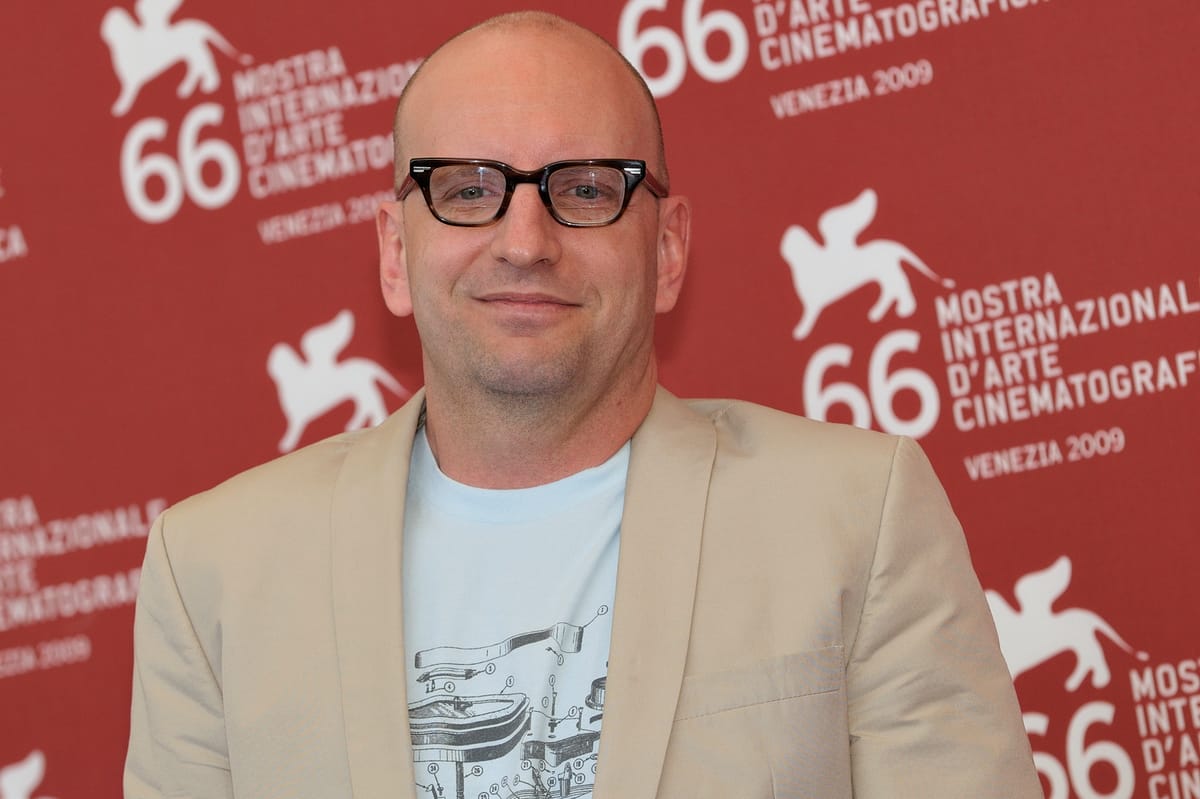
In 1989, director Steven Soderbergh’s debut film “Sex, Lies, and Videotape” made him the youngest solo winner of the prestigious Palme d’Or at the Cannes Film Festival. In 2000, Soderbergh won the Best Director Oscar for “Traffic,” while also being nominated for the same award in the same year with “Erin Brockovich.” The next year, he directed “Ocean’s Eleven,” kicking off a trilogy of heist movies that would collectively gross over $1 billion at the box office. These are all enormous peaks, and combining them all makes Soderbergh a unique man in the Hollywood establishment. He intertwines the craft of a large-scale technician with the intimacy of someone who first pioneered, and still pioneers within, independent cinema.
Nowadays, Soderbergh almost entirely operates within his smaller, more low-key registers — short, slick, and intimate indies. His past two movies, “Presence” (2024) and “Black Bag” (2025) fall into this category, despite starring movie stars like Lucy Liu and Cate Blanchett, but neither fits the mold quite so perfectly as his latest movie, “The Christophers.”
The film ostensibly features a cast of four, but two of them — James Corden and Jessica Gunning — have very little screen time. Instead, the runtime almost entirely rests on the shoulders of two central performers: Ian McKellen as the old, dying, and broke artist, Julian, and Michaela Coel as the younger artist, Lori, hired to finish the valuable paintings he refuses to even look at.
McKellen, an aged veteran most known now for playing Gandalf and Magneto in two decades of blockbusters, wrangles his outsized pedigree into the smaller visage of Julian Sklar. He follows well in Soderbergh’s mold, letting his skills loose as the scale decreases. Most of the script consists of verbal battles between the two artists, as McKellen turns Julian into a savage yet beaten animal, throwing everything he has against the wall to survive one more day. He convinces the viewer of every aspect of Julian’s conflicting beliefs on the nature of art in a capitalist world. Simultaneously utterly magnetic and entirely enigmatic, McKellen is the center of the movie, and he wildly succeeds.
Coel is given a little less to work with, as her character, Lori, is required to listen to most of Julian’s ramblings before she can hit back. But when he gives her that opportunity, Coel proves that she can spar with the best of them, fitting aptly into the contours of McKellen’s performance. Coel is best known for writing and starring in the 2020 miniseries “I May Destroy You,” but has been in little since then. Here, she proves she can easily lead a movie or show alongside someone else at the creative helm, especially in a more substantial, developed role.
Soderbergh, for his part, does all that he can to construct a movie around his two actors. Nearly the entire story is set in Julian’s apartment, and the director manages to turn this cramped space into both a wild, lived-in home and a staging ground for intense and mobile dialogue. There are virtually no flaws in the directing, but there is also almost no room for any sort of flair. Soderbergh almost appears to be reveling in the smallness; he functions less as a pilot of a ship than as a container packing everything in. Everything is either in service of the characters or ultimately caging them.
All three of them seem to do the best with what they were given in the script, written by Ed Solomon, best known as the brains behind both the “Bill and Ted” and “Men in Black” sci-fi comedy franchises. He is writing against type here, and his hand threatens to show at times. Without the benefit of any large set pieces, the script occasionally drags, lulling the audience with the light rocking of constant verbal patterns.
Still, Solomon does manage to work in some set pieces, where the film elevates beyond simple drama into pockets of comedy, thriller, and the sublime. However, it remains unclear whether this comes from Solomon directly or from the able hands that mold his screenplay from the page to the screen. Either way, it is these scenes that the average audience member is most willing to take with them as they leave.
These four — McKellen, Coel, Solomon, and Soderbergh — are the central artists of the film, all acting according to their own sensibilities and skills. And the tale that they weave together is, ultimately, about the very nature of art. The movie’s careful, intimate, and understated style thus turns reflexively in on itself. As Julian and Lori attempt to understand the reasons why each of them fell in and out of love with art and creation, the movie almost appears to ask itself the same question.
After those three peaks relatively early in his career, Soderbergh could have easily coasted into a path of non-stop work, alongside other immediate ingenues such as Steven Spielberg. However, he has instead worked in fits and starts, dropping into semi-retirement twice. Both times, he returned exclusively to work on small-scale films, like “The Christophers.” The second time, his return was most notably marked by two films, “Unsane” (2018) and “High Flying Bird” (2019) both filmed on an iPhone.
It’s not hard to see the parallels between Steven Soderbergh and Julian Sklar, beyond the similar surnames: Both are artists who wildly succeeded early. Both grew disillusioned with the predatory, facetious capitalist natures of their industries as they became successful. Both have large amounts of unrealized projects, most of which will never be seen. Even Soderbergh’s use of the iPhone gets a parallel — Julian’s main method of income in the film is videos he records on one for the Cameo service. If the film wasn’t written by Soderbergh, it is almost certain that it was written for him and him alone.
“The Christophers” is a movie obsessed with the mortality of artists: when they die, when they choose to die, and what works they choose to kill with them. If the movie succeeds, it is on the level of a personal diatribe by Soderbergh. When Julian justifies his own smallness and his tendency to only produce minor works when compared to early richness, one tends to hear Soderbergh echoing the same words. The movie, however, doesn’t let either off the hook easily — Lori is trying to remake the paintings, after all.
Still, Julian is creating, and so is Soderbergh. Even as they shrink, the hearts of artists still beat. The movie is self-assured and made to delight, so who cares if it costs or makes hundreds of millions of dollars? Being singularly of an artist should be enough. And, through it all, for all of the intimate good and all of the too-simple bad, this is a movie only Steven Soderbergh could make.

Comments ()