

Trick or Trampled: Why the Rave Failed
Staff Writer Christopher Karmonik '27 confronts the chaotic Halloweekend Rave, arguing that poor planning and student misconduct turned an Amherst tradition into a dangerous failure.
As a senior, I don’t make it out as much as I used to, but I couldn’t miss the Halloweekend Rave. I had good memories of previous functions hosted by the school, and it would be my last Halloween at Amherst College. Halloween also fell on a Saturday this year, so I expected the organizers to pull out all the stops.
Upon arrival, it took a moment to orient myself and figure out where the entrance to the dance floor was. The different lines were not marked, and it was hard to tell which groups of people were supposed to go where. One was for general admission, and the other was for 21+ students. Since I turned 21 this past May, I hopped in that line, which also happened to be significantly shorter than the other. The so-called “line” was more of a mass of people oozing through the barricades, peppered with a few bad actors incessantly urging others to shove their way forward. Some say these instigators were UMass students, but I recognized my peers among them.
Indeed, during the Association of Amherst Students (AAS) meeting Monday night, Associate Vice President for Student Affairs and Senior Associate Dean of Students Megan Lennon shared that she dispersed a group 50-60 non-Amherst students before the main party began, which is thought to have been the majority of 5 College students who tried to get into the event. By the time I made it to the front of the line, had my Amherst Student ID scanned, and made it to the drink area, all chaos had broken out and the line had collapsed. Fortunately, I escaped to the dance floor; not to stay, but to find the exit which was connected to the main area. On the way out, I witnessed a security worker of shorter stature bracing themselves against the barricades of the main line as people tried to push through them; I saw a group of students dressed as bumblebees topple over a barricade and run into the rave, before they were called off and then froze in place; and I saw an unidentified student climb on top of an upside down waste bin in an attempt get everyone’s attention and to call off the hoard pushing forwards.
When I woke up the next morning I was still turning over that moment in my mind. The Halloweekend Rave was a failure, but there wasn’t one factor that brought it down. I identified fatal errors in one, the planning and two, a lack of purpose and understanding of the function the rave serves, which led to it being shut down prematurely.
A crucial area which was underplanned was crowd control. One puzzling feature about this year’s Halloweekend Rave was the tented venue, which traps sound, heat, and people. In the past, similar AAS-sponsored raves have avoided trapping attendees in by having one wall completely open, but this design hasn’t appeared for a while. An open wall approach would allow heat, noise, and attendees to exist more freely, as well as handle spillover if the rave becomes overcrowded. Below is a rendering of the space from Saturday which I put together from memory.
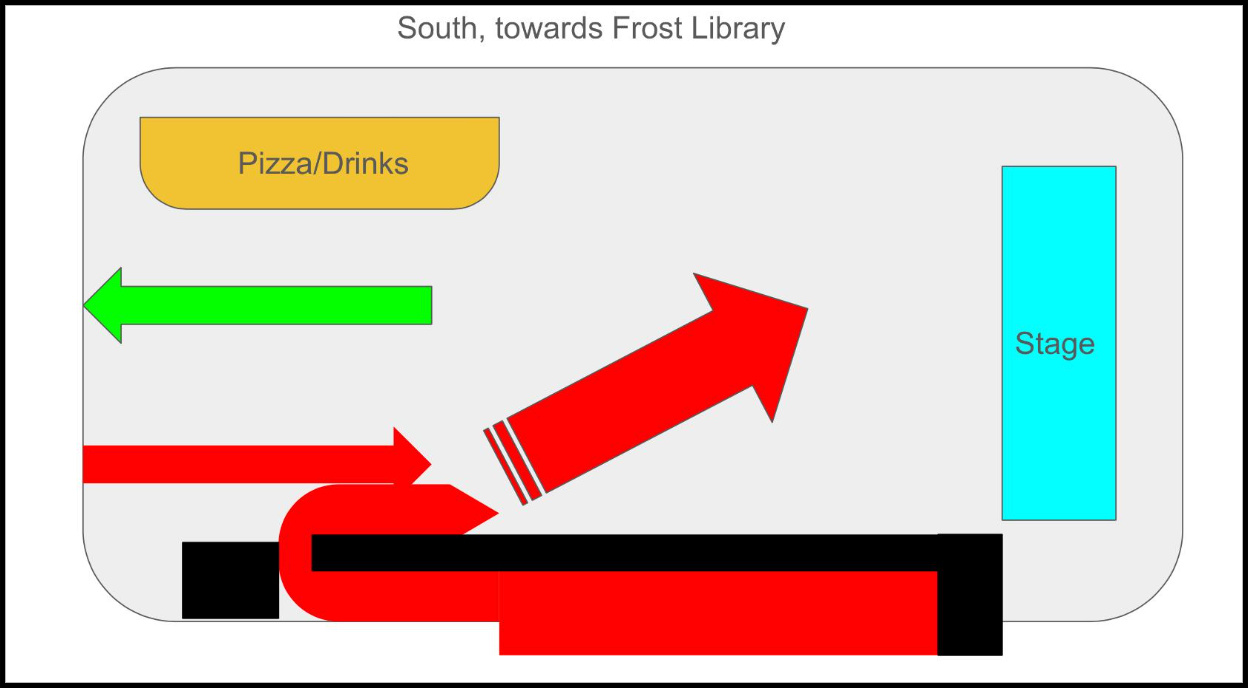
Beyond the tented design, the location of the openings were unideal. The main entrance (red arrow on the left) allowed inflow from the east, from the direction of Morrow, which quickly generated a crowd of its own even as the influx became practically zero. I don’t know why so few people were being let in; I imagine that towards the beginning, the fact that IDs were being checked in the dark right at the threshold rather than earlier, and people trying to slip through the barricades, could have been factors, but towards the end staff likely panicked, which made the crowding at the main entrance even worse. Five College students who realized that security was enforcing the college’s Amherst-only restriction either held up the line or tried to muscle through. Likewise, the exit being right next to, as opposed to the opposite, the entrance aggravated crowding and also made it more difficult to prevent students from cutting the line and entering through the exit flow (marked green).
Another issue was the 21+ entrance on the north side, which was supposed to be open for students of age who wanted a complimentary beer (the red area towards the bottom of the diagram represents this line). There were several problems with this setup. First, there were students who were not of age (as well as five college students) who shoved their way into the line because it appeared shorter from the outside. Secondly, because two IDs per person had to be checked on this line, the entrance process per-person was even slower and more arduous than that of the main entrance, where drinkers were marked with Sharpie and had wristbands placed on them; it’s difficult to hold one’s hand out steady when one is being shaken by a dozen eager partygoers. The flow of attendees from this line intersected with the flow from the main entrance, creating a blockage (see the intersection of the two smaller red arrows). As the rave was approaching its untimely end, the barricade that girded the 21+ line was, for a brief moment, clamped down, and people were barred from exiting onto the dance floor. This clamping down combined with the unyielding influx of rowdy partygoers from outside, meant that people stuck in the 21+ line were being squeezed against the barricades. In concert settings, barricades are extremely dangerous as they give “no space to breathe if one is pushed up against them,” and while trapped in this swarm I wondered if someone would be seriously injured.
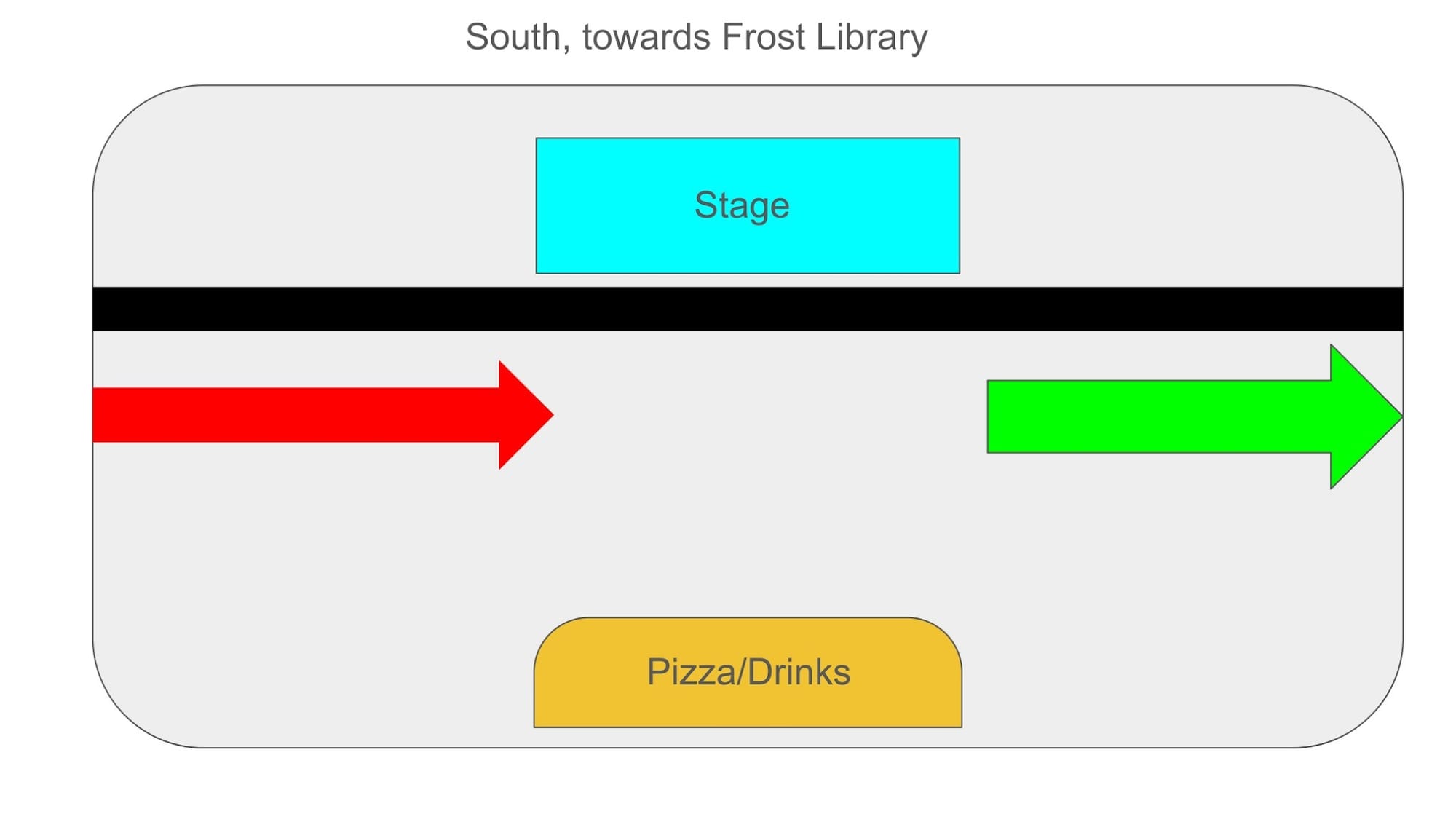
To make matters worse, while this was going on, a security worker demanded students back out the way they came, which was of course impossible given the crowding. Thankfully, Associate Dean of Students Crystal Norwood pulled the barricade away from the line, allowing students trapped there (including me) to spill out onto the dance floor, which likely prevented serious harm. At that moment, it felt intimately clear to me that there was a lack of communication between leadership and the security workers. In my opinion, a better layout would be to position the stage hot-dog style, spanning the long wall, and to have entrances and exits on opposite sides, east and west, to prevent crushing against the barricades. Even better would be to substitute narrow doors with thresholds spanning whole walls. Although this would make it more difficult to ensure all attendees are Amherst College students, it would make the venue much safer and less anxiety-inducing. I say this all in hindsight, though, so it’s not as much a criticism as it is hope for a return of the rave format.
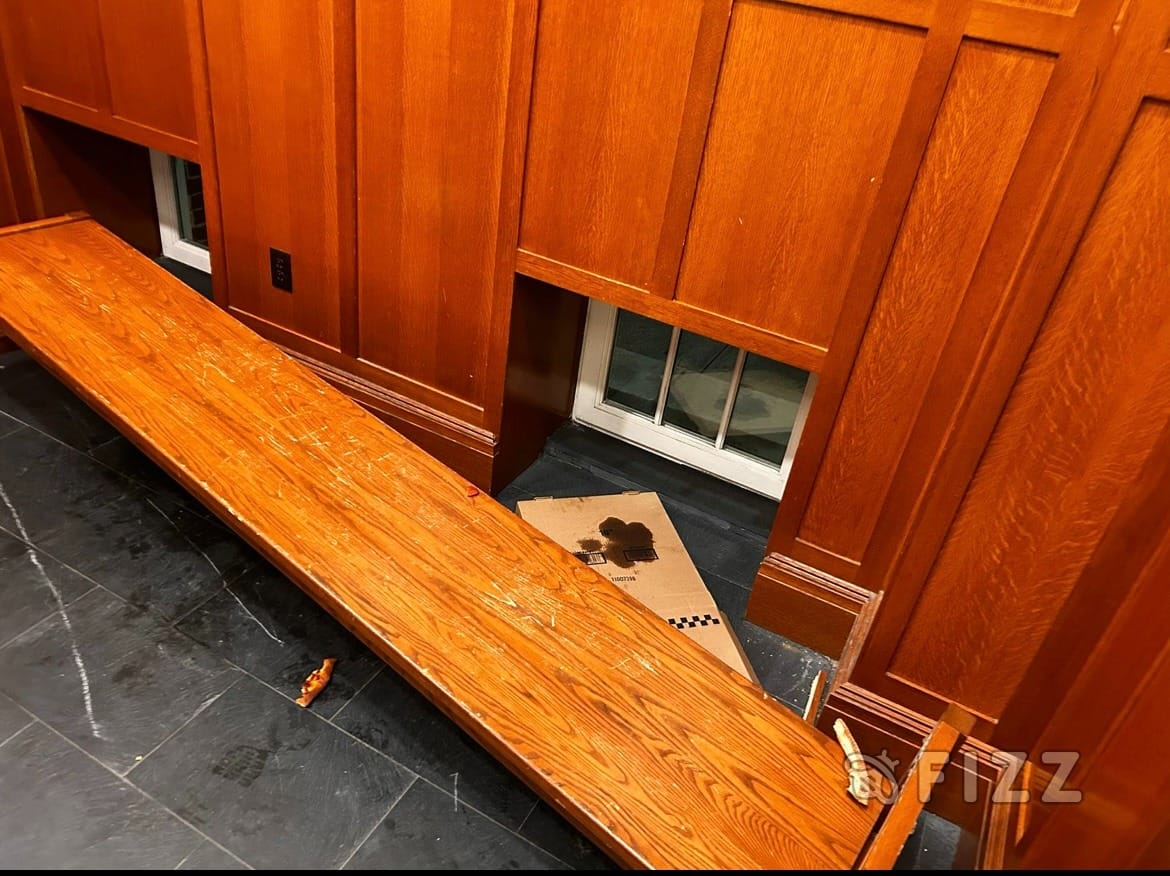
The Halloweekend Rave was started by AAS as a clever way to reduce damage to Amherst College property, which was unusually high during this time of year. In previous years, it was largely successful, as a 2023 article from Matthew Fisher ’26 notes: “Dorm repair costs were reduced from their typical Halloween Weekend level of around $25,000 to just $1,500 this year.” I encourage everyone to revisit this short article, as it details the damages Morris Pratt Hall faced that year and continues to face, which are thought to have been “caused deliberately.”
While the reason why Amherst students choose to vent their death drive instinct on their dorms is beyond the purview of this article, the Halloweekend Rave and other school-sponsored raves used to be a success, despite a lack of competent infrastructure (I still remember when there was no floor paneling, and dancers faced a mudbath that decimated many pairs of sneakers). They evolved each year and became a tradition, but some may not realize the effort and thought that went into the inaugural rave.
Since the Halloweekend Rave was started in October of 2023 and Amherst will be graduating its class of 2027 in the spring, the overwhelming majority of the current student population doesn’t know what Amherst was like without the rave and does not understand its purpose — to make Halloweekend safer by bringing everyone into a supervised space and making sure dorms remain liveable the week after. There are, of course, always a few malicious individuals and many more disrespectful ones. The presence of administrators, and even President Michael Elliott, is therefore meant to project authority onto these characters so that students remember where they are and how to behave. However, there was a lack of respect across the board this year: Security personnel were pushed and trampled — even President Elliott was reportedly shoved. This, in turn, led to a few cases of security workers yelling at even well-behaved students, indicating the stress they were under. It is a sad thing that a plurality of the students did not treat the contracted security workers as human beings, and it is alarming that students were willing to blatantly disrespect administrators and other college workers that they might have seen the coming Monday.
Over the years, AAS has perhaps been too successful in marketing the rave as the main Halloweekend event. The rationale, of course, is that the more students that are under one tent, the fewer are in dorms or other spaces ravaging away. However, since the rave has been around for so long, it has become the de facto Halloweekend venue. Because of this reputation, so many students came, even though the space could not have possibly accommodated all of the party-going student body, as proven on Saturday. Even worse, all the destructive elements meant to be kept out of the dorms were concentrated under one tented roof. The outrageousness and loosening of restraint once made the rave more palatable, but now that the entire student body at Amherst College and around is conditioned to go to school-sponsored raves, that outrageousness has become superfluous: High attendance is guaranteed. This contributed to the rave imploding because of the number of entitled — or malicious — students who did not respect their peers and wanted to shove their way in. The loud music, which amplified the boxed-in environment, did not help the situation and made communication among security workers and between them and students difficult, as evidenced by the fact that entry and exit points were being opened and closed spontaneously. There seemed to be some kind of disruption in communication, but that is speculation.
Accountability is often used as a catch-all term but that’s what was lacking. In the context of last weekend, it could have looked like this: speaking up and standing your ground when people tried to cut or shove through; telling Five Colleges friends not to come and letting them know it was only for Amherst College students; or even standing up to friends that were behaving badly. Yes, these things take a lot of bravery, but they are what’s needed if this school is to succeed in establishing traditions, including the rave and other future events. If I had to identify a single reason as to why the rave failed, it would not be the setup, security, or culture built up around these raves. It would have to be the student conduct. No amount of security personnel or clever modifications to the layout would be able to stop 300 — let alone 1000 — students who were intent on getting in and ignoring the risks their behaviour would pose to themselves and those around them. I don’t want to be at an event where the people around me are eager to push me over just to get to the dance floor a little earlier.
Comments ()