

When There’s ‘Much Ado About Nothing’
In their coverage of the Green Room’s production of Shakespeare’s “Much Ado About Nothing,” Staff Writer Emma Chen ‘30 and Contributing Writer Katherine Parker ‘30 share perspectives from behind the scenes and from the audience to capture the show’s chaos and unserious joy.
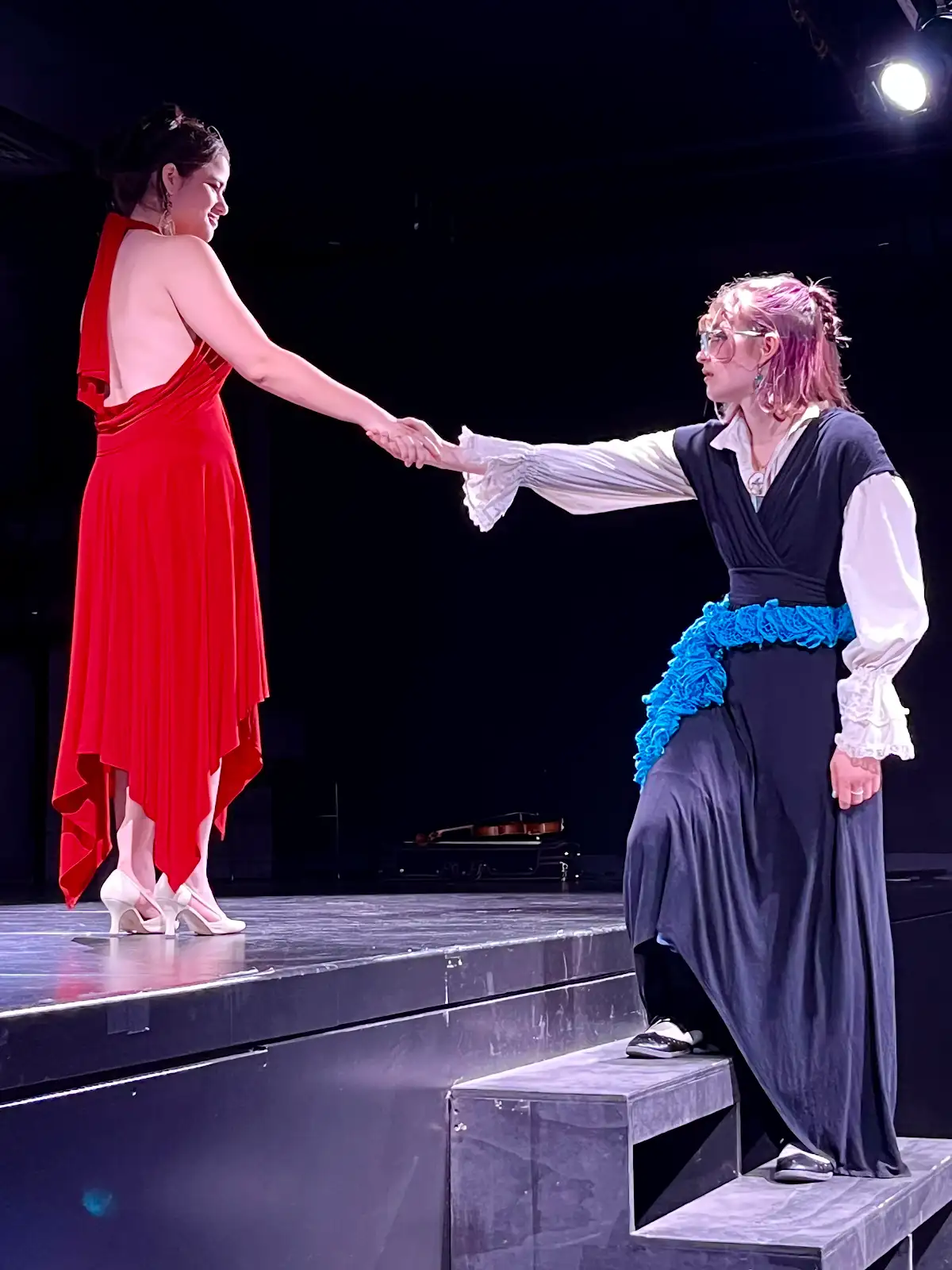
Last week, The Student had the opportunity to see the dress rehearsal of the Amherst College Green Room’s production of William Shakespeare’s “Much Ado About Nothing.” After the rehearsal, the cast gathered to debrief, forming a circle as Green Room Vice President Harry Kim ’27 excitedly affirmed, “this s— is funny,” with the cast laughing in response.
Despite the Green Room’s relatively recent renewal, the club put on a quick, exciting, and entertaining production of “Much Ado” this past weekend, featuring a cast of mostly freshmen, a first-time director in Nico Martinez-Nocito ’29, and a first-time stage manager in Sylvester Vacisek ’29.
Unique Choices
The show took place in Studio 3 room of Webster Hall. Walking into the theatre, the audience is immersed in the show, with seating surrounding a wide aisle down the middle of the room. While there is a main stage, the cast frequently used the stairs and the ground level throughout the play, allowing the viewer to walk into the drama.
Audience interaction fueled the actors as they performed. The actors found meaningful moments of audience engagement throughout. The comedy was brought to life both through audience laughter and the unique experiences each actor brought to their character.
Perhaps the most interesting characteristic of Green Room’s interpretation of “Much Ado” was the people brought to the stage — the role of Benedick was gender-swapped from male to female, filled by Dulcie McGrath ’28. Commenting on this choice, Mirabelle Alpher ’30, who appeared as Beatrice, Benedick’s love interest, shared that “Benedick [being] femme [and] played by a woman … is really interesting because Beatrice has a lot of lines that [imply she] will never marry a man.” Though imagining the relationship between Benedick and Beatrice as queer was likely not Shakespeare’s original intention, Alpher said she feels like that choice “makes a lot of sense” in relation to much of the dialogue.
One of the main reasons for the decision to gender-swap Benedick and a few other characters was the relative absence of strong female roles. The casting crew acknowledged that the original work primarily centers on male characters, featuring only Beatrice, Hero, and their two handmaids as women. To address this lack of gender diversity, actors were asked to indicate which genders they would be open to playing at auditions, helping to create a more balanced cast.
Grappling With Shakespeare
Taking on a Shakespeare play can seem incredibly daunting, but the performers were able to dig into the poetic context to better understand it. In one of the first rehearsals, Kim taught the cast a lesson in reading Shakespeare through an acting lens. They gave a short lecture on iambic pentameter, trochaic meter, and prose usage throughout the play, inviting the cast members to participate in deciphering and reading various passages with correct emphasis and tone. They also gave some acting tips they had learned, highlighting the importance of acting with direction and intention.
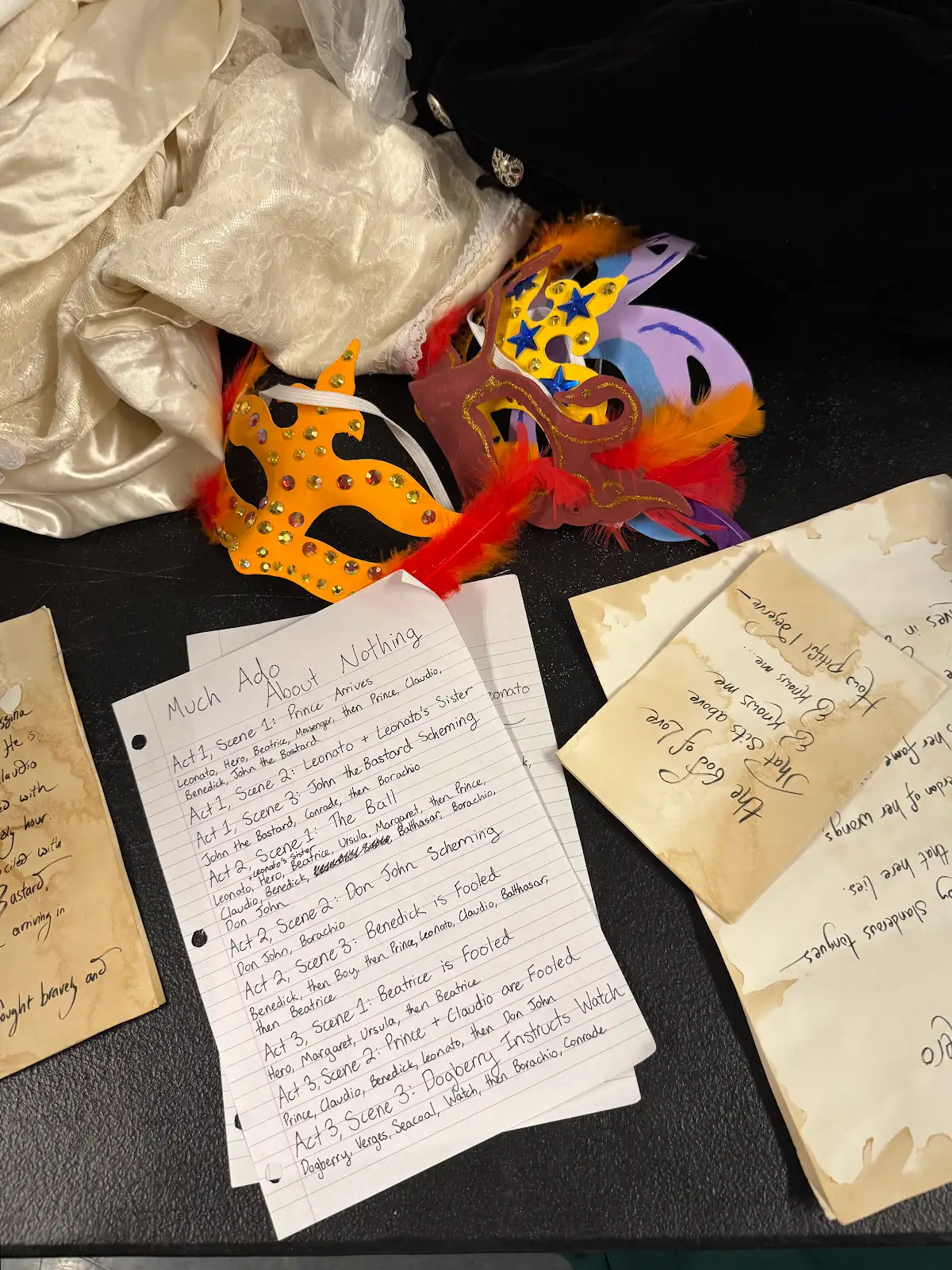
For individual study and line memorization, the cast used a variety of methods. Some would simply repeat lines over and over until they became natural, while others used flashcards and other techniques. Actors could frequently be seen practicing their upcoming lines with one another between scenes, even during the performances. During rehearsal, cast members were free to ask questions about interpretation or pronunciation, and Martinez-Nocito and Vacisek would provide feedback on their own interpretations of each interaction to make the scenes more cohesive.
The cast focused on understanding Shakespeare’s intent in writing the play, and, with the exception of gender-bending and some abridgment, the performance remained faithful to the original story. However, Green Room’s production of “Much Ado” was shaped by the participants’ modern interpretations. One cast member remarked that “in general, shows are always shaped by the cast, and … everyone brings a unique perspective to their character in some way.” Vacisek, the show’s stage manager, similarly commented, “I think there are some scenes where I’m just watching, and the actors are putting everything they have into it.”
Behind the Scenes
At the beginning of every rehearsal, all of the cast members would circle up and Martinez-Nocito, the director, would ask how everyone was doing. Each person would rate their mood on a scale out of ten, with some adding details and context that contributed to their mood. If someone shared that they were having a particularly exciting or work-heavy day, the rest of the members would clap and cheer in support or commiserate, respectively. Often, Vacisek or Martinez-Nocito would jump in with a vocal exercise or a fun icebreaker game, starting the rehearsal off with community-building fun.
Being a comedy, the content of the play itself also shaped the group dynamic. Even on days when the language was difficult to parse, or the majority of the cast had a pile of assignments to work on afterward, they could always find a laugh from some odd line or antic in the script. Most rehearsals were dominated by laughter — at one rehearsal, a few actors were called back at the end to retry a scene they had all broken character in due to the humorous Shakespearean phrasing. However, instead of reprimanding the actors when scenes went awry, Vacisek or Martinez-Nocito laughed alongside them, contributing to the welcoming atmosphere throughout the rehearsal process. Martinez-Nocito’s favorite part of directing was “getting to watch people find joy in theater.” He went on to note that “there are moments in the production where you see people just really get a scene and have so much fun with it.” Instead of ruminating on what went wrong, he found that in some scenes, everyone would just break into laughter and then move on, “because everyone’s just really funny and doing it so well.”
Green Room’s Accessibility
Interestingly, both the play’s director and stage manager are current sophomores at Amherst — Vacisek and Martinez-Nocito. Throughout the dress rehearsal, both took notes attentively, a book in hand. Martinez-Nocito explained that he got involved with the Green Room last year, with its production of “Idiotic Geniuses.”
They also noted that this is their first time directing and stage managing. Martinez-Nocito explained directing for the first time has been “really awesome.” “I’ve done a lot of acting, and I’ve also done some playwriting,” he said. “So, I’ve definitely come from a background of thinking about how things look on stage in a lot of different ways, and so it’s been a really cool process.”
When discussing their favorite parts of this new experience, Martinez-Nocito talked about getting to watch people find joy in theater. “Getting to see people enjoy what they’re doing, have fun, discover parts of themselves, meet new people, and express themselves creatively through this outlet they otherwise wouldn’t have is just amazing.”
Adding on, Vacisek noted, “Seeing it come together, there was a moment where I was like, ‘that is now a show.’ That was probably my favorite.”
This experience of joy is particularly special, according to Jones and Kim, as the majority of the cast is freshmen and non-theater majors. They also explained that part of the reason they pushed for this play was that it made a wide range of roles accessible to the Amherst community. “Why we picked this play overall: one, it’s free, it’s easy to do, and two, it’s just a big cast,” Kim said. “It lets a lot of people try theater out.”
Specifically, “Much Ado” is also an opportunity for students to try Shakespeare, some people for the first time. “It’s really a good thing because, as [Kim] said, we’re trying to make theater accessible to people, especially Shakespeare, which people don’t really get the chance to try out very often,” Jones said.
Kim added that “Much Ado” is a better play for beginners. “Because again, [with] Hamlet, you have to think about so many different tragic elements,” they said. “Whereas [Much Ado] is like you could very easily just make this dumb fun.”
This “fun” is apparent throughout the production’s multiple songs, weddings, and even live violin throughout. The play is one of slight chaos, and while much of the cast and crew agreed the theme of the play was hard to articulate, Martinez-Nocito believes that’s “the heart of the play — not taking yourself too seriously, which I think is a great theme for a show you’re putting on.”
Getting Involved!
Ultimately, “Much Ado” is not only a show about chaos and unserious joy, but also reflects the broader, more inclusive environment the Green Room hopes to cultivate for theatre lovers on campus. Kim explained that ultimately, casting often comes down to a question of fit, and that it’s always great to see students come out and audition. With this, if students are looking for chaotic, authentic fun, they should consider giving the Green Room a try!

Comments ()